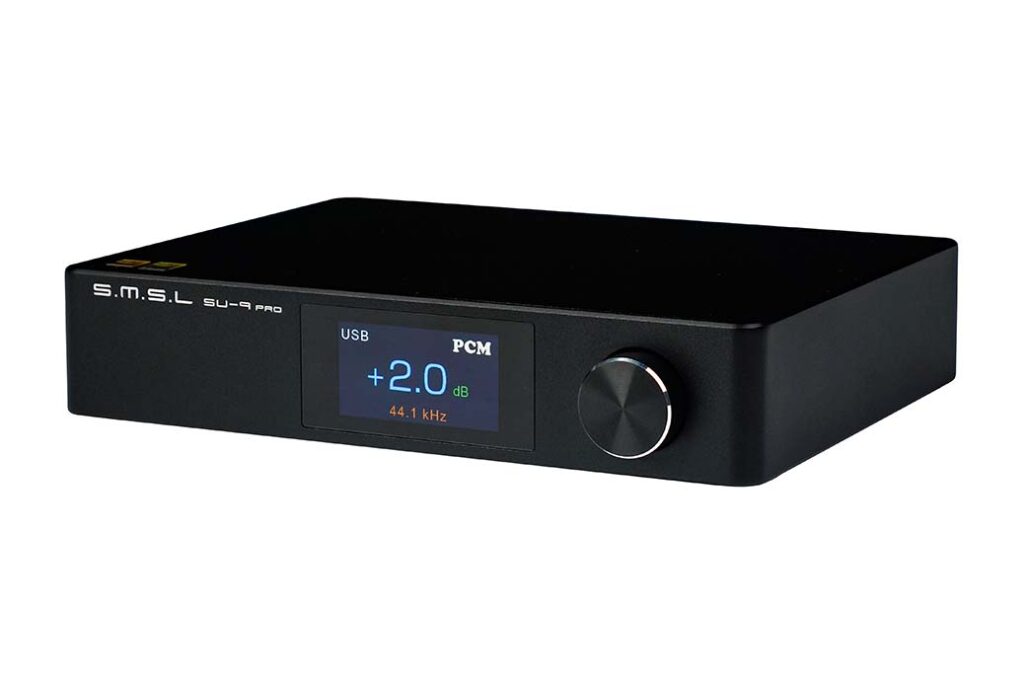
The S.M.S.L SU-9 Pro is a dedicated desktop DAC for listeners who already have an amplifier they want to keep. Its appeal is a compact digital hub with proper line outputs and convenient control, rather than an all-in-one headphone station. That distinction is the starting point for deciding whether it belongs in your system.
S.M.S.L SU-9 Pro — Design and everyday operation
A component that disappears into a daily listening routine is often more useful than one with an impressive specification that remains awkward to operate. The SU-9 Pro has a small colour display and a remote, putting input selection and level control within reach when it sits beside an amplifier or between active monitors. Its restrained appearance should fit a mixed-brand system without requiring a matching stack. Leave space behind it for plugs: the depth of the box alone does not describe the space needed on a shallow shelf.
The display is particularly useful for confirming that the intended source is selected. That sounds basic, but a desktop shared between a computer and a separate transport benefits from clear feedback. Set up the normal input and output behaviour before concentrating on the optional processing menus. An uncomplicated reference configuration makes later comparisons much easier and prevents an accidental setting change from being mistaken for a hardware problem. The remote is a practical benefit for speaker listening, not evidence of network streaming.
Digital connections and system limits
Official documentation lists USB, optical, coaxial and Bluetooth inputs, with RCA and XLR analogue outputs. There is no headphone socket or analogue input. A record player therefore needs its own phono stage and an amplifier with an appropriate analogue connection; it cannot enter this DAC through a passive cable. Likewise, passive speakers need a power amplifier. These are ordinary boundaries of a dedicated converter, but they matter when comparing its cost against a combined DAC and headphone amplifier.
A straightforward arrangement is computer to USB, followed by the DAC into an existing integrated amplifier. Optical can provide a separate connection from a suitable television or transport. For television use, choose a supported stereo PCM output rather than assuming a home cinema bitstream will decode. This is a stereo audio device, not an HDMI receiver or surround processor. Bluetooth provides a convenient alternative source, but a supported codec must exist at both ends of the connection. The Bluetooth logo alone does not establish which codec a particular phone will use.
Sound quality: what the evidence supports
Headfonics found the SU-9 Pro composed and smooth in its original evaluation, while noting limitations in the consistency of instrument placement and dynamics. That supports a favourable assessment without turning the product into a universal upgrade. The review is one listening report in a particular chain; it does not prove that every amplifier or headphone will reveal the same subjective differences. Our recommendation rests on a useful combination of documented conversion capability and sensible system integration.
For an owner whose existing DAC already works cleanly, the first question should be what problem the new unit solves. Missing inputs, awkward volume control or an unsuitable output connection are concrete reasons to change. Expecting a converter to transform a headphone whose tonal balance you dislike is a much less reliable buying strategy. Compare at matched playback levels, using familiar passages, and avoid changing several components together. A slightly louder signal can seem more detailed even when the underlying change is simply level.
The DAC also offers filter and sound-colour options. Treat these as settings to explore after establishing a stable baseline, rather than reasons to expect a different loudspeaker or headphone character. They cannot correct a room resonance or substitute for meaningful equalisation. A clear vocal recording, a dense mix and a quiet acoustic passage make a more useful small comparison set than constantly switching tracks in search of a dramatic effect.
Output levels and amplifier matching
The manual specifies maximum line levels of 5.2 V from XLR and 2.5 V from RCA. Those are maximum signal levels, not headphone power ratings. Check the receiving amplifier’s input sensitivity and available gain before deciding how the DAC should operate. A larger voltage is not automatically better: the aim is adequate headroom without overloading the next input or leaving only a tiny useful range on its volume control.
When the amplifier already controls volume, decide which component will be the everyday control and keep the arrangement predictable. With active speakers, start with their input level reduced and the DAC at a low setting. Bring the system up gradually, checking left and right connections before normal listening. An XLR connection can be useful in a compatible balanced chain, especially where cable routing is awkward, but RCA remains a legitimate option for a short domestic connection. Choose the interface your equipment supports correctly rather than buying adaptors solely to use the larger sockets.
Files, wireless use and practical priorities
The stated USB ceiling is PCM at 32-bit/768 kHz and native DSD512. Those figures describe compatibility with suitable source software and drivers; they do not promise an audible improvement when an ordinary recording is upsampled. A stable connection at the recording’s native rate is a perfectly sensible starting point. If a computer fails to send audio, first check the selected output device, application routing and required driver rather than assuming the DAC is faulty.
The absence of a streaming platform is equally important. This DAC does not independently browse a music library or replace a network player. A phone or computer remains the source when using Bluetooth or USB. Buyers seeking music without a computer should budget for a separate streamer with a compatible digital output. The advantage is modularity: the source can change without replacing the converter. The disadvantage is another box, cable and control interface. Whether that trade is worthwhile depends more on your routine than on the highest supported sample rate.
Value and who should buy it
The SU-9 Pro makes the most sense as the centre of a small separates system. Someone with a favoured analogue headphone amplifier can add several digital sources without duplicating an amplifier stage. A listener building from nothing should compare the complete cost of DAC, amplifier, cables and shelf space against a single-box alternative. The separate route offers flexibility, but it is not automatically the economical route.
For a European purchase, compare like-for-like offers including VAT, local return arrangements and warranty handling. An older launch price is not a reliable guide to today’s value, and a low import listing can involve a different support experience. There is also little reason to replace a functioning earlier DAC solely because the newer model uses a different chip. The SU-9 Pro earns its place when its connections, remote operation and output arrangement improve a real system, rather than simply adding another specification to it.
Alternatives to consider
S.M.S.L DO100 Pro: Consider this published alternative when the priority is a separate converter rather than a headphone all-in-one. Compare the required inputs and controls before choosing.
Topping DX5 II: A different route for a buyer who also needs headphone amplification. A combined unit can reduce both the total purchase and the number of connections.
S.M.S.L SU-9 Pro key specifications
- Role
- Dedicated stereo DAC
- Inputs
- USB, optical, coaxial, Bluetooth
- Outputs
- RCA and XLR line
- Maximum line level
- 2.5 V RCA; 5.2 V XLR
- USB decoding
- Up to PCM 32-bit/768 kHz and DSD512
- Display
- 1.9-inch LCD
Verdict
A capable dedicated DAC for an existing separates system, with useful inputs, remote control and both RCA and XLR line outputs. It is a less compelling purchase when you also need a headphone amplifier, network streaming or analogue source switching.
Primary documentation and independent reviews
S.M.S.L official SU-9 Pro specifications · S.M.S.L SU-9 Pro manual · Headfonics original SU-9 Pro review
Editorial record
Sources and updates
Product specifications and factual claims were checked against Official S.M.S.L SU-9 Pro product page ↗. Scores and buying advice follow our category-specific editorial methodology.
- Published
- November 8, 2026
- Last updated
- November 8, 2026