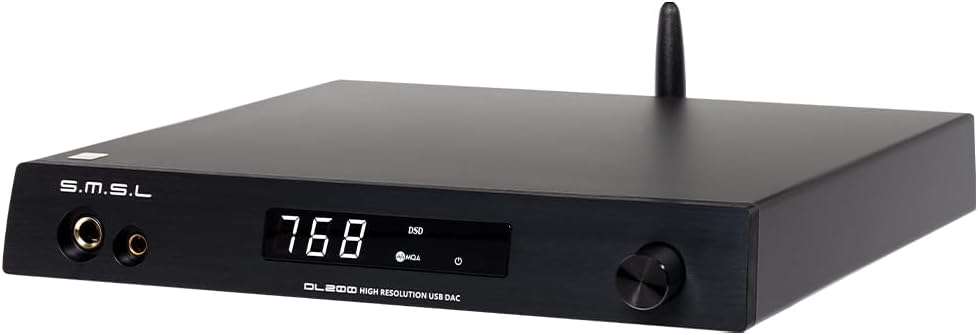
S.M.S.L DL200 is an affordable desktop DAC and headphone amplifier with several digital inputs, Bluetooth, remote control and balanced line outputs. It offers substantial functionality, but the larger case and abbreviated menus are not the whole ownership story. This research-based review considers strong original performance evidence alongside the important distinction between a 4.4 mm socket and a genuinely balanced headphone amplifier. Source-rate switching behaviour also deserves a check before it becomes the centre of a busy computer-audio setup.
Research-based review. This assessment draws on manufacturer documentation and the original published evaluations linked below. Audio Review has not performed a hands-on test of this model.
Good original evidence with a useful operational reservation
Headphone Corner’s original evaluation finds the DL200 capable, quiet and good sounding, while identifying brief clicks or interrupted starts during some sample-rate transitions. It also reports that the larger case and budget finish are less impressive than the functionality. Those are the original reviewer’s observations, not Audio Review test results.
Try a realistic session that moves between music, browser video and other everyday audio rather than only playing one album. Check the opening of tracks, pausing and returning from computer sleep. A device can perform well during continuous playback yet be less convenient when a source repeatedly changes format. That practical distinction may matter more than a small specification advantage. Listen with the intended headphones at matched level and assess noise, control and comfortable adjustment. The evidence supports a strong budget shortlist position, with an informed purchase depending on whether the reported transition behaviour is acceptable in the buyer’s actual routine.
The two headphone sockets do not mean two power tiers
The DL200 provides 6.35 mm and 4.4 mm headphone connections. The original evaluation identifies the same available amplifier power from both, rather than a more powerful balanced amplifier behind the smaller socket. The rear balanced line outputs are a separate function.
Choose a headphone cable for correct wiring and convenient use, not for an assumed power increase. A properly connected single-ended headphone does not need replacing simply to occupy the 4.4 mm socket. When comparing outputs, match level rather than interpreting a louder connection or a different cable fit as an automatic improvement. Confirm the headphone’s sensitivity and actual listening requirement alongside impedance. Manufacturer maximum ratings do not establish ideal performance with every load. The physical choice of sockets is useful because it can reduce the need to swap cables or adapters. It should be described honestly as connection flexibility. Buyers who specifically require a particular balanced amplifier architecture should verify that requirement instead of inferring it from the front-panel connector.
Balanced line output uses a different kind of TRS connection
The rear analogue connections comprise RCA and a balanced TRS pair. Some entries in the manual’s specification table use XLR wording, but the rear-panel diagram identifies the actual TRS sockets. There are no physical XLR sockets on that panel.
Check the destination equipment and use properly wired balanced line cables where supported. A pair of balanced mono line connections must not be treated as a single stereo headphone jack merely because the plug dimensions look familiar. Active monitors or another amplifier may suit this arrangement, provided volume and input level are configured sensibly. Start low, identify which component controls listening level and verify the selected output. The line/headphone output menu is distinct from the gain menu. If the desk needs frequent changes between speakers and headphones, try that sequence before committing. Correct connection planning is inexpensive compared with buying unsuitable adapters. The rear line facilities are a genuine strength when they connect directly to the intended system, especially where a combined unit avoids another control box.
Digital inputs cover several sources but omit analogue equipment
USB, optical, coaxial and Bluetooth are the source routes documented by S.M.S.L. The signal always enters digitally; the DL200 cannot accept an ordinary analogue line source as a standalone headphone amplifier.
That excludes direct use with a phono-stage output or another analogue player. A television with compatible optical output may work, but this is not an HDMI ARC device and television remote behaviour should not be assumed. Confirm a supported audio format and a practical volume-control route. Bluetooth reception adds convenient phone playback, with codec use depending on both devices. It does not add Wi-Fi, autonomous music services or multiroom playback. If network listening is important, another source remains necessary. List actual sources and switching habits before comparing price. The DL200 is particularly coherent when a computer, compatible digital transport and occasional phone share one desk. It becomes less economical if several additional boxes are needed to accommodate functions outside its digital design.
Gain and USB modes should match the real task
The manual provides low and high gain, along with selectable USB operation modes. The most ambitious advertised format support belongs to the appropriate USB configuration; it is not a promise that every input or connected device supports the same ceiling.
Use low gain first, especially with sensitive earphones. Check quiet adjustment and background noise before moving to high gain for a demonstrated requirement. Install official drivers when the intended computer mode requires them, and test recognition after sleep or reconnecting. A compatibility mode can be useful with some devices, but do not translate that into a guarantee for every console or television. Confirm the exact host’s supported USB-audio behaviour. The DPLL setting described in the manual can help tolerate some digital input timing conditions; it is not a substitute for checking an unsuitable format or defective cable. Keep a stable baseline configuration before experimenting with digital filters. Reliable playback and a comfortable volume range are more useful than chasing the largest number on the display.
Budget value depends on fit and control
The internal mains supply avoids an external power brick, but the case occupies more desk area than many compact alternatives. A remote and a dimmable display can be convenient when it sits beside speakers rather than immediately under a hand.
Measure the available space with rear cables connected and allow sensible ventilation. Check whether the screen abbreviations are clear enough for the person using it daily. For a used unit, test both headphone sockets, gain settings, required inputs and the line-output switching routine. Verify the exact model and relevant support files before maintenance; DL200 is not D200 or another visually similar device. Historical review pricing is not a current local offer, so compare warranty support and the complete package. The DL200 has the strongest value when its connections replace extra components. If a simpler device meets the same need with more convenient switching, the higher feature count is not automatically the better purchase.
Alternatives to consider
S.M.S.L C200: Compare the size, socket arrangement and source-switching behaviour. Pick the model that fits the intended desk rather than assuming a higher number guarantees better sound.
FiiO K5 Pro ESS: Consider a different combined desktop route when its controls and connections suit the actual sources. Include adapters and any separate speaker-control requirements.
S.M.S.L DL200 key specifications
- Role
- Desktop DAC and headphone amplifier
- DAC
- ESS ES9039Q2M
- Inputs
- USB-C, optical, coaxial and Bluetooth
- Headphone sockets
- 6.35 mm and 4.4 mm; no added balanced amplifier power from 4.4 mm
- Line outputs
- RCA and balanced TRS stereo pairs
- Manufacturer headphone output
- 1.5 W/channel at 32 ohms; 3 W/channel at 16 ohms, stated ratings
- Gain
- Low 0 dB; high 11 dB
- USB format ceiling
- Supported PCM up to 32-bit/768 kHz; DSD512 in appropriate mode
- Power
- Internal mains supply
- Size / weight
- Approximately 221.9 × 31 × 206.7 mm; 1.39 kg
- Not provided
- Analogue input, HDMI ARC or native network playback
Verdict
DL200 is a convincing research-based budget DAC/amp when its digital inputs and balanced line facilities fit the desk. Check transitions between different computer-audio sources and understand the headphone-socket implementation. Its practical flexibility is the main attraction, with clear limits around analogue input, network functions and an assumption of extra balanced headphone power.
Documentation and original reviews
S.M.S.L official DL200 product · S.M.S.L official DL200 manual and operating modes · Headphone Corner original DL200 evaluation
Editorial record
Sources and updates
Product specifications and factual claims were checked against Official S.M.S.L DL200 product page ↗. Scores and buying advice follow our category-specific editorial methodology.
- Published
- November 17, 2026
- Last updated
- November 17, 2026