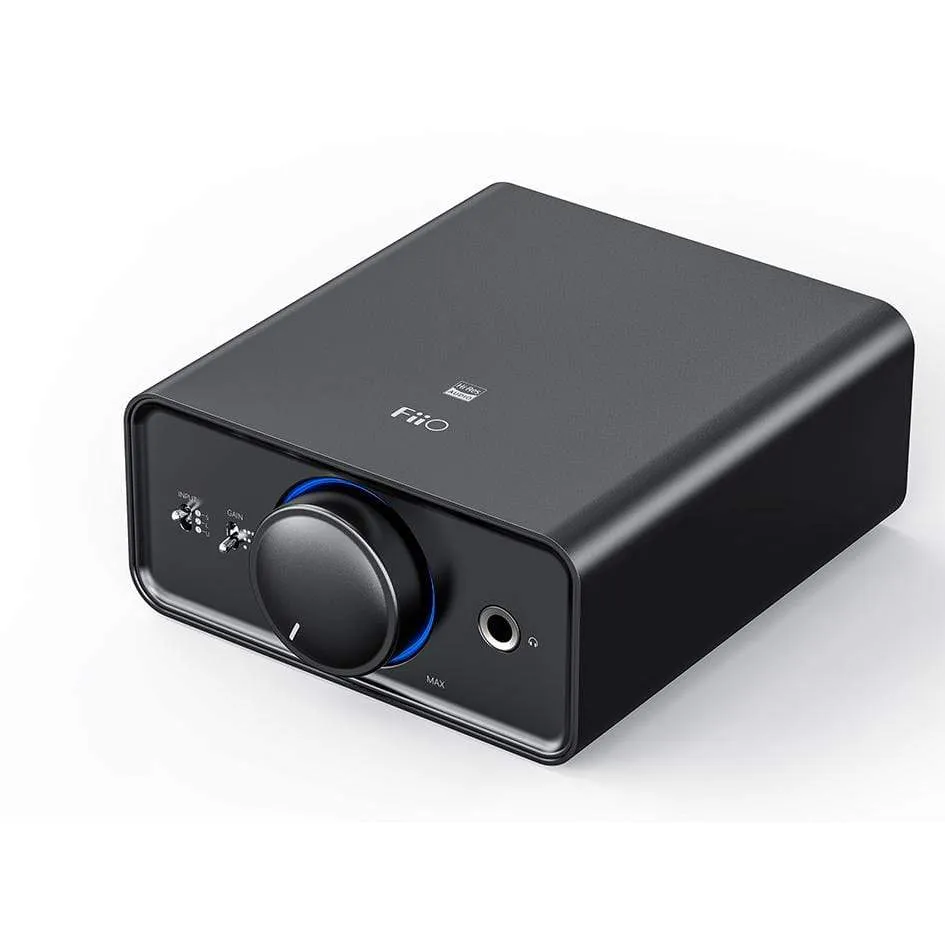
The FiiO K5 Pro ESS is a straightforward desktop DAC and headphone amplifier for listeners who value physical controls and wired sources. It offers a conventional headphone socket, a large volume dial and useful analogue input alongside digital connections. This is the ESS revision with the ES9038Q2M converter, not the earlier AKM K5 Pro.
FiiO K5 Pro ESS — Design: direct controls instead of menus
The attraction of the K5 Pro ESS is that the daily interaction is easy to understand. A large dial handles volume, while physical switches select the source and gain. There is no need to browse a complicated screen simply to start listening. That makes sense for a desk where the amplifier stays within reach and the headphones are connected regularly. It is a functional tool rather than a display-led centrepiece.
The simplicity also imposes limits. Someone who wants to control a system from across the room or see a detailed status screen should examine a different kind of component. The K5 Pro ESS is at its best close to the listener. Its external power supply also needs a home, so measure the complete arrangement rather than the small chassis alone. Leave room for a full-size headphone plug at the front and the relevant interconnects at the rear. A tidy placement will contribute more to everyday satisfaction than adding unnecessary accessories.
Digital and analogue sources
FiiO documents USB, optical, coaxial and RCA line inputs, with a 6.35 mm headphone output and RCA line outputs. The analogue input is a useful distinction at this level. It allows a suitable external DAC, player or phono stage to feed the headphone amplifier without requiring another headphone box. That gives the device a role beyond converting computer audio, even though the overall layout remains uncomplicated.
A record player must reach line level through a phono stage before it enters the RCA input. The K5 Pro ESS does not supply cartridge loading or phono equalisation. Similarly, a television needs a compatible digital connection and a supported stereo PCM output; the unit does not accept HDMI ARC or decode a home cinema soundtrack as surround audio. Thinking through the source path is essential because a low purchase price loses its appeal if it requires several additional adaptors to do the intended job.
Headphone drive and the three gain settings
The manufacturer quotes 1.5 W headphone power, and the cited original review specifies that figure at a 32-ohm load. This is a useful desktop capability, but it should not be interpreted as equal power at every impedance. Some high-impedance headphones need more voltage, while low-sensitivity planars can make substantial current demands. Sensitivity and actual listening needs should accompany impedance when judging a match.
Low, medium and high gain settings make it easier to work with different headphones. Begin low and increase only if the recording and headphone require more range. A gain switch does not improve the recording by itself; it changes the available amplification. With sensitive earphones, comfortable fine adjustment is generally more relevant than the maximum output figure. The single-ended 6.35 mm socket also avoids suggesting that a balanced cable purchase is necessary to get started.
A 3.5 mm headphone can use an appropriate adaptor, provided the plug and wiring are suitable. Avoid improvised balanced-to-single-ended arrangements without checking how the headphone is wired. The aim is a stable, correctly connected system using the cable you already own where possible. The K5 Pro ESS makes a particularly sensible shortlist when the chosen headphone needs more practical drive or a better control routine than the computer provides.
Sound quality and the original review
Headfonics’ ESS-version review reported an engaging, dynamic presentation and useful results with a range of headphones and earphones. It also found that more demanding high-impedance examples were not as convincing as with a stronger alternative. That combination supports a positive but bounded recommendation. The review’s descriptive impressions are listening observations, not measurements of frequency-response changes, and should not be repeated as though they were laboratory data.
For the buyer, the important question is whether the amplifier works comfortably with the actual headphone. A system that becomes loud enough with headroom and remains quiet at the required level can be a better choice than a more elaborate one bought for unused features. Compare at matched volume and use a few familiar recordings, including something quiet and something dense. A dramatic first impression is less useful than a comfortable session in which the controls and headphone behave predictably.
Do not expect the converter to change the fundamental character of an unsuitable headphone. If comfort, isolation or tonal balance is the main complaint, deal with that choice directly. The K5 Pro ESS is most persuasive as a practical improvement in source access and amplification, not a promise that a familiar recording will become a completely different performance.
Using the RCA output and building around it
The RCA line output offers a route to a compatible amplifier or active speakers, but it is not a speaker-level output. Passive speakers still need their own amplifier. Before relying on the unit for a mixed headphone and speaker routine, check the documented output behaviour and establish where volume and muting will be handled. Do not assume that inserting a headphone plug automatically manages every downstream component in the way you prefer.
A desktop with one pair of headphones and a separate speaker system can benefit from the shared digital source. However, a buyer who primarily wants a dedicated monitor controller, multiple balanced line outputs or sophisticated speaker management should compare equipment designed for that role. Adding an assortment of boxes to work around those requirements may cost more than starting with the correct device. The K5 Pro ESS succeeds through a focused set of functions, and it is worth respecting that focus when planning the rest of the system.
Formats, omissions and current value
Official USB support reaches PCM 32-bit/768 kHz and DSD512. These are file-compatibility limits rather than a requirement for good playback. Ordinary recordings can be enjoyed at their native rates, and a correctly selected computer output matters more than a large rate indicator. If a source fails to play, confirm routing, cable type and the relevant driver before changing unrelated audio settings. A USB cable must carry data, not merely power.
There is no built-in Bluetooth receiving or standalone network streaming platform. For a listener who wants a simple wired desk, that may be an acceptable omission; for someone who regularly sends music from a phone, it can be decisive. Compare the complete cost of adding wireless equipment against a unit that already includes it. The same applies to balanced headphone connections, remote control and more elaborate line outputs.
Because this is an older model, current European availability and pricing should drive the value judgement. Confirm that the listing is for the ESS revision, that the correct supply is included and that the support arrangement is clear. A well-priced example can still be a sensible, uncomplicated purchase. Paying close to a newer and more flexible rival is harder to justify unless the physical controls and analogue input are exactly what your system needs.
Alternatives to consider
FiiO K7: Compare this when balanced headphone connection and a more developed desktop arrangement are priorities.
Topping DX3 Pro+: A relevant alternative when wireless convenience and a different control layout are more useful than the K5 Pro ESS analogue input.
FiiO K5 Pro ESS key specifications
- Revision
- K5 Pro ESS; ES9038Q2M converter
- Inputs
- USB-B, optical, coaxial and RCA line
- Outputs
- 6.35 mm headphone and RCA line
- Gain
- Low, medium and high
- Headphone power
- Manufacturer headline: 1.5 W; cited review specifies 32 ohms
- USB decoding
- PCM up to 32-bit/768 kHz; DSD512
Verdict
A practical wired desktop DAC and headphone amplifier with clear controls, useful analogue input and a sensible gain range. It remains attractive at an appropriate price for a straightforward system, while wireless use, difficult headphones and more elaborate speaker control point toward alternatives.
Primary documentation and independent reviews
FiiO official K5 Pro ESS launch and features · Headfonics original K5 Pro ESS review · Headfonics K5 Pro ESS matching and specifications
Editorial record
Sources and updates
Product specifications and factual claims were checked against Official FiiO K5 Pro ESS product page ↗. Scores and buying advice follow our category-specific editorial methodology.
- Published
- November 8, 2026
- Last updated
- November 8, 2026