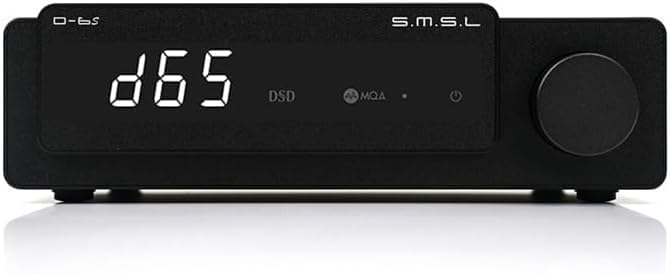
S.M.S.L D-6s is a compact stereo DAC with balanced XLR and RCA line outputs, several digital inputs and remote control. It can be a useful step beyond a bare fixed-output converter when a system needs convenient source selection and compatible balanced wiring. This research-based review considers its positive original listening evidence and the limits of a standalone DAC. It also treats D-6s as its own ESS-based model, rather than transferring the specification of the older and differently configured D-6.
Research-based review. This assessment draws on manufacturer documentation and the original published evaluations linked below. Audio Review has not performed a hands-on test of this model.
Dynamic and textured in the original evaluation
Headfonics’ original D-6S evaluation praises its dynamics, texture and input flexibility while finding the treble less distinctive. Those listening descriptions belong to that reviewer and system. They are not Audio Review test findings or a promise of a particular sound in every chain.
Compare it using the intended amplifier and transducers, with output level matched carefully. An apparently stronger bass line or clearer voice can be influenced by a louder line signal. Listen to quiet passages and dense arrangements as well as immediate musical peaks. The most useful improvement may be more convenient source switching or a suitable balanced connection rather than a large tonal change. If an existing converter already works quietly and reliably, establish what benefit is actually required before replacing it. The original evidence gives the D-6s a credible place on a budget shortlist. A practical audition and the completed system should decide whether its particular feature set is worth choosing over a simpler DAC.
D-6s is not the older D-6
S.M.S.L identifies the D-6S with an ESS ES9039Q2M conversion chip. The similarly named D-6 is a different model. Product identity matters for both technical descriptions and support files.
Check the actual label and retailer order text rather than assuming one missing letter is unimportant. Used listings can carry generic photographs or inherited descriptions, so confirm the rear connections and included accessories. Firmware instructions should match the exact model and relevant manufacturer guidance. Do not install another product’s update because its front panel looks similar. Model distinctions also matter when comparing reviews: an account of one version does not automatically establish the other’s performance. The D-6s should be selected for its own connection set, control routine and original evidence. That simple identity check avoids confusion around chip architecture and features, and makes a later comparison with alternatives much more meaningful than treating a whole product family as one interchangeable converter.
XLR output is useful when the destination supports it
The DAC provides RCA and balanced XLR line outputs. Manufacturer nominal levels differ between those routes, so comparing them without level matching can be misleading. Neither connection is a headphone output.
Use appropriate line cables and confirm the input requirements of the amplifier or active speakers. Establish which component controls listening volume, start conservatively and verify behaviour before normal playback. A higher nominal signal is not automatically better if it makes the downstream control range inconvenient. Balanced wiring can suit compatible equipment and cable routing, but it does not eliminate every source of noise or guarantee a different musical presentation. A short RCA connection may be entirely adequate. If active speakers are used, check their sensitivity controls and the practical listening-volume arrangement rather than assuming XLR sockets alone create a complete preamplifier system. The value of the D-6s output choice lies in fitting the actual equipment. It should reduce connection compromises instead of encouraging expensive adapters without a demonstrated need.
Digital sources are well covered, analogue sources are excluded
USB, optical, coaxial and Bluetooth are the documented input routes. There is no analogue line input, phono stage or HDMI ARC. The unit therefore serves digital conversion rather than all-source switching.
List the sources and their supported output formats before buying. A compatible optical television output may be useful, but it does not provide HDMI remote integration, and the television must send a format the DAC accepts. A turntable needs another analogue path even after a phono stage. Bluetooth adds convenient reception from a compatible source, with codec selection determined by both devices. It does not make this a Wi-Fi network player or autonomous streaming endpoint. If most music comes from a network service, budget for the source that actually provides that function. A compact DAC can be an efficient digital hub when those boundaries are clear. It becomes less convenient when it is expected to absorb functions belonging to a receiver, streamer or analogue preamplifier.
Simple menus should be configured for stable playback
The display and remote support everyday source and level control, while the manual documents digital filter, brightness and DPLL options. Those settings are useful only when their purpose is understood.
Start with a stable supported format and official driver arrangement where required. Check ordinary computer playback, source changes and return from sleep. The highest USB format ceiling is not shared by every connection and does not need to become the default target for a normal music library. If an optical source produces interruptions, the manual’s DPLL guidance can be relevant after verifying the source format and cable. It is not a cure for an unsupported signal. Compare filter options only if there is a clear preference, without assuming the most complex menu choice must be more accurate. Remote convenience and an easily understood baseline configuration are likely to matter more every day than frequently changing technical settings. The best arrangement lets someone select music and listen without diagnosing the DAC first.
The package should be judged with amplification included
The D-6s needs a headphone amplifier, integrated amplifier or appropriate active speakers. Its compact case and internal mains supply are convenient, but the complete system may still involve several boxes and interconnects.
Include those costs and the required remote, mains lead and cables when comparing offers. Check local support and actual condition rather than using an old review price as a current guarantee. For used equipment, test every required input and both output channels, and verify that controls remain reliable. Leave enough rear clearance for XLR plugs and allow sensible ventilation. A combined DAC and headphone amplifier may be more economical for a simple headphone desk, while separate conversion can make sense when an amplifier is already owned. The D-6s has the clearest value when balanced line output, remote operation and source flexibility are all useful. Buying by chip reputation alone is less persuasive than choosing a component that fits an established system without unnecessary additions.
Alternatives to consider
Topping E70 Velvet: Compare the connections, controls and current installed cost in the actual system. A different conversion platform is a reason to audition rather than a guarantee of a preferred result.
S.M.S.L SU-9 Pro: Consider a more elaborate standalone DAC if its facilities are useful. Avoid paying for a specification difference that does not change the intended listening routine.
S.M.S.L D-6s key specifications
- Role
- Compact stereo digital-to-analogue converter
- DAC
- ESS ES9039Q2M
- Inputs
- USB, optical, coaxial and Bluetooth
- Line outputs
- Stereo RCA and balanced XLR
- Manufacturer nominal output
- RCA 2.5 Vrms; XLR 5 Vrms
- Headphone amplifier
- Not included
- USB ceiling
- Supported PCM up to 32-bit/768 kHz and DSD512
- Optical / coaxial PCM
- Supported up to 24-bit/192 kHz
- Power
- Internal mains supply
- Size / weight
- Approximately 150 × 42 × 128.5 mm; 590 g
- Not provided
- Analogue input, HDMI ARC or native network streaming
Verdict
D-6s is a persuasive research-based budget DAC with useful line connections and positive original musical evidence. Confirm exact version identity, the volume-control route and required external amplification. Its strongest case is a digital stereo system that benefits from XLR output and remote convenience, with clear limits around headphones, analogue sources and native streaming.
Documentation and original reviews
S.M.S.L official D-6S product · S.M.S.L official D-6S operating manual · Headfonics original D-6S evaluation · Headfonics original D-6S comparisons
Editorial record
Sources and updates
Product specifications and factual claims were checked against Official S.M.S.L D-6s product page ↗. Scores and buying advice follow our category-specific editorial methodology.
- Published
- November 17, 2026
- Last updated
- November 17, 2026