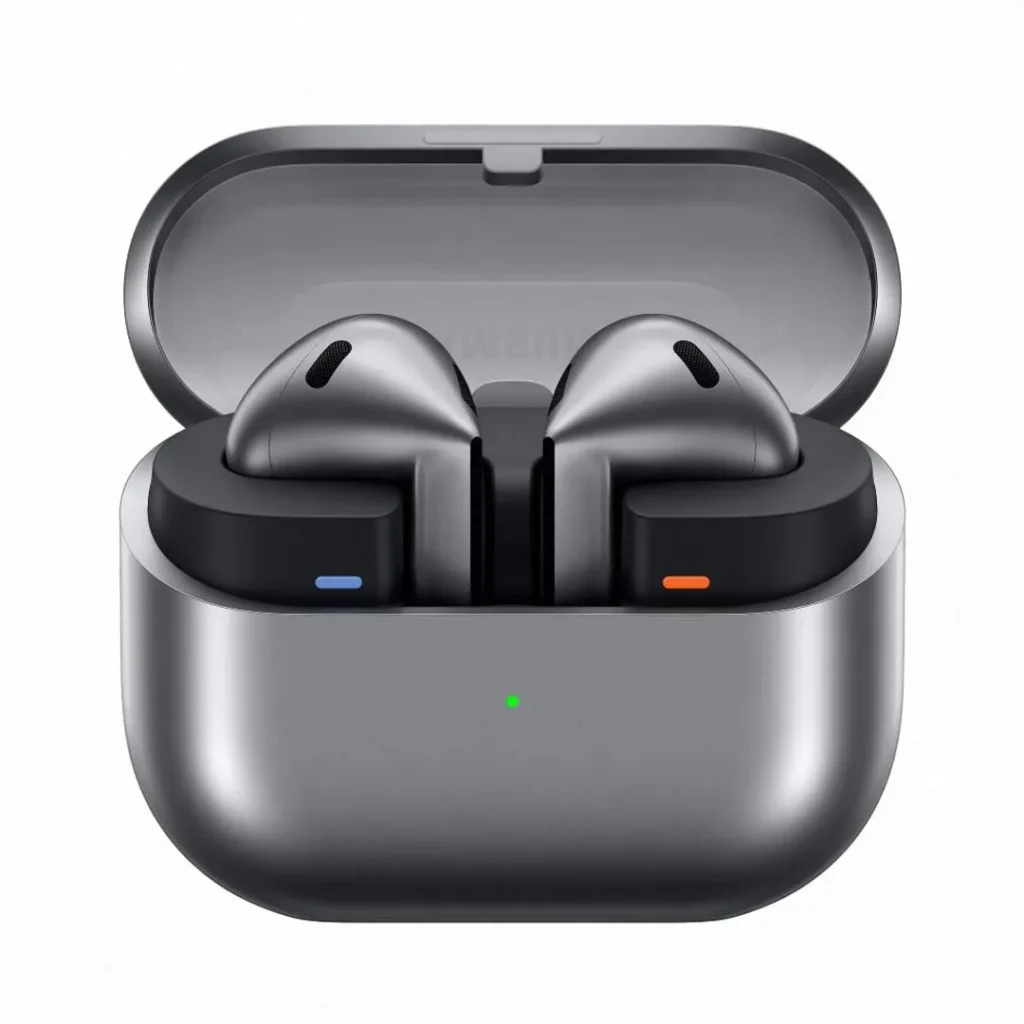
Samsung Galaxy Buds3 makes a more specific promise than its position below Buds3 Pro might suggest. It offers an open fit without silicone tips, while retaining ANC and a collection of Galaxy features. That can be appealing if sealed earbuds feel intrusive. It also means the physical relationship between speaker and ear is difficult to adjust. The most important part of the recommendation is therefore a stable, repeatable fit, not a codec or an AI feature.
Research-based review. This assessment draws on manufacturer documentation and the original independent evaluations linked below. Audio Review has not performed a hands-on test of this model.
Open fit changes the buying decision
Samsung documents an eleven-millimetre one-way speaker, 4.7 g earbud weight and Bluetooth 5.4. The shape rests at the ear opening without the interchangeable canal tips of Buds3 Pro. It is a different acoustic format, not simply the same earbud with a few premium settings removed.
Before comparing performance claims, decide whether an unsealed design is what you want. It can be more comfortable for someone who dislikes pressure in the canal, but gives fewer options when the shell does not match the ear. You cannot choose a larger silicone tip to compensate. A return-friendly purchase is particularly valuable because a successful fit on another person’s ear says little about whether the same shell will remain stable on yours.
Sound quality depends on position
SoundGuys’ original evaluation finds respectable sound when fit is controlled, but a substantial deterioration when the buds move away from the intended position. Its reviewer experienced instability and gives a strongly qualified overall recommendation. That is a sample-based finding, not proof that every owner will have the same anatomical match.
Our judgment is that the Buds3 should be auditioned as an open-fit product first and a feature-rich Galaxy accessory second. Listen while talking and moving your head, then check whether bass and vocal balance stay consistent. If you must reposition the shell repeatedly to recover the intended sound, the problem is not solved by quoting an ideal-fit measurement. The performance you can maintain during ordinary use is the one that matters.
ANC without a passive seal
The presence of active noise cancellation does not make the Buds3 behave like a tightly sealed earbud. External sound has a more open route to the ear, and the ANC system also depends on stable positioning. SoundGuys reports inconsistent results associated with fit and wear detection. This makes it a cautious choice for someone whose main goal is maximum isolation.
Compare ANC on and off with no music playing before judging the effect through a loud track. Then test the exact environment you care about, such as a desk beside a fan. Do not assume that a mode icon means the same reduction is occurring in both ears. If isolation is essential and silicone tips are comfortable for you, compare a sealed alternative before accepting the trade-off merely because the Buds3 is smaller or less expensive.
Galaxy features and the rest of the market
Samsung lists its proprietary SSC options alongside SBC and AAC, with advanced modes tied to compatible Galaxy devices and software. Auto Switch is also an ecosystem function with compatibility conditions. It should not be treated as a promise of unrestricted two-device operation across any work laptop and phone combination.
Make a list of the devices you use every day and establish which functions actually work on them. An advanced stream format on a compatible Galaxy phone does not improve convenience on an unrelated office computer. Similarly, a translation feature may depend on phone software, language support and settings beyond the earbuds. Assign value to the functions you will use regularly, rather than paying for a feature list whose most elaborate entries are unavailable in your setup.
Controls, calls and the compact case
The angular stems provide pinch and swipe controls, while the case supports USB-C and wireless charging. These are useful conveniences when the earbud fit remains stable. A control gesture is less convenient if it changes the position of the speaker each time, so test pause, volume and call handling during the fit trial.
For calls, compare a quiet room and the place where you normally speak. If the microphone sounds different on a computer, check the application input and Bluetooth routing before concluding the hardware has changed. The case is for storing and charging the earbuds; it is not an analogue audio transmitter. A headphone socket on an aircraft screen does not become a compatible source merely because the charging case has a USB-C port.
Battery life and daily reserve
Samsung claims up to five hours of music with ANC and twenty-four hours including the case, or six and thirty hours without ANC. SoundGuys measured four hours and fifty-six minutes with ANC in its own test. That is useful context, although a test result is not a guarantee for calls, higher volume or different settings.
Plan around your longest uninterrupted session and leave reserve rather than assuming the case total describes one long listening period. Wireless charging is convenient at home, while a cable can be more predictable when travelling. Check that both buds sit correctly and begin charging. Contact contamination or a poorly seated earbud can leave one side flat even when the case itself still has ample battery.
Resistance, exercise and value
The official IP57 rating applies to the earbuds only. It does not establish that the charging case has the same protection or that the product is intended for swimming. More importantly for exercise, a resistance rating does not determine whether the unsealed shell stays in your ear during movement.
If running is the main use, test stability with realistic head movement and perspiration conditions where practical. An ear-hook product may suit that role better even if it is less compact. For value, compare the current cost with both the sealed Buds3 Pro and alternative open-fit models. A discount is meaningful only if the physical fit works; an unstable bargain delivers neither dependable sound nor dependable convenience.
Alternatives to consider
Samsung Galaxy Buds3 Pro: Buds3 Pro uses a sealed design with replaceable tips and a different speaker system. It is the more relevant Galaxy comparison when isolation is central and a canal tip is acceptable, rather than a model to assume sounds identical with extra software.
Apple AirPods 4 with Active Noise Cancellation: AirPods 4 ANC is a direct unsealed-format comparison, particularly for an iPhone user. Neither shell can be assumed to fit like the other, so platform choice and personal stability need to be checked together.
Samsung Galaxy Buds3 key specifications
- Design
- Open-fit, no silicone canal tips
- Speaker
- One-way 11 mm dynamic
- Bluetooth
- 5.4
- Codecs
- SBC, AAC, Samsung SSC HiFi and SSC UHQ on compatible devices
- Earbud weight
- 4.7 g each
- ANC
- Yes, performance strongly fit-dependent
- Claimed battery with ANC
- Up to 5 h; 24 h with case
- Claimed battery without ANC
- Up to 6 h; 30 h with case
- Ingress rating
- IP57 earbuds only
- Charging
- USB-C and wireless case charging
- Switching
- Galaxy Auto Switch subject to compatibility
Verdict
Galaxy Buds3 is a preference-led option for a Galaxy owner who dislikes canal tips and can establish a stable fit. Its controls, case charging and compatible-platform features have real value, but none removes the dependence on the shape and position of the shell.
Our recommendation is cautious for general commuting and stronger for a buyer who has already confirmed the open fit works well. Compare Buds3 Pro if isolation matters and AirPods 4 ANC if you use an iPhone. Choose the Buds3 for a practical match between ear shape, platform and listening routine, rather than expecting a smaller version of the Pro with otherwise identical behaviour.
Primary documentation and independent reviews
Samsung UK official Galaxy Buds3 product information · Samsung Mobile Press official Buds3 specifications · Samsung official wireless charging compatibility · SoundGuys original Galaxy Buds3 evaluation
Editorial record
Sources and updates
Product specifications and factual claims were checked against Official Samsung Galaxy Buds3 product page ↗. Scores and buying advice follow our category-specific editorial methodology.
- Published
- November 17, 2026
- Last updated
- November 17, 2026