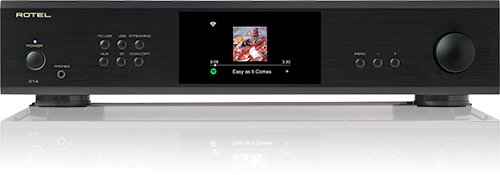
Rotel S14 combines network music, digital conversion and Class-AB speaker amplification in a conventional full-width component. Unlike Rotel integrated amplifiers whose Ethernet socket is reserved for control, the S14 actually plays music over the network. It also leaves some traditional facilities out: there is no built-in phono stage or HDMI ARC connection. This research-based review considers the positive original evidence for precision and dynamics while examining app use, source roles and the full-range subwoofer output that can affect an otherwise attractive just-add-speakers system.
Research-based review. This assessment draws on manufacturer documentation and the original published evaluations linked below. Audio Review has not performed a hands-on test of this model.
Precision and dynamics are the strongest original-review themes
HIFI.DE’s original evaluation praises the S14’s defined bass, dynamic expression and fine tonal detail. It also describes a relatively basic app approach rather than a rich all-purpose control environment. Its observations about service behaviour belong to the tested software period and should not be presented as fresh testing of today’s firmware.
For an audition, follow the shape and stopping of a bass note rather than asking only how much bass is present. Compare a rhythm-led recording with natural voices and acoustic instruments, keeping levels consistent. A precise presentation should remain engaging at normal volume, not require a loud demonstration to make its point. Speaker choice and placement still affect bass definition, and an awkward room can dominate a good amplifier’s contribution. The original evidence makes the S14 a serious music-first candidate. It does not mean its interface will suit every listener or that a sound preference established with one speaker pair transfers automatically to another installation.
This Ethernet connection really carries a streaming role
Rotel’s current specification lists Ethernet and Wi-Fi networking, Roon Ready certification, AirPlay 2, Google Cast and Spotify Connect alongside supported services. Those are actual playback routes, rather than a control-only Ethernet connection or a Roon Tested USB certification.
Choose the route that matches the household’s accounts and devices. Try discovery, starting a favourite album, changing users and returning from standby. A simple service application’s connection mode may be more useful than spending time inside the amplifier’s companion app. Conversely, someone who relies on local libraries, radio browsing and stored favourites should test that exact workflow. Confirm current service support on an older or used unit and apply appropriate official updates where needed. Do not infer permanent catalogue or resolution availability from a launch-era description. The benefit of a streaming integrated amplifier is ordinary access to music with fewer boxes. Its practical value depends on making that routine predictable rather than merely accumulating several ways to send the same song.
The modest app approach can be a benefit or a limitation
The original HIFI.DE review describes the Rotel app as relatively rudimentary and finds established service and Roon routes useful alternatives. That is a practical qualification, not evidence that a complex application is always preferable or that the older app assessment remains unchanged today.
Demonstrate the current software on the actual phones before purchase. Check how another household member finds radio, changes a source and adjusts volume. Confirm that artwork and track information remain legible from the normal listening distance. A remote and physical controls can be reassuring when a phone is unavailable, but they do not necessarily replace every browsing task. Think about the music collection that will be used most often. A service-centred listener may appreciate avoiding a proprietary browsing environment, while someone managing several libraries may want richer organisation. The right question is whether the S14 makes the buyer’s repeated tasks simple. A polished front display alone does not answer that question, and neither does a long supported-service list.
Conventional sources remain useful but vinyl needs another stage
The S14 includes a line input, optical and coaxial connections, PC-USB and supported local USB-media playback. It has no dedicated phono stage and no HDMI ARC. The line input is not a substitute for the gain and equalisation required by an unamplified cartridge.
Use a turntable with suitable line output or add a matching external phono stage. For television, check a compatible stereo optical connection, source formats and lip synchronisation rather than expecting HDMI control behaviour. With a computer, verify the official USB driver and operating-system configuration, including recovery after sleep. Keep the PC-USB and USB-media roles distinct; a connector’s presence does not guarantee support for every drive or file format. Demonstrate the actual source collection before deciding that the one-box electronics arrangement covers everything. The S14 is versatile for digital music, but a record-heavy or television-centred system may need more external equipment than the streamlined appearance initially suggests.
The subwoofer output does not perform automatic bass management
The manual explicitly describes the mono subwoofer signal as full range, relying on the subwoofer to filter it. It also states that headphone insertion cuts speaker, preamplifier and subwoofer outputs. Those details help distinguish the S14 from products with automatic crossovers or different private-listening behaviour.
Choose an active subwoofer with appropriate filtering and level controls, then adjust placement and crossover in relation to the main speakers. Do not assume the amplifier automatically removes bass from the passive pair. Room correction is not built in, so careful installation remains central. Check the headphone transition at a reduced level and try the intended headphones for noise and useful gain. A convenient mute routine is welcome, but the headphone connection still needs its own listening assessment. The strongest system is often a well-positioned pair of suitable speakers before extra bass is added. A subwoofer should address a specific extension or room need rather than become a default accessory purchased because an output socket is available.
Compare the whole installation and current offer
Rotel specifies eighty watts per channel continuous into eight ohms and a differently labelled one-hundred-and-fifty-watt maximum into four ohms. Keep those conditions clear when comparing another amplifier. A full-width streaming component also still requires passive speakers, suitable support and ventilation.
Price the actual installation, including stands, an external phono stage or television connection if needed. Check regional mains, remote, network discovery and current service access on a used or demonstration unit. The S14 is most persuasive when direct streaming and competent stereo amplification replace a collection of separate boxes without complicating the daily routine. A buyer already owning a capable streamer may place less value on the integrated network platform. Another may prefer a system with HDMI and automatic room adjustment even if its physical styling is less traditional. Compare complete current offers with the same sources and intended speakers. That shows whether the Rotel’s particular balance of musical evidence, network routes and restrained interface is useful enough to justify its price.
Alternatives to consider
NAD M10 V3: Compare its compact interface and room-adjustment approach with the intended speakers. Include licence requirements and the household television route in the complete comparison.
Marantz MODEL 60n: Consider a different network integrated platform and control routine, checking analogue sources and daily service use as carefully as musical preference.
Rotel S14 key specifications
- Role
- Network streamer, DAC and Class-AB stereo amplifier
- Manufacturer output
- 80 W/channel continuous into 8 ohms; 150 W/channel maximum into 4 ohms
- Network
- Ethernet and dual-band Wi-Fi
- Playback routes
- Roon Ready; AirPlay 2; Google Cast; Spotify Connect; supported services
- Bluetooth
- Reception with aptX HD and AAC support
- Conventional sources
- One RCA line input; optical; coaxial; PC-USB; supported USB media
- Phono / HDMI
- No built-in phono stage or HDMI ARC
- Outputs
- Passive speakers; variable stereo pre-out; mono sub; 3.5 mm headphones
- Subwoofer signal
- Full range; relies on subwoofer filtering
- Headphones
- Insertion cuts speaker, pre-out and sub signals per manual
- Dimensions / weight
- Approximately 430 × 93 × 345 mm; 9.15 kg
Verdict
S14 is a strong research-based shortlist choice for music-first streaming stereo, with positive original evidence for precision and dynamics. Verify the current service routine, plan external phono or television requirements and treat the full-range sub output correctly. It can form a convincing system when its deliberately limited feature set matches the household rather than being discovered after purchase.
Documentation and original reviews
Rotel official S14 product and current streaming specification · Rotel official S14 owner manual · HIFI.DE original S14 evaluation by Bernhard Rietschel
Editorial record
Sources and updates
Product specifications and factual claims were checked against Official Rotel S14 product page ↗. Scores and buying advice follow our category-specific editorial methodology.
- Published
- November 17, 2026
- Last updated
- November 17, 2026