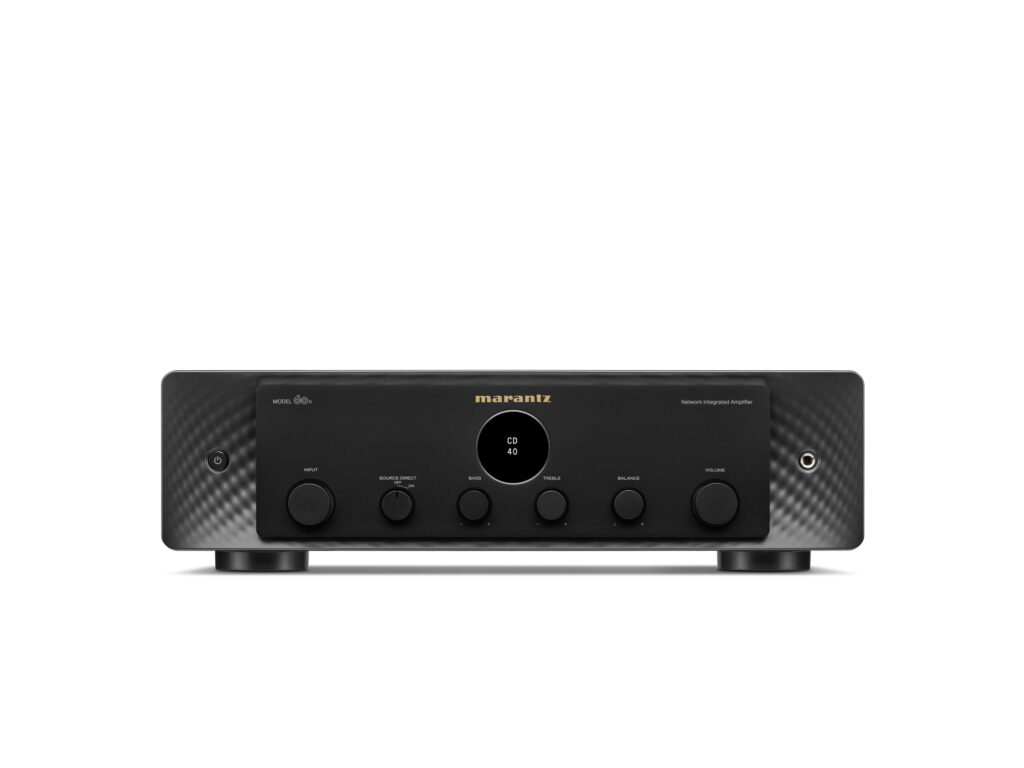
The Marantz MODEL 60n brings network streaming and television audio into a traditional stereo amplifier. It combines a conventional front panel with HEOS, digital inputs and a moving-magnet phono stage. The appeal is a complete everyday music system that still looks and operates like a substantial hi-fi component.
Marantz MODEL 60n — Design and everyday control
The MODEL 60n follows Marantz’s current visual language, with prominent rotary controls and a small central display. It suits a room where the amplifier is visible and used directly, rather than hidden behind a television. The physical presentation is more traditional than a compact app-led streaming box, so confirm that the shelf, ventilation and cable routing suit that choice.
A small display is adequate for basic status but less useful for browsing a large library from the sofa. Expect the phone or tablet to handle much of that work. Before buying, try the browsing and source-change routine rather than judging the system only by the front panel. An attractive amplifier still needs to make finding an album and changing volume easy for every person who will use it.
Power and loudspeaker requirements
The European specification gives 60 watts per channel into eight ohms and 80 watts into four ohms, measured across 20 Hz to 20 kHz. That places the MODEL 60n in a sensible traditional stereo role rather than a high-output specialist one. Choose speakers with the room, listening distance and realistic peak levels in mind, instead of assuming a premium enclosure removes all matching requirements.
A moderate-sized room and suitable loudspeakers make a different demand from a large open space with inefficient speakers. An audition should include the loudest level actually intended for home use, with clean peaks and stable balance as the target. Spending more on amplification is less productive if the speakers are badly placed or the room strongly exaggerates a bass note.
The amplifier provides the main stereo power within the same component as its network functions. That reduces the need for separate source equipment, but it also means the streaming interface is part of the long-term ownership decision. Assess both sides of the product: the preferred control platform matters, and so does the ability to drive the chosen loudspeakers comfortably.
HEOS and network listening
HEOS playback is built in, with wired and wireless network connections and support for convenient app-based listening. AirPlay 2 and current Roon Ready support broaden the available routes. Service availability and account requirements can vary by region and change with firmware, so verify the service you actually subscribe to rather than treating a long logo list as the whole purchase decision.
Wired Ethernet is useful if a socket is available near the equipment; Wi-Fi is convenient where running a cable would complicate placement. Either should provide stable ordinary playback when the network is working properly. Choose based on reliability and installation, not on a promise that a more expensive cable or a higher advertised sample rate necessarily improves every recording.
Bluetooth adds a quick route for visitors and compatible headphones. The current European manual lists SBC for Bluetooth audio, so an assumption of LDAC or aptX support would be misplaced. Bluetooth capability and network streaming are separate features with different operating paths. For a regular library, try the network interface first and keep Bluetooth as a practical option where its convenience is useful.
Television and physical sources
HDMI ARC is an important part of the MODEL 60n’s living-room role. It lets a compatible television share the stereo speakers and can simplify everyday volume control. It is not a bank of HDMI video inputs, and it does not turn this two-channel amplifier into an Atmos receiver. Configure the television for a compatible stereo audio output and check control behaviour with the exact TV.
Optical and coaxial digital inputs provide routes for other sources. USB-A supports compatible media playback, but should not be described as a USB-B computer DAC connection. A laptop connected by an ordinary USB cable is therefore not automatically equivalent to inserting a supported storage device. Plan the required source path before buying an adapter that cannot perform the missing conversion.
Analogue line inputs and an MM phono stage cover conventional sources and a suitable turntable. Keep phono-level and line-level signals distinct, particularly if the turntable has an internal preamp. A subwoofer output and headphone connection add useful flexibility, but neither should be mistaken for a full multichannel bass-management system or a published guarantee of ideal matching with every headphone.
Sound quality and review evidence
AVForums’ original MODEL 60n review praised its engaging sound, build and wide range of useful features, while finding the HEOS interface less polished than some competing platforms. That is a helpful balance: the evidence supports a capable all-round amplifier, with software preference remaining a valid reason to choose another model. It is not necessary for every owner to value the same interface in the same way.
The original listening assessment belongs to that reviewer. Audio Review’s rating weighs that evidence with the documented feature set and practical limitations, rather than claiming a separate hands-on audition. For a personal demonstration, use a familiar streamed album, a television programme with dialogue and any analogue source that will be used regularly. This checks the system as a whole instead of only its most flattering input.
Compare listening levels carefully. A slightly louder presentation can initially seem clearer and more dynamic without establishing a better long-term match. Listen for intelligible vocals, stable bass and comfort through a complete track. If the interface becomes frustrating while finding the next album, that also counts against the ownership experience even when the amplifier itself performs well.
Value and alternatives
The MODEL 60n is most persuasive when its included source functions replace several separate components. A television, turntable and regular streaming service can share one amplifier and one pair of speakers. That makes its traditional size easier to justify than in a system that uses only a single line input and ignores the network section.
Compare current European pricing with complete alternatives, including any external phono stage or streaming hardware they need. A smaller Class D design may offer a more compact installation, while an analogue amplifier and separate streamer allow the network platform to change independently. Choose the Marantz when the blend of physical controls, HEOS, ARC and conventional source access matches everyday use. The strongest argument is the complete system, not the number of services printed on the packaging.
Alternatives to consider
Marantz MODEL M1: A more compact Marantz approach when a small enclosure and streaming-led operation matter most.
Bluesound POWERNODE (2025): Compare a different network platform and source-control experience before committing to HEOS.
Marantz MODEL 60n key specifications
- Type
- Class AB integrated streaming amplifier
- Rated output
- 60 W/channel at 8 ohms; 80 W/channel at 4 ohms, 20 Hz–20 kHz
- HDMI
- ARC
- Digital inputs
- Optical, coaxial and USB-A media
- Phono
- Moving magnet
- Network
- HEOS, Ethernet, Wi-Fi, AirPlay 2 and Roon Ready
- Bluetooth
- Receiver and transmitter; SBC
- Other outputs
- Subwoofer and headphones
Verdict
A versatile and appealing traditional streaming amplifier with useful television and vinyl integration. Its sound and build receive strong original support, while the small display and HEOS workflow deserve a personal trial.
Primary documentation and independent reviews
Marantz official MODEL 60n product details · Marantz official European MODEL 60n specifications · AVForums original MODEL 60n review
Editorial record
Sources and updates
Product specifications and factual claims were checked against Official Marantz MODEL 60n product page ↗. Scores and buying advice follow our category-specific editorial methodology.
- Published
- November 8, 2026
- Last updated
- November 8, 2026