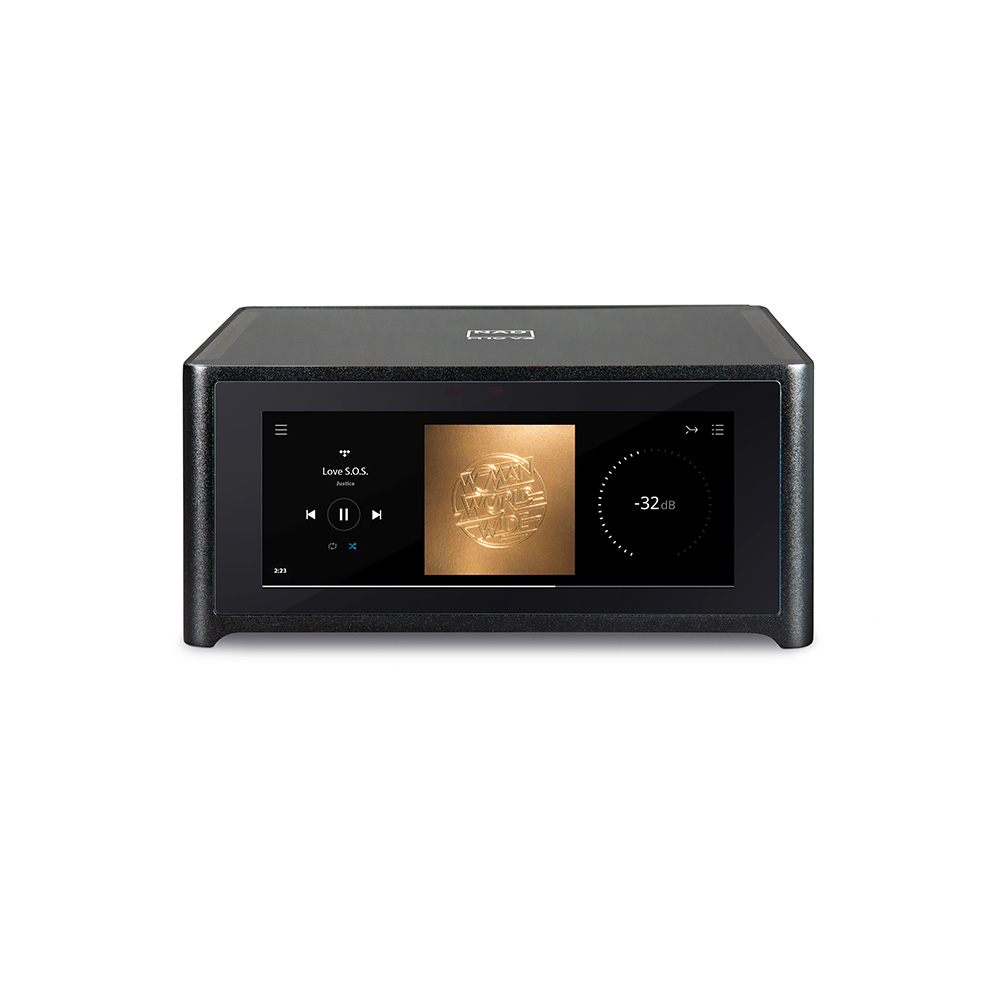
The NAD M10 V3 combines network streaming, digital conversion and speaker amplification in a compact component with a colour touchscreen. It is intended to replace much of a traditional stereo stack while retaining television and analogue-source access. The third-generation model adds useful changes, but the complete system should be judged on control, room integration and speaker matching rather than its screen alone.
NAD M10 V3 — Design and the compact-system advantage
The M10 V3 is small enough to make a different kind of room arrangement possible. A large equipment rack is not a prerequisite for a substantial two-speaker system, and the artwork display gives the component a visible role without demanding several matching boxes. That can be valuable in a shared living room where appearance and simplicity affect whether the system is used regularly.
Compact does not mean it should be hidden without ventilation or cable access. Allow room behind it for speaker and source connections, and put the screen where it is useful. The included remote provides an alternative to touchscreen or app operation. Try the expected daily routine: start music, change volume, switch to television and return to a favourite source. A polished-looking component should earn its place by making those actions straightforward for everyone in the household.
Amplification and loudspeaker choice
NAD specifies continuous output above 100 W per channel into 8 or 4 ohms, across the audio band with both channels driven at the rated distortion. That is a manufacturer specification, not our bench result. It indicates that the compact enclosure is intended for real passive-speaker use, but it does not settle compatibility with every loudspeaker. Sensitivity, impedance variation and listening distance remain important.
A small amplifier can be a sensible partner for capable floorstanders or standmounts if their demands and the room are appropriate. Conversely, a small low-sensitivity speaker may need more headroom than its size suggests. Choose for the listening space and normal level rather than pairing purely by dimensions or price. If substantial EQ boosts are planned, account for the extra demand on the amplifier and speaker.
The strongest compact system is often a well-chosen pair of speakers placed properly. Adding more electronic features will not compensate for speakers forced into awkward corners or a seat in a severe bass null. The M10 V3’s correction and subwoofer tools can help refine a good foundation, but the physical arrangement should come first.
BluOS and source flexibility
BluOS network playback is included rather than depending on a separate expansion card. A phone or tablet can control the system without serving as a continuous Bluetooth audio transmitter, which is a useful distinction for everyday streaming. Network stability and the preferred service’s actual integration matter more than a long logo list. Confirm that the household’s normal playback and multiroom routine is supported before treating the ecosystem as interchangeable with another platform.
The V3 adds an MM phono input, alongside line-level and digital source connections and HDMI eARC. That makes records and television natural parts of the same system. A low-output moving-coil cartridge still needs appropriate matching equipment, and a turntable already delivering line level should use the ordinary analogue input. HDMI likewise requires the television’s correct return-audio port and settings.
USB-A media access should not be confused with a direct computer USB DAC input. A compatible storage device and a computer acting as an audio host are different roles. If the main source is a laptop, decide whether network playback or another documented connection is the intended route. Source planning remains worthwhile even when the overall product is sold as a complete system.
Dirac, subwoofers and licence costs
The included Dirac Live licence is Limited Bandwidth, correcting up to 500 Hz, with a microphone supplied. NAD lists Full Bandwidth as an optional upgrade and Dirac Live Bass Control as a separate paid option for the M10 V3. Do not combine these into a claim that every version of room correction is included in the box. The total price depends on the level of processing the owner actually needs.
Two independent subwoofer outputs with adjustable crossover provide useful room-integration flexibility. That is especially relevant when small main speakers need support or when subwoofer placement can improve bass consistency. Two subwoofers are not automatically better if both are placed without thought. Begin with the room, level and crossover plan, then measure and refine the arrangement.
Correction works best when expectations are realistic. It can address certain response problems and improve consistency, but it cannot make every position identical or create clean deep bass from a driver beyond its capabilities. Keep an uncorrected reference, use a target suited to the speakers and avoid treating the flattest possible graph as the only acceptable result. The useful outcome is comfortable, coherent listening in the intended area.
Sound quality and V3-specific evidence
Stereophile’s original M10 V3 evaluation found the compact amplifier highly capable with its chosen Dynaudio speakers, with articulate reproduction and a convincing presentation. The reviewer also described the V3 as slightly less forgiving in the treble than the original M10 on some recordings. Those are useful comparative observations rather than a guaranteed character in every system. The cited review did not use Dirac during the main listening comparison.
That context matters. A corrected system at home is not identical to an uncorrected amplifier evaluation, and a different speaker or room may alter the balance substantially. For an audition, use the same source material and similar levels, then evaluate the processing configuration you intend to own. Avoid comparing one amplifier with correction enabled against another with correction disabled and attributing every difference to their power stages.
The V3’s DAC hardware specification also should not be confused with the network playback limit. NAD lists BluOS audio up to 24-bit/192 kHz. A higher internal chip capability does not mean every source path accepts files at the largest number printed in marketing. Stable playback and correct service integration are more valuable than choosing a component because of a DAC-rate headline alone.
Private listening, television and value
Bluetooth can serve compatible wireless headphones, but there is no ordinary wired headphone socket on the M10 V3. Someone with a favourite wired pair should include an appropriate separate solution in the system plan. This is an example of why a compact all-in-one should be checked against an actual checklist rather than assumed to contain every function of a larger stack.
The supported wireless surround expansion is also specific to compatible BluOS equipment and Dolby Digital use; it is not equivalent to a full Atmos AV receiver with freely assignable speaker channels. Buy the M10 primarily as a stereo streaming amplifier unless its documented expansion exactly matches the intended use.
For current EU value, compare the complete package with the necessary licences and any wired-headphone equipment included. The M10 V3 is particularly persuasive when its small size, included network platform and room tools replace several components. A listener happy with an existing separates system may gain less from the screen and integration. It is a premium convenience and capability purchase, best justified by how well the whole system fits the room and the owner’s routine.
Alternatives to consider
NAD C 700 V2: A relevant compact BluOS alternative when the complete feature and correction requirements do not justify moving to the M10 V3.
Naim Uniti Atom: Compare this for another premium compact streaming system with a different control and connection approach.
NAD M10 V3 key specifications
- Type
- BluOS streaming integrated amplifier
- Continuous output
- More than 100 W/channel into 8 or 4 ohms, both channels driven
- Sources
- Network, MM phono, line, optical, coaxial, HDMI eARC and USB-A media
- Subwoofers
- Two independent outputs with adjustable crossover
- Included correction
- Dirac Live Limited Bandwidth up to 500 Hz
- Optional correction
- Paid Full Bandwidth and eligible Bass Control licences
- BluOS audio
- Up to 24-bit/192 kHz
- Control
- Touchscreen, BluOS app and BC1 remote
Verdict
An accomplished compact stereo system with included BluOS, useful television and vinyl access, and a meaningful room-integration path. Its strongest case is replacing several boxes, while optional Dirac licences, the absence of a wired headphone socket and speaker matching remain important.
Primary documentation and independent reviews
NAD official M10 V3 EU product information · NAD M10 V3 owner manual · NAD current Dirac licence and model support · Stereophile original M10 V3 review
Editorial record
Sources and updates
Product specifications and factual claims were checked against Official NAD M10 V3 product page ↗. Scores and buying advice follow our category-specific editorial methodology.
- Published
- November 8, 2026
- Last updated
- November 8, 2026