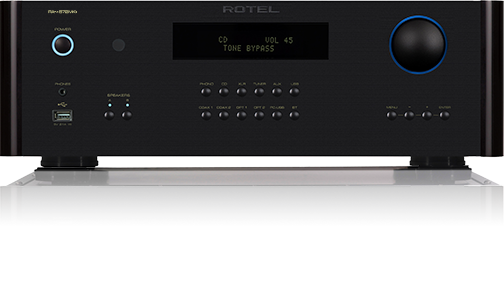
Rotel RA-1572MKII combines substantial Class-AB speaker amplification with balanced analogue input, conventional digital sources, computer USB and moving-magnet phono. It is a broad stereo hub, but Ethernet is for control and updates rather than native music streaming. This research-based review considers Roger Kanno’s positive original listening evidence and the practical details hidden behind the input list, including headphone muting, differently labelled power claims and hardware-dependent integration features. Those checks help determine whether it offers the right kind of flexibility for an existing system.
Research-based review. This assessment draws on manufacturer documentation and the original published evaluations linked below. Audio Review has not performed a hands-on test of this model.
Smoothness and weight are supported by the original evaluation
SoundStage Hi-Fi’s evaluation describes a principally neutral presentation with a little added warmth, good vocal placement and substantial low-frequency weight. Its demanding speaker comparison is positive, while the reviewer also identifies room for more percussion impact, some vinyl sibilance and tighter headphone bass. Those observations describe the tested combinations, not Audio Review measurements or listening.
The useful buying lesson is to check the whole presentation with the intended loudspeakers. Play natural voices, a dense arrangement and a recording with sharp rhythmic changes at matched levels. A smoother balance can be appealing without obscuring the timing and articulation that make music engaging. Do not assume that the reviewer’s successful speaker pairing proves universal load compatibility. Listening distance, maximum level and the room’s low-frequency behaviour still matter. The evidence supports an assured conventional amplifier, but a listener seeking a particularly exposed or leaner presentation may prefer another option. A proper demonstration should establish that preference before any source or cable changes are proposed.
Balanced, digital and phono sources serve distinct purposes
The product supports RCA line level, balanced XLR, MM phono, optical, coaxial and PC-USB sources. Its converter and input-format limits should be read by connection, rather than assuming every supported file can enter through every socket.
Use the actual sources in a demonstration. Match the cartridge to the MM stage and route an already amplified turntable output to line level. With balanced equipment, choose the appropriate supported connection and avoid duplicating connections from the same source unnecessarily. For computer playback, confirm the official driver and USB configuration required by the operating system. Test application switching and waking from sleep, not only one short music sample. A broad input section can keep a conventional system tidy, particularly when several sources are already owned. It does not remove the need to understand levels and formats. Compare the built-in conversion against an external preference only after volume and source settings are consistent, otherwise a setup difference can be mistaken for an improvement.
The Ethernet socket does not supply network streaming
Rotel describes Ethernet and RS232 in the context of control-system integration and updates. Roon Tested certification is also distinct from Roon Ready network endpoint operation. Bluetooth provides wireless reception from a compatible device, but does not replace a native service player.
Plan an external streamer if music needs to play independently of the phone or computer. That can be a useful modular arrangement, allowing the network source to change while the amplifier remains familiar. Include its price, remote or app routine and physical connections in the comparison. For television, a compatible stereo optical route may be possible, but the amplifier has no direct HDMI ARC input. Check lip synchronisation and volume control with the actual set. A buyer who expects one application and one television remote to manage everything should demonstrate the complete arrangement carefully. The RA-1572MKII is not lacking a network port; it assigns that port a different role from an integrated streaming system.
Output connections need an intentional operating routine
The current manual describes variable preamplifier outputs and parallel mono subwoofer outputs. It also states that inserting headphones does not switch off the speaker signal; the A/B selector is used separately. That differs from the automatic behaviour found on some smaller integrated amplifiers.
Check the headphone routine before purchase if private listening is frequent. Reduce volume before changing modes, deselect speakers deliberately and verify the resulting sound with the actual headphones. Do not infer independent subwoofer processing from two sockets: parallel outputs are not separately corrected bass channels. Choose suitable active subwoofer controls and plan level, placement and crossover behaviour. Follow the documented speaker-load requirements when both A and B are used, rather than treating them as independent amplifiers with separate sources. These details are manageable once understood, but they affect household convenience. Someone changing between speakers and headphones several times a day may place more value on automatic muting than another owner who almost always listens through loudspeakers.
Current documentation identifies version-dependent integration
Rotel’s current manual notes that not every RA-1572MKII version supports a trigger input for its described HT-bypass arrangement. The relevant rear-panel marking is part of identifying supported hardware. This is a reason to verify an individual unit rather than treating all examples as functionally identical.
If integration with an AV processor is planned, ask for confirmation using the actual unit and the current instructions. Do not apply a bypass or fixed-level configuration experimentally to an ordinary music source. Check what controls volume in each operating mode and how the system returns to normal stereo listening. For a second-hand offer, obtain clear rear-panel photographs and confirm the supplied remote and accessories. Leave sufficient shelf depth, rear clearance and ventilation for a substantial Class-AB component. A lower purchase price can lose its appeal if it assumes a feature or accessory that the particular example does not have. Accurate version identification is more useful than a general statement that the amplifier is easy to integrate.
Power and value should be compared under clear conditions
The current specification separates continuous eight-ohm non-FTC power from a four-ohm maximum and a separate FTC listing. These should remain labelled rather than combined into an invented universal output rating. They are manufacturer claims, not Audio Review bench results.
Compare complete local offers with the intended speakers, an external streamer if required and any additional phono equipment included. A buyer with conventional transports and a balanced source may benefit more from this arrangement than someone starting with television and a phone service alone. Check regional mains suitability, condition and support when considering used or demonstration stock. Avoid assuming that a larger amplifier will correct poor speaker placement or a difficult bass resonance. The strongest value case combines sufficient headroom, a preferred musical balance and genuinely useful inputs. The RA-1572MKII has positive evidence for that combination, but a different platform may be simpler when room correction, automatic bass integration or native streaming is the main problem to solve.
Alternatives to consider
Audiolab 9000A: Compare source conversion, display and operating style with the actual speakers. Include any external network source and the required analogue connections in both complete prices.
NAD C 399: Consider a different amplification and optional-module platform when room adjustment or network integration is central. Price the exact configuration and relevant licences.
Rotel RA-1572MKII key specifications
- Role
- Class-AB stereo integrated amplifier-DAC
- Power, non-FTC
- 120 W/channel continuous into 8 ohms; 200 W/channel maximum into 4 ohms
- Power, FTC listing
- 135 W/channel into 4 ohms; separately labelled specification
- Analogue sources
- RCA line, balanced XLR and MM phono
- Digital sources
- Optical, coaxial and PC-USB; PCM support per input
- Wireless
- Bluetooth; current product page lists aptX and AAC
- Outputs
- A/B speakers; variable stereo pre-out; parallel mono sub outputs
- Headphones
- 3.5 mm; speaker outputs need separate deselection
- Ethernet
- Control and updates, not network music playback
- HDMI / room correction
- Not built in
- Dimensions / weight
- Approximately 431 × 144 × 358 mm; 13.63 kg
- Version check
- Current manual notes not all versions support trigger-input HT bypass
Verdict
RA-1572MKII is a persuasive research-based choice for a substantial conventional stereo system with varied sources. Its positive musical evidence comes with practical qualifications that deserve attention. Verify hardware-dependent integration, the headphone routine and the complete network-source plan. With suitable speakers and an accurate current offer, it can make a coherent long-term system hub.
Documentation and original reviews
Rotel official RA-1572MKII current specification · Rotel official RA-1572MKII current owner manual · SoundStage Hi-Fi original RA-1572MKII evaluation by Roger Kanno
Editorial record
Sources and updates
Product specifications and factual claims were checked against Official Rotel RA-1572MKII product page ↗. Scores and buying advice follow our category-specific editorial methodology.
- Published
- November 17, 2026
- Last updated
- November 17, 2026