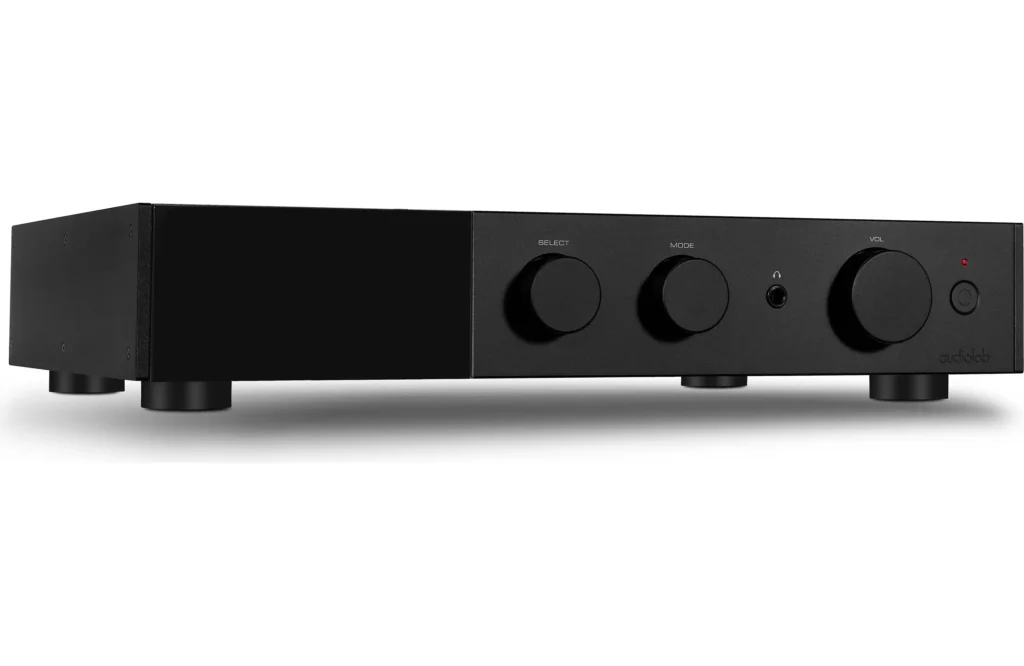
The Audiolab 9000A is a versatile integrated amplifier for a system built around several digital and analogue sources. Its colour display, computer USB input and separable preamp and power sections make it more adaptable than a minimalist amplifier. The main buying question is whether that flexibility and measured approach to presentation outweigh the convenience of an integrated streamer or the stronger subjective drive of some rivals.
Audiolab 9000A — Design and display
The 9000A uses a slim, understated enclosure with a 4.3-inch colour display. That screen provides system information, menu access and optional meter presentations rather than making the amplifier a network music browser. A large display should not be taken as evidence that a streaming service or library is built in. Source selection and volume remain the basic front-panel tasks.
What Hi-Fi’s original review praised the finish, solid casework and precise controls while noting that some graphics were small from across a room. Try the display at the actual viewing distance. A screen that is crisp close up can still be hard to read from a sofa, and an equipment shelf needs enough depth for the amplifier plus its USB, XLR and speaker connections. Leave ventilation clear rather than stacking another component directly over the cooling area.
Amplification and speaker matching
Audiolab specifies Class AB amplification rated at 100 watts per channel into eight ohms and 160 watts into four ohms, with its stated distortion condition. These are manufacturer ratings, not Audio Review measurements. They provide a useful starting point, but the intended loudspeaker, room size and peak listening level determine whether the complete system has comfortable headroom.
A capable amplifier cannot make a small speaker reproduce unlimited deep bass, and a difficult impedance curve can demand more than a nominal speaker rating suggests. Use the exact loudspeaker specification and a realistic audition where possible. Listen for a stable presentation on peaks at the highest level actually needed, rather than using a volume-knob position as a universal measure of power.
Speaker placement and room behaviour remain central. The 9000A does not provide automatic acoustic measurement and correction. Its flexible pre/power arrangement can allow external processing, but that adds equipment and setup work. Consider those needs in the total system budget instead of assuming a premium amplifier automatically resolves a difficult bass resonance or reflective room.
Digital sources and USB audio
Two coaxial and two optical inputs join a proper USB-B computer audio input. The official specification allows supported computer USB PCM rates up to 768 kHz and DSD512, while optical and coaxial accept lower limits. Those capabilities belong to their respective inputs; a maximum figure should not be applied indiscriminately to every connection.
Ordinary recordings do not need to be upsampled to the highest supported rate to justify using the amplifier. Stable output selection, a working data cable and the correct computer setup are the immediate priorities. Use the required supported driver and format settings for the source system, and confirm the amplifier appears as the intended audio device before diagnosing silence as a hardware failure.
A separate USB-A service socket is for updates rather than music storage playback. This distinction prevents confusion with network receivers that play files from a memory stick. The 9000A has a capable internal DAC but no independent network platform: a separate streamer or computer is still needed to browse and deliver network music. Include that component and its preferred app in the ownership plan.
Analogue flexibility and operating modes
Three RCA line inputs, a balanced XLR input and MM phono support a broad analogue system. Balanced connections are useful when the source and installation benefit, but a connector type alone does not establish an audible improvement in a short, quiet domestic system. Connect the source appropriately and compare levels before attributing a change to the cable format.
The phono stage is for moving-magnet use. A low-output moving-coil cartridge needs a suitable external stage, and a turntable with an enabled internal preamp should use a line input. The original What Hi-Fi evaluation found the phono section less dynamically engaging than the line and digital stages, so a vinyl-first buyer should audition that path specifically rather than assuming every input performs identically.
Integrated, Pre and Pre-Power modes allow the two amplifier sections to be used together or separately. The preamp output and direct power input can support an external power amplifier, another preamp or suitable intervening processing. Set gain and operating mode deliberately. The wrong assumption about which component controls volume can produce an unexpectedly high level, particularly when returning from a processor-based arrangement to an ordinary source.
Bluetooth, headphones and television limitations
Bluetooth offers a convenient route from a compatible phone or tablet, with supported codecs including aptX HD and LDAC in the current official list. The transmitting device determines the negotiated format, so not every phone will use the amplifier’s highest-capability option. Bluetooth is useful for convenience, but it does not replace a network streamer with independent service browsing and multiroom control.
The 6.3 mm headphone output is more than a cosmetic addition in the original review evidence. What Hi-Fi found it retained the amplifier’s clear, composed character with the headphones used in that evaluation. Check the intended pair for background noise, level and comfortable adjustment rather than extrapolating universal compatibility from the speaker amplifier’s watt rating.
There is no HDMI return-audio input. A television can use a supported optical PCM route or an appropriate external source arrangement, but it will not gain HDMI switching and control simply by connecting to an optical socket. A household expecting television-remote power and volume integration should evaluate that workflow before selecting the 9000A for a living-room system. Its input flexibility serves music sources more directly than AV convenience.
Sound evidence and value
What Hi-Fi’s original 9000A review described an open, balanced and detailed presentation with convincing control, but found dynamic contrast and rhythmic momentum less involving than some similarly priced rivals. It praised the digital section while being less enthusiastic about phono performance. That nuanced result supports a capable amplifier with specific strengths, rather than an inflated universal recommendation.
The practical audition should therefore ask two questions: does the amplifier reveal enough detail without fatigue, and does it keep familiar music engaging over time? A short demonstration of spaciousness cannot settle the second question. Match levels and include several ordinary tracks, then test the actual input that will be used most. All listening descriptions here refer to the linked original evidence, not a separate Audio Review audition.
The 9000A is strongest for a buyer who values its USB DAC, analogue input range, construction and upgrade flexibility. Current European pricing should be compared with the complete cost of a streamer or external phono stage where needed. An integrated network amplifier may be simpler, while a less feature-rich amplifier may better suit a listener prioritising one source and a particular subjective character. Choose the Audiolab for a system that will use its breadth.
Alternatives to consider
Cambridge Audio CXN100: A separate network source to compare when building a conventional amplifier and streamer system.
Naim Uniti Atom: Consider a complete premium streaming system if fewer components and a unified interface matter more than the Audiolab input range.
Audiolab 9000A key specifications
- Type
- Class AB integrated amplifier
- Rated output
- 100 W/channel at 8 ohms; 160 W/channel at 4 ohms, THD below 1%
- DAC
- ESS ES9038PRO
- Digital
- USB-B audio, two optical and two coaxial
- USB PCM / DSD
- Up to PCM 768 kHz / DSD512 on supported computer setup
- Analogue
- Three RCA line, balanced XLR, MM phono and power input
- Display
- 4.3-inch colour IPS LCD
- Modes
- Integrated, Pre and Pre-Power
Verdict
A polished, highly flexible stereo amplifier with a strong digital section and useful pre/power options. Its lack of streaming and HDMI, together with more restrained original listening impressions, makes system fit and a personal audition important.
Primary documentation and independent reviews
Audiolab official 9000A specifications · What Hi-Fi original 9000A review
Editorial record
Sources and updates
Product specifications and factual claims were checked against Official Audiolab 9000A product page ↗. Scores and buying advice follow our category-specific editorial methodology.
- Published
- November 8, 2026
- Last updated
- November 8, 2026