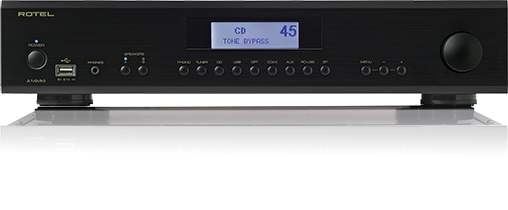
Rotel A14MKII combines traditional Class-AB amplification with a broad DAC and analogue input section. It can accommodate a computer, digital transports, line sources and an appropriate MM turntable, but its Ethernet connection is not a network music input. This research-based review considers positive original listening and laboratory evidence alongside the menu, connection and speaker-output details that determine everyday usefulness. It also keeps the manufacturer’s differently labelled power ratings distinct and treats Roon Tested certification accurately rather than presenting it as built-in network streaming.
Research-based review. This assessment draws on manufacturer documentation and the original published evaluations linked below. Audio Review has not performed a hands-on test of this model.
The original review supports a capable all-round presentation
Australian Hi-Fi’s original review, hosted by What Hi-Fi, is highly positive about the A14MKII’s clean delivery, bass timing and quiet operation across its tested sources. Newport Test Labs also provides separate measurement evidence. The reviewer identifies menu navigation and the small headphone connector as practical reservations. These findings are not tests conducted by Audio Review.
Use that evidence as a reason to audition the amplifier with the speakers that will remain in the room. Check natural voices, complex rhythm and a recording with broad dynamic changes at realistic levels. Compare sources at similar volume rather than attributing every loudness difference to better conversion. A convincing amplifier should remain easy to follow during quiet listening as well as louder passages. Positive bench results help establish competence under specified conditions; they do not predict the whole room and speaker interaction. The A14MKII’s main research case is a balanced combination of conventional system flexibility and confident musical delivery, rather than a specialist feature that every buyer must need.
Ethernet and Roon labels need careful interpretation
The owner manual describes the network connection as a route for software updates and IP control. It is not a built-in service streamer. The product is Roon Tested, which should not be substituted for Roon Ready network endpoint capability.
If the household expects the amplifier itself to appear as a direct music-service destination, plan an appropriate external player or choose a different platform. A control-system Ethernet socket can be valuable in an installation without carrying ordinary music playback. Bluetooth offers a separate convenient route from a compatible device, but still leaves the phone or other source involved. Try the expected daily sequence: start music, change users, stop playback and return from standby. Avoid buying around a port shape or certification badge without understanding the exact signal path. The Rotel can fit a very flexible system when network playback is intentionally external. It is less convenient if the extra source becomes an unexpected purchase after installation.
Computer and digital transports have distinct setup requirements
Optical, coaxial and PC-USB sources are supported, with documented format and USB-mode requirements. The converter’s advertised capability is not a guarantee that every input accepts every format. MQA-related menu options should not be used as a promise about the current catalogue or format of a music service.
Demonstrate the actual computer and playback software, including operating-system device selection and any official driver requirement. Test recovery after sleep and ordinary application switching rather than checking only a short music file. For a television’s optical output, select supported stereo PCM and check synchronisation; the amplifier is not a surround decoder and has no direct HDMI ARC interface. Keep a familiar CD-quality recording in the comparison. High maximum sample rates do not establish better playback of ordinary material by themselves. The best configuration is one that handles the existing collection reliably with understandable volume control. A separate DAC remains a possible preference, but should be compared in the actual system rather than assumed necessary because the amplifier contains several functions.
MM phono, pre-outs and A/B speakers expand its practical role
Line inputs and MM phono cover familiar analogue sources. The manual also describes variable preamplifier output and switchable A/B speaker connections. Those connections broaden installation choices without creating independent music sources or an automatic bass-management system.
Check the cartridge’s requirements and the turntable’s output setting before choosing the phono or line route. For an active subwoofer, confirm suitable inputs and manual crossover control rather than assuming that the main speakers will be high-pass filtered. Follow the documented impedance requirements when operating two speaker pairs together. The load seen by an amplifier changes when speakers are used simultaneously, and a second set of binding posts does not double the available independent amplifier channels. If another room must play different music or have separate volume, a different multiroom arrangement may be required. The A14MKII is versatile when these output roles are understood. Treating every extra connector as a separate zone would make the specification appear more capable than the actual stereo architecture.
Menus and installation deserve a hands-on demonstration
The original review finds the setup navigation less intuitive than the amplifier’s ordinary use. Tone and balance settings, display behaviour and source configuration are useful facilities, but the owner needs to understand them. A display and remote do not automatically make every menu task quick.
Ask for a demonstration of source selection, fine volume changes, standby behaviour and restoration of a normal listening setup. Check any fixed-gain configuration deliberately, especially if an external processor is involved. Leave rear clearance for plugs and enough ventilation for Class-AB amplification. The relatively low chassis is still a full-width hi-fi component rather than a small sealed desktop accessory. Try the actual headphones and any necessary adapter, checking usable level and noise independently of the speaker result. Another household member should be able to use the usual source without revisiting the full settings menu. The best ownership experience comes from a sensible initial configuration followed by straightforward daily operation, not from changing every available option simply because it exists.
Current power labels and complete cost make a fairer comparison
Rotel now separately lists eighty watts continuous into eight ohms under its non-FTC specification, a ninety-two-watt eight-ohm FTC figure and a differently described four-ohm maximum. Keep those labels attached when comparing another product’s output claims.
Select speakers and required listening headroom as a system rather than using the largest number as a ranking. Compare actual local offers with the external streamer, television route and any additional phono or subwoofer equipment included. Check regional mains suitability, remote, accessories and current support on a used or demonstration example. A buyer with several conventional sources may gain more from the Rotel’s input range than someone who uses only a phone service and television. Conversely, a network integrated amplifier can reduce boxes when its software and HDMI behaviour fit the household. The A14MKII’s value is strongest when its traditional source flexibility, computer audio and documented musical competence solve the real installation. It should not be selected as a substitute for network facilities that are absent.
Alternatives to consider
Audiolab 9000A: Compare digital handling, physical operation and the exact analogue source needs with the intended speakers. Use current complete offers rather than the hierarchy of launch prices.
NAD C 389: Consider a different integrated platform when HDMI or optional network and room-adjustment facilities are important. Include the required modules and licences in the comparison.
Rotel A14MKII key specifications
- Role
- Class-AB integrated amplifier-DAC
- Power, non-FTC
- 80 W/channel continuous into 8 ohms; 150 W/channel maximum into 4 ohms
- Power, FTC listing
- 92 W/channel into 8 ohms; separate specification
- Analogue sources
- RCA line inputs and MM phono
- Digital sources
- Optical, coaxial and PC-USB
- Bluetooth
- aptX and AAC reception
- Certification
- Roon Tested, not native Roon Ready streaming
- Ethernet
- IP control and updates; no native network music player
- Outputs
- Speaker A/B; variable RCA pre-out; front 3.5 mm headphones
- HDMI / room correction
- Not built in
- Dimensions / weight
- Approximately 430 × 93 × 345 mm; 8.94 kg
Verdict
The A14MKII is a well-supported research-based choice for a varied conventional stereo system. Its source range and positive original evidence are substantial strengths. Keep Ethernet, Roon certification and A/B outputs within their actual roles, demonstrate the menus and compare complete current systems. Accurate expectations make its broad connectivity more useful than an inflated feature list.
Documentation and original reviews
Rotel official A14MKII current specification · Rotel official A14MKII owner manual · Australian Hi-Fi original A14 MkII review and Newport Test Labs report
Editorial record
Sources and updates
Product specifications and factual claims were checked against Official Rotel A14MKII product page ↗. Scores and buying advice follow our category-specific editorial methodology.
- Published
- November 17, 2026
- Last updated
- November 17, 2026