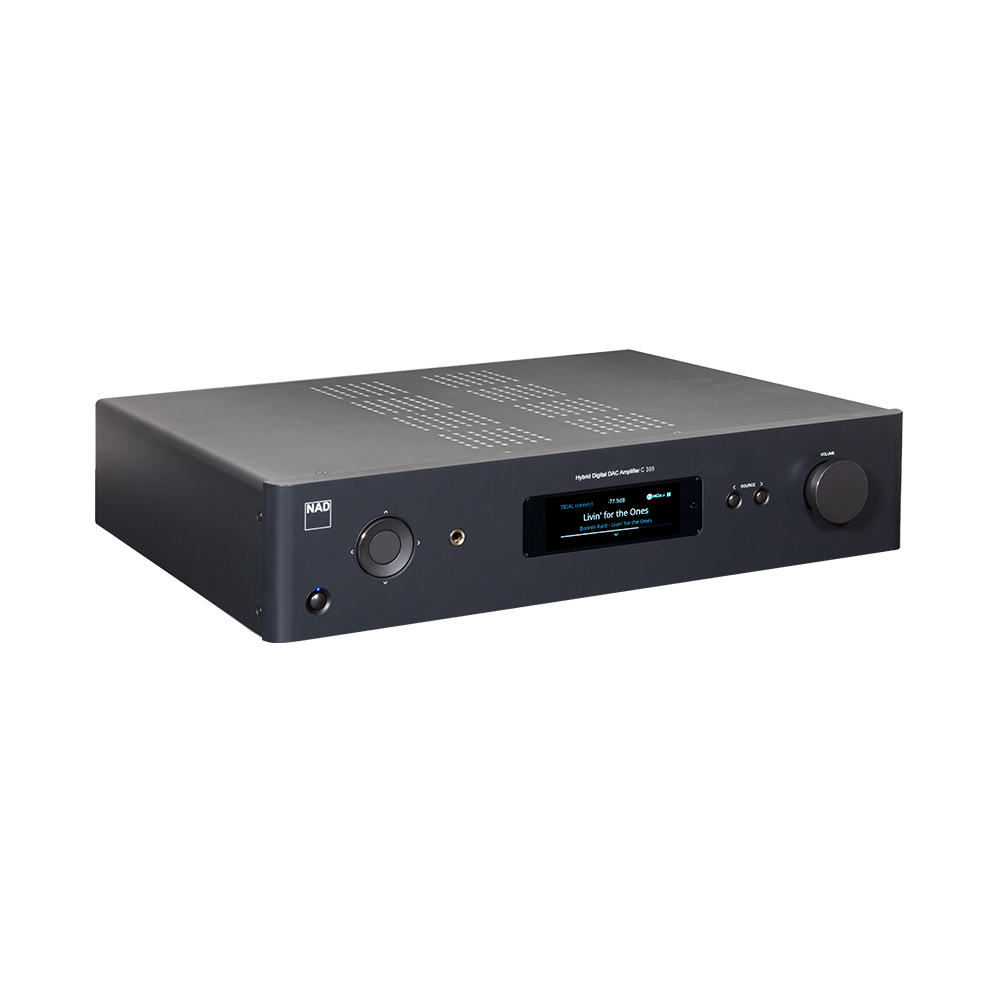
The NAD C 389 is a conventional-looking stereo amplifier with a broad modern source brief. It can accommodate vinyl, television and wired digital sources before any streaming module is added. Its optional MDC2 BluOS-D route then changes it from a capable integrated amplifier into a more complete network and room-correction system.
NAD C 389 — Design and the everyday control experience
The C 389 favours a practical front panel over a large artwork display or retro styling. That can be useful in a system where the amplifier’s job is to select sources and control volume while a separate device supplies the music interface. It is a full-width component, so the purchase should start with shelf space and cable access rather than an assumption that class-D amplification means a tiny enclosure.
Allow enough depth for the speaker and source connections, and leave ventilation clear. Think about whether the owner will operate the front panel regularly or mostly use a remote. A less decorative component can be a positive choice when reliability of routine matters more than display impact. It also leaves the loudspeakers and sources as the visible focus of the system. The C 389’s appeal is how many useful tasks it can cover without demanding that every task happen through a touchscreen.
Power and matching the room
The official continuous output rating is 130 W per channel into 8 and 4 ohms, with the specified distortion conditions. This is a manufacturer rating rather than an Audio Review measurement. It provides a meaningful starting point for a stereo system, but it is not a guarantee for every speaker. Sensitivity, impedance variation, listening distance and the level required by the owner still determine how much headroom is useful.
A larger power number should not be the sole reason to move up from another competent amplifier. If the room is small and the speakers efficient, the extra capability may be rarely used. Conversely, a low-sensitivity speaker in a large room can justify a more deliberate choice. Include the intended recordings and any EQ in the matching decision. Bass boosts can demand much more from both amplifier and speaker than a flat setting at the same apparent loudness.
Before making electrical changes, spend time on speaker position. Moving a loudspeaker away from a boundary or adjusting the listening seat can address balance more effectively than exchanging an amplifier. The C 389 offers a useful foundation, but the final system remains a partnership between electronics, transducers and room.
Sources: a useful mixture
The documented connection set includes two ordinary analogue line inputs, MM phono, two optical and two coaxial inputs, and HDMI eARC. That makes it unusually adaptable for a household mixing records and television with digital music. The phono stage is for moving-magnet cartridges. A low-output moving-coil cartridge needs appropriate matching elsewhere, while a turntable already delivering line level should enter a normal line input.
HDMI gives a suitable television a more natural connection and control route than treating TV audio as another manually selected optical source. Check the television’s return-audio socket, supported output format and volume behaviour during setup. This remains a two-channel amplifier, so HDMI should not be mistaken for a promise of multichannel decoding and height-speaker processing.
Bluetooth is available for convenient wireless use, but a supported codec still depends on both devices. The C 389’s core Bluetooth function is distinct from adding a network streaming platform. If the owner wants music-service browsing, shared-room playback and library access through BluOS, that is a separate configuration choice. The difference is central to understanding the complete cost.
MDC2, BluOS and what Dirac includes
Two MDC2 slots provide the route for compatible expansion. The optional BluOS-D module adds high-resolution network playback and Dirac Live Limited Bandwidth correction. NAD specifies correction up to 500 Hz with that licence and offers full-bandwidth correction as a paid upgrade. A module-equipped review sample should not be treated as proof that every base C 389 arrives with those functions.
The room-correction option is potentially more useful than a sequence of small electronics changes when room-induced bass imbalance is the problem. However, it needs careful measurements and a sensible target rather than blind faith in an automatic result. Establish reasonable speaker and subwoofer placement first. Compare the resulting filter with bypass at similar levels and resist making large low-frequency boosts that exceed the speakers’ useful range.
Do not assume that the presence of Dirac Live includes every other Dirac product. NAD’s current support matrix separates Limited Bandwidth, Full Bandwidth and Bass Control eligibility. The C 389 module package should be evaluated for the functions it actually provides. That clarity prevents optional licences and hardware from appearing as unexpected costs after the amplifier is already installed.
Sound quality and the original assessment
Hi-Fi Voice’s original C 389 evaluation found a full-bodied, substantial presentation with an enjoyable sense of authority, while also describing the bass as heavier than a strictly neutral balance. That is a useful matching perspective, particularly for a listener with small speakers or a room that already emphasises the lower registers. It is a subjective system observation, not a measured response claim or our own listening test.
The implication is to compare with the intended loudspeakers rather than choose from a brand reputation alone. A rich balance can be satisfying in one system and excessive in another. Use familiar recordings, keep the level matched and assess whether voices remain clear when arrangements become busy. A short burst of impressive bass should not outweigh long-term comfort and intelligibility.
The original review used particular source and speaker combinations, and a BluOS/Dirac-equipped system can behave differently once correction is applied. Identify the configuration being auditioned. If the purpose is to compare amplifier character, keep processing consistent; if the purpose is to choose the best complete system, include the functions that will actually be used at home. Those are different comparisons and should not be confused.
Subwoofers, private listening and value
Dual subwoofer connections, preamp outputs and a headphone stage broaden the C 389’s role. Two sockets alone do not establish every form of independent subwoofer optimisation, so plan the control and calibration arrangement explicitly. The useful outcome is a smooth blend with the main speakers at the listening position. Start with a sensible crossover and modest level rather than turning the subwoofer up until it dominates familiar music.
The C 389 is easiest to justify when several of its core inputs are used and the optional streaming path offers a real future or immediate benefit. Compare current European prices for the base amplifier and the complete module-equipped package. A separate streamer may already be available, while a new system may be simpler with BluOS integrated. Someone needing only one network source and moderate speaker power should also consider a smaller all-in-one. The NAD’s value comes from flexibility and appropriate drive, not from filling every connection on the rear panel.
Alternatives to consider
NAD C 700 V2: Consider the more compact integrated streaming route if a screen and included network playback matter more than the C 389’s expansion structure.
Bluesound POWERNODE (2025): A useful comparison for a system built around the BluOS ecosystem and fewer separate components.
NAD C 389 key specifications
- Type
- Stereo integrated DAC amplifier
- Continuous output
- 130 W/channel into 8 and 4 ohms
- Analogue sources
- Two line inputs and MM phono
- Digital sources
- Two optical, two coaxial and HDMI eARC
- Expansion
- Two MDC2 slots
- Streaming / Dirac
- Optional MDC2 BluOS-D; Limited Bandwidth up to 500 Hz
- Other outputs
- Headphone, preamp and dual subwoofer connections
Verdict
A versatile stereo foundation for television, records and digital sources, with useful optional BluOS and room correction. Its broad connectivity is a strength, while the complete module price, licence limits and a speaker-room match for the rich presentation in the cited review deserve careful attention.
Primary documentation and independent reviews
NAD official C 389 specifications · NAD current Dirac support and licence scope · Hi-Fi Voice original C 389 listening review
Editorial record
Sources and updates
Product specifications and factual claims were checked against Official NAD C 389 product page ↗. Scores and buying advice follow our category-specific editorial methodology.
- Published
- November 8, 2026
- Last updated
- November 8, 2026