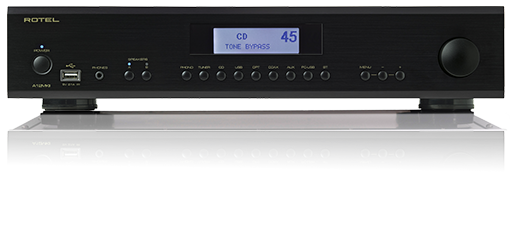
Rotel A12MKII sits between a traditional analogue integrated amplifier and a modern network system. It supplies useful computer USB, optical and coaxial conversion alongside moving-magnet phono and ordinary line inputs, but network music remains an external-source task. This research-based review considers the strong original listening evidence for dynamics and detail while clarifying current Bluetooth documentation, USB configuration and subwoofer integration. Those practical distinctions matter more than assuming that every MKII model or every USB socket performs the same job.
Research-based review. This assessment draws on manufacturer documentation and the original published evaluations linked below. Audio Review has not performed a hands-on test of this model.
Original evidence supports control as well as detail
Dennis Burger’s SoundStage Access evaluation is strongly positive about the A12MKII’s bass authority, dynamics, imaging and preservation of recorded detail. It also notes that the presentation does not conceal recording imperfections and that the amplifier can become warm during demanding use. Those are findings from the reviewer’s system, not Audio Review listening results.
For a buyer, the useful question is whether that directness remains enjoyable with the actual speakers and music collection. Include a rougher favourite recording rather than relying entirely on polished demonstration material. Compare a dynamic acoustic performance with rhythm-led music at matched levels. Follow the organisation of bass and the stability of voices, not just the first impression of energy. A clear amplifier can be satisfying without flattering every mix, while a listener seeking a consistently softened presentation may choose differently. The original evidence supports a serious audition, particularly when computer playback and conventional hi-fi sources need the same competent speaker amplifier.
PC-USB is a real source route with configuration requirements
The A12MKII provides a computer USB connection in addition to optical and coaxial inputs. Rotel documents separate USB Audio Class modes and operating-system or driver requirements. Its current specification should take priority over an older review’s abbreviated maximum-format description.
Connect the actual computer and test normal playback, application switching and recovery from sleep. Verify the selected device and mode in the operating system instead of assuming a cable alone selects the intended route. Install only the appropriate official driver when required. A higher maximum sampling rate is not a reason to force all music through unnecessary conversion or buy different files. The important result is reliable playback of the collection already used. Keep USB roles distinct: a front device connection and a rear computer input need not support identical devices or file-reading behaviour. Demonstrate the precise source rather than inferring compatibility from connector shape. That prevents a feature-rich specification from hiding an inconvenient daily computer routine.
Current Bluetooth documentation differs from an early review
The current owner manual lists AAC and aptX alongside traditional Bluetooth. The original SoundStage review reported an absence of AAC on its tested configuration. The draft therefore follows current official documentation for the supported list without claiming that Audio Review has verified every hardware or firmware revision.
Try the intended phone and confirm ordinary pairing and reconnection. Codec negotiation depends on both devices, so aptX support on the amplifier does not make every phone use it. Check whether the household needs casual wireless playback or a source that plays independently of the phone. Bluetooth can fulfil the first job; it is not a built-in network streamer. Roon Tested certification similarly should not be interpreted as Roon Ready network endpoint capability. If direct service playback or whole-home grouping is a priority, price an appropriate external source or compare a network integrated amplifier. A short practical demonstration provides more useful buying evidence than arguing from an old codec summary alone.
MM vinyl and preamp output broaden the traditional system
Four line inputs and a moving-magnet phono stage accommodate conventional sources. The variable stereo preamplifier output can feed suitable additional equipment, but the A12MKII does not provide automatic bass management or a dedicated crossover arrangement for an added subwoofer.
Match the cartridge to the phono stage and use line level when a turntable’s internal stage remains enabled. For a subwoofer, confirm suitable inputs and controls, then plan crossover, level and placement rather than assuming the amplifier will redirect bass automatically. A variable pre-out can be useful without changing what reaches the main speakers. Check the manual’s permitted speaker loads before using both A and B outputs together. Two output sets do not mean two independent source zones. Those distinctions are easy to overlook in a feature list but make a large difference to system planning. The Rotel is versatile within a conventional stereo arrangement, provided each connection is assigned its actual role.
Menus, heat and remote behaviour should be demonstrated
The original review notes some navigational quirks and a crowded rear connection area. Rotel provides setup options including tone control, source-related settings and power behaviour. The value of those options depends on setting them intentionally and understanding the resulting daily operation.
Test source changes, fine volume adjustment and standby recovery from the listening seat. Keep fixed-gain configurations deliberate and clearly understood if they are needed for integration with another system. Leave ventilation and connector space around the amplifier, particularly when cable plugs project behind the case. The relatively slim front does not remove the heat generated by Class-AB amplification. Assess the actual headphones for useful level and noise rather than assuming the speaker result transfers unchanged to private listening. Once setup is complete, another household member should be able to restore the normal source and volume without searching the menu. A traditional remote and clear display can be reassuring when the system is configured around that ordinary routine.
Compare the correct power regime and complete price
Rotel’s current page separately identifies a sixty-watt continuous eight-ohm non-FTC figure and a seventy-five-watt eight-ohm FTC listing. Its four-ohm maximum figure has different conditions again. These should remain labelled rather than being combined into one supposedly universal output claim.
Speaker choice, listening distance and required headroom still determine the practical match. Audition a difficult or high-level combination instead of relying on the name of the series. Compare current local offers with the necessary external streamer, television connection and phono equipment included. The A12MKII is especially useful when a computer is already the main source and the buyer wants its DAC and speaker amplification in one conventional component. Someone whose household mostly uses television ARC and direct streaming may find a different integrated platform simpler. Confirm regional mains, accessories and support for a used example. Its strongest value argument is an accurately matched source system with positive musical evidence, not simply a long list of inputs at an attractive old review price.
Alternatives to consider
Cambridge Audio CXA81 Mk II: Compare computer input, analogue requirements and speaker presentation at current complete-system prices. Include a phono stage where the chosen alternative requires one.
Audiolab 6000A MkII: Consider its source and control arrangement if a different integrated format better suits the room. Confirm the exact generation and every required connection.
Rotel A12MKII key specifications
- Role
- Class-AB integrated stereo amplifier-DAC
- Power, non-FTC
- 60 W/channel continuous into 8 ohms; 120 W/channel maximum into 4 ohms
- Power, FTC listing
- 75 W/channel into 8 ohms; separate specification
- Analogue inputs
- Four RCA line inputs and MM phono
- Digital inputs
- Two optical and two coaxial; PC-USB
- USB modes
- Audio Class 1 and Class 2; current documentation and OS requirements apply
- Bluetooth
- Current manual lists traditional Bluetooth, AAC and aptX
- Outputs
- Speaker A/B; variable stereo RCA pre-out; front 3.5 mm headphones
- Bass management
- No dedicated automatic crossover system
- Network / HDMI
- No native network player or HDMI
- Dimensions / weight
- Approximately 430 × 93 × 345 mm; 8.76 kg
Verdict
The A12MKII is a strong research-based option for a computer, vinyl and conventional digital stereo system. Original evidence supports its dynamic control and detail, while USB setup, current Bluetooth configuration and subwoofer planning deserve attention. Compare the complete source arrangement and actual speakers. It is most convincing when its real connectivity is useful every day.
Documentation and original reviews
Rotel official A12MKII current specification · Rotel official current A12MKII owner manual · SoundStage Access original A12MKII evaluation by Dennis Burger
Editorial record
Sources and updates
Product specifications and factual claims were checked against Official Rotel A12MKII product page ↗. Scores and buying advice follow our category-specific editorial methodology.
- Published
- November 17, 2026
- Last updated
- November 17, 2026