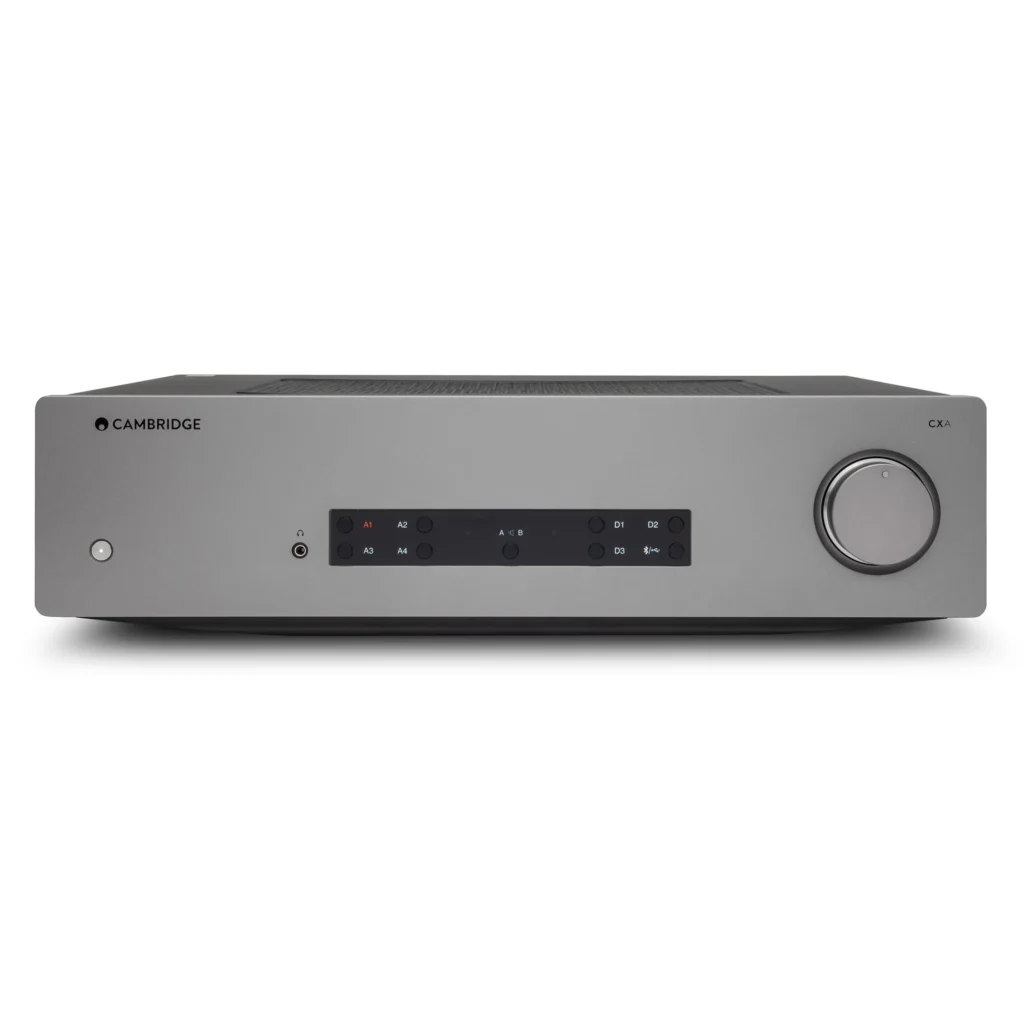
The Cambridge Audio CXA81 Mk II is a stereo integrated amplifier with analogue and digital inputs, Bluetooth receiving and a deliberately conventional control layout. It can form the centre of a substantial two-speaker system, but it is not a network streamer. This review covers the Mk II and keeps its evidence separate from the much-praised original CXA81.
Cambridge Audio CXA81 Mk II — Design and the role in a stereo system
The CXA81 Mk II follows a familiar full-width hi-fi format, with source selection and a prominent volume control rather than a large touchscreen. That makes sense when an amplifier is expected to remain useful as sources change around it. A CD player, streamer and analogue source can each have their own role, while the amplifier continues to select and drive the loudspeakers. Its appeal is a stable centre for separates rather than a self-contained app-based music system.
Give the case enough ventilation and allow for speaker cable and interconnect bends behind it. An amplifier may fit a shelf by its dimensions while still lacking usable space for plugs. The supplied remote makes armchair listening practical, but source applications remain on the source device. Someone expecting the amplifier’s front panel to browse a streaming library will need a different product or a separate network player with an appropriate interface.
Power and loudspeaker matching
Cambridge specifies continuous output of 80 W RMS into 8 ohms and 120 W RMS into 4 ohms. These are manufacturer ratings, not Audio Review measurements. They indicate useful capability for a conventional stereo system, but do not make every loudspeaker an appropriate partner. Sensitivity, impedance behaviour, listening distance and desired level all affect the demand placed on an amplifier. A compact speaker can be harder to drive than a much larger efficient one.
Choose the speakers for the room and intended use, then assess amplification needs. In a smaller room at moderate levels, an extreme output figure may matter less than good placement and an appropriate listening distance. A larger room or a low-sensitivity speaker calls for more deliberate matching. If bass EQ is added at the source, remember that boosts use amplifier and speaker headroom. Raising the volume to overcome an awkward room response is rarely a substitute for addressing placement.
The two speaker-output sets offer connection flexibility, not independent music zones with separate programme and volume. If using two pairs together, follow the manual’s load requirements. Do not infer that more terminals mean the amplifier can drive any combination of speakers without regard to the combined impedance.
Analogue and digital sources
The official documentation includes RCA and balanced XLR line inputs alongside USB audio, optical, coaxial and Bluetooth. That is a useful spread for a separates system. A compatible streamer can connect through analogue outputs or send digital audio to the amplifier’s DAC. A computer can use USB, while an optical connection can serve suitable television audio. There is no need to use the most complicated route if a direct connection already solves the problem.
The CXA81 Mk II does not include a phono stage. A turntable therefore needs a suitable external phono amplifier or a built-in stage operating at line level. Do not connect a raw cartridge output and expect a normal line input to provide the missing gain and equalisation. The balanced input is similarly a line-level connection, not a microphone socket. Choosing the source path correctly matters more than whether the cable happens to fit.
Roon Tested status describes compatibility in an appropriate source arrangement; it does not turn the amplifier into an independent network endpoint. USB audio expects a compatible host, not a hard drive full of music plugged directly into the socket. Buyers who want music without a computer or phone supplying the programme should include a separate streamer in the system plan.
Sound quality and the Mk II review evidence
What Hi-Fi’s original Mk II review praised its scale, clarity and authoritative presentation, but preferred the Arcam A15 used for comparison for rhythmic organisation and expression. That is a more balanced picture than assuming the successor inherits every accolade of the original CXA81. It supports a positive assessment with a clear reason to compare alternatives, rather than declaring an automatic class winner.
Those findings are subjective listening observations from that review’s system. They do not mean every speaker will create an identical ranking or that the amplifier has a measured rhythmic defect. For a buyer, the useful implication is to compare familiar music through the intended speakers at similar levels. Include something rhythmically busy, something intimate and a recording with large dynamic changes. A powerful first impression is worthwhile only if it remains involving and comfortable over longer listening.
The built-in DAC is useful for reducing the number of boxes, but a different chip is not by itself a reason to replace a working earlier amplifier. Identify the improvement you need, whether that is source access, appropriate drive or a more convenient arrangement. If the current amplifier already performs those jobs well, speakers and room setup may deserve attention before another amplifier purchase.
Television and subwoofer integration
A television can connect through a compatible optical or coaxial stereo PCM path. There is no HDMI ARC or eARC input, so it does not provide the same control integration as an HDMI-equipped stereo amplifier. Confirm the TV’s output and the expected volume-control routine before buying. A system that plays television sound correctly can still be less convenient if several remotes are needed.
The manual provides preamp and subwoofer outputs, but the sub output is not a complete automatic bass-management system. Set the active subwoofer’s crossover and level appropriately, then assess the blend at the listening position. Simply connecting a sub does not establish a smooth transition or remove the main speakers’ room interactions. Start with placement and a modest level rather than trying to make the additional bass obvious on every recording. The goal is coherent extension, not a separate bass source that calls attention to itself.
Value and who should shortlist it
The CXA81 Mk II suits someone who wants an enduring amplifier with broad source connections and is comfortable choosing a separate streamer when needed. Bluetooth is convenient for occasional sending from a phone, but source codec support still determines the actual wireless link. It should not be confused with a full streaming platform or a reason to ignore the quality and usability of the source device.
Compare current European prices with all required components included. An amplifier plus network player may cost more than a streaming integrated alternative, but offers flexibility when one source becomes outdated. The right choice depends on whether that modularity is useful to the owner. Given the mixed competitive judgement in the cited Mk II review, auditioning a serious alternative is sensible. The Cambridge remains a capable, well-connected option whose traditional approach should match the buyer’s routine before its specification becomes the deciding factor.
Alternatives to consider
Cambridge Audio CXN100: A separate network source to consider alongside a traditional amplifier. It adds streaming rather than replacing the CXA’s speaker power stage.
WiiM Amp Ultra: A different integrated streaming route when app-based playback and fewer separate components are priorities.
Cambridge Audio CXA81 Mk II key specifications
- Type
- Stereo integrated amplifier
- Rated continuous output
- 80 W RMS/channel at 8 ohms; 120 W RMS/channel at 4 ohms
- Analogue inputs
- RCA and balanced XLR line
- Digital inputs
- USB audio, optical and coaxial
- Wireless
- Bluetooth receiving; not network streaming
- Other outputs
- Headphone, preamp and subwoofer
- Phono / HDMI
- Not included
Verdict
A capable traditional integrated amplifier with useful analogue and digital connections and convincing scale in the cited review. Its lack of network streaming, phono and HDMI makes system planning important, and the Mk II deserves comparison with rivals rather than relying on its predecessor’s reputation.
Primary documentation and independent reviews
Cambridge Audio official CXA81 Mk II information · Cambridge Audio shared CXA manual, Mk II entries · What Hi-Fi original CXA81 Mk II review
Editorial record
Sources and updates
Product specifications and factual claims were checked against Official Cambridge Audio CXA81 Mk II product page ↗. Scores and buying advice follow our category-specific editorial methodology.
- Published
- November 8, 2026
- Last updated
- November 8, 2026