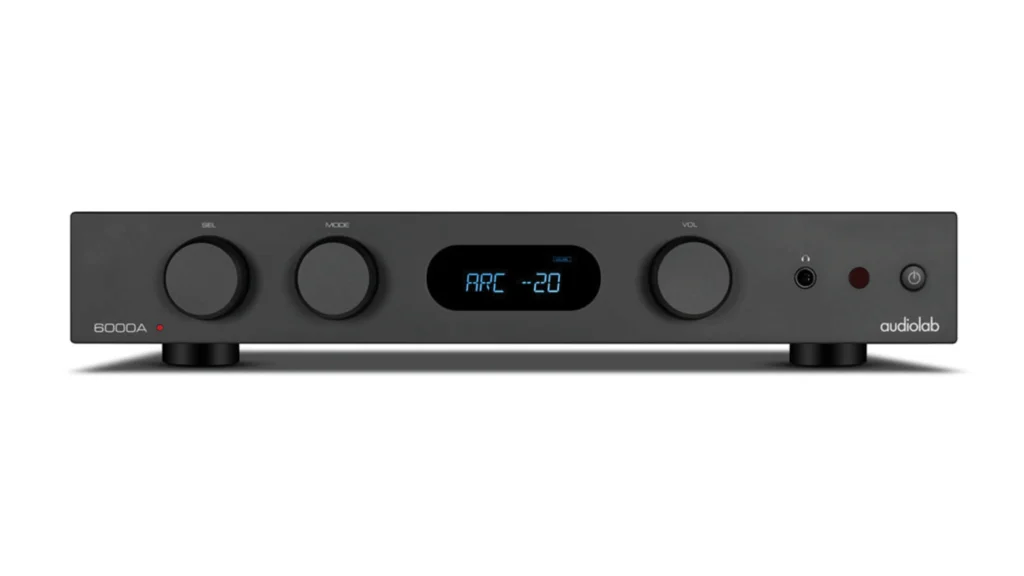
The Audiolab 6000A MkII updates a familiar integrated-amplifier formula with HDMI ARC and revised digital circuitry. It remains a conventional stereo component rather than an all-in-one network streamer. That combination is useful for a listener who wants records, an external music source and television through the same speakers, with room to change the source system later.
Audiolab 6000A MkII — What changes with the MkII
This is the 6000A MkII, not the original 6000A and not the 6000A Play. The names are close enough to create confusion in discounted listings, but their source functions differ. Confirm the exact model before assuming HDMI or network playback is included. The MkII adds television return audio while still requiring an external device for independent network streaming.
The restrained casework and physical controls will suit buyers who prefer a traditional component stack. It is not built around a large colour screen or album-art interface. AVForums praised the build and appearance in its original test. The practical attraction is a source arrangement that can be operated directly and expanded, although a separate streamer still needs space, cabling and its own control routine.
Power and speaker requirements
Audiolab specifies 50 watts per channel into eight ohms and 75 watts into four ohms, using Class AB amplification. The MkII’s power-supply changes should not be simplified into an invented increase in the basic advertised output rating. Nor does the manufacturer’s peak-current figure mean that any loudspeaker load is automatically suitable.
For a modest room with appropriate speakers, the rating can be sufficient. Larger spaces, lower sensitivity and high listening levels increase the need for headroom. Judge the complete system with its realistic demands rather than assuming a 50-watt amplifier is either inherently inadequate or universally enough. A well-chosen speaker can make a greater practical difference than chasing a slightly larger number on another specification sheet.
Give the amplifier ventilation and assess bass control with the speakers in a sensible position. If the room strongly reinforces one note, a change of amplifier may not fix it. The 6000A MkII does not supply automatic room measurement. Budget and placement should therefore account for the environment as well as the component’s electronics, particularly if a subwoofer will eventually be added.
Digital sources and the DAC
The revised digital section uses an ESS ES9038Q2M converter. Two optical and two coaxial inputs accept supported PCM sources up to 192 kHz. That input limit is distinct from a DAC chip’s theoretical processing capability: the manufacturer discussing a high-capability chip does not mean every file format or sample rate can enter through every socket.
There is no computer USB audio input. A service or update facility should not be described as a laptop DAC connection. An external streamer with optical or coaxial output is a straightforward partner, while a USB-only computer source needs a suitable interface or external DAC. Establish that path before choosing a cable. A cable cannot create an audio interface that the amplifier does not have.
Bluetooth with aptX and aptX HD provides a convenient wireless option where supported by the sending device. It does not make the amplifier a Wi-Fi streamer, and an iPhone or another source cannot be assumed to negotiate a codec it lacks. Use Bluetooth for the convenience it offers, while choosing an external network platform on the basis of actual service support and browsing preference.
HDMI ARC and television control
HDMI ARC is the MkII’s most important everyday addition. It allows a compatible television to share the main stereo speakers and can simplify volume and power control. Audiolab’s official specification calls it ARC; broader eARC wording in a review should not override that documented description. This remains a stereo audio input, not an HDMI video-switching bank or multichannel decoder.
AVForums reported a temporary communication failure with its LG B8 during the original 2025 test, resolved by reconnecting the cable. The reviewer also noted that CEC needed enabling in the amplifier. That is a specific historical test result, not proof that every current unit or firmware version is unstable. It does justify trying the actual television, including waking from standby and switching between TV apps and external sources.
Use the television’s compatible stereo output setting and check audio delay with ordinary speech. A system that plays one demonstration track has not necessarily passed the daily-use test. If TV reliability is the main purchasing criterion, compare the complete control experience with alternatives before deciding that the presence of an ARC socket alone guarantees the easiest installation.
Vinyl, headphones and operating modes
The MM phono input covers a suitable moving-magnet cartridge. A turntable with an enabled internal preamp already supplies line level and should use an ordinary line input. Low-output moving-coil cartridges require an appropriate stage elsewhere. These distinctions should be settled before blaming an unexpectedly loud, quiet or tonally wrong result on the amplifier.
A dedicated front headphone output is useful for private listening. Evaluate it with the intended headphones rather than inferring its drive capability from the speaker power rating. A quiet background, usable volume range and comfortable listening level are more useful checks than the presence of a large jack by itself.
Integrated, preamplifier and separated pre/power modes make the 6000A MkII unusually adaptable. The preamp output and power input can support another amplifier or appropriate processing between stages. This flexibility also requires understanding which component controls volume. Configure the ordinary system at low level before using a mode in which an external device determines gain, and document the arrangement if others will operate it.
Sound evidence and value
AVForums’ original evaluation found consistently good sound across the input set, strong construction and an attractive balance of performance and facilities. It also found some rivals more immediately engaging. That supports a high all-round assessment without turning the product into an automatic winner for every musical preference. Its listening and HDMI observations belong to that original test, rather than an Audio Review hands-on session.
A useful audition should include the source that will dominate ownership. If the amplifier is mainly for television and streamed music, do not choose it solely from a vinyl demonstration. If records matter most, compare a familiar cartridge and album. Match levels against alternatives and listen through complete songs to assess tonal comfort and musical continuity.
The MkII is strongest when its included phono stage, DAC and television input replace extra boxes while an external streamer remains a deliberate choice. Compare current European prices with that complete system included. A compact streaming amplifier can reduce box count, while the Audiolab offers more conventional source flexibility and expansion. Its value comes from that fit, with the absence of USB audio and built-in network playback clearly understood.
Alternatives to consider
WiiM Pro Plus: A separate network source for an amplifier-led system; it requires an amplifier and speakers.
WiiM Amp Pro: Compare a smaller complete streaming amplifier if fewer boxes matter more than conventional input and operating-mode flexibility.
Audiolab 6000A MkII key specifications
- Version
- 6000A MkII
- Amplification
- Class AB; 50 W/channel at 8 ohms, 75 W/channel at 4 ohms
- DAC
- ESS ES9038Q2M
- Digital inputs
- Two optical, two coaxial and HDMI ARC
- S/PDIF PCM support
- Up to 192 kHz
- Analogue
- Three line inputs, MM phono and power input
- Wireless
- Bluetooth 5.1 with aptX / aptX HD; no network streamer
- Modes
- Integrated, Pre and Pre-Power
Verdict
A capable and well-built update with useful television integration and flexible pre/power operation. It is a strong conventional-system choice, provided an external streaming source is planned and ARC behaviour is checked with the intended television.
Primary documentation and independent reviews
Audiolab official 6000A MkII specifications · AVForums original 6000A MkII review
Editorial record
Sources and updates
Product specifications and factual claims were checked against Official Audiolab 6000A MkII product page ↗. Scores and buying advice follow our category-specific editorial methodology.
- Published
- November 8, 2026
- Last updated
- November 8, 2026