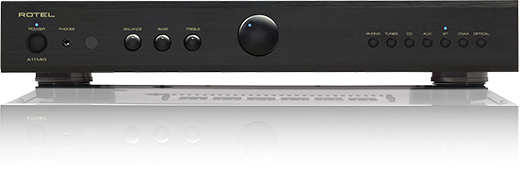
Rotel A11MKII is a traditional stereo integrated amplifier with useful digital connections rather than a full network music system. It combines line inputs, moving-magnet phono, optical and coaxial sources with Bluetooth reception, retaining physical tone and balance controls. This research-based review considers the clear, lively presentation described in original European evaluation and the practical limits of its connectivity. It also separates Rotel’s current FTC and non-FTC power listings, so buyers are not left comparing incompatible headline figures or assuming the DAC chip’s capability applies to every input.
Research-based review. This assessment draws on manufacturer documentation and the original published evaluations linked below. Audio Review has not performed a hands-on test of this model.
Clear and lively rather than deliberately softened
Audio’s original Polish evaluation characterises the A11 MkII as direct, detailed and dynamic, with controlled bass and a comparatively cool, explicit midrange. It does not describe a deliberately thick or softened presentation. Its laboratory work is that publication’s evidence, not testing performed by Audio Review.
That makes careful speaker matching more valuable than assuming the amplifier will add warmth to every recording. Audition familiar voices, brighter productions and a bass line that is easy to follow. Keep levels consistent when switching between alternatives. A more explicit sound can help separate an arrangement, but it should remain comfortable over an evening with the actual loudspeakers. Pay attention to ordinary listening levels, where a demonstration’s initial excitement may matter less than tonal balance and control. Room reflections and placement can change that result substantially. The published evidence supports a confident conventional stereo choice for listeners who appreciate clarity; it does not establish that everyone will prefer its balance over a richer or more relaxed alternative.
The useful inputs are not the same as a streaming platform
Rotel provides three line-level RCA inputs, moving-magnet phono, optical and coaxial digital audio plus Bluetooth reception. It does not provide a native network player, HDMI ARC or a computer USB-DAC connection. The service connector should not be treated as an extra music input.
Map the real sources before buying. A CD transport can use a suitable digital connection, while an existing streamer with analogue or compatible digital output can handle network services independently. That modular approach is useful when the buyer prefers to replace the streamer without replacing amplification. It is less economical if the apparent one-box price excludes a source that is essential from day one. Television can use a compatible stereo optical route, but remote-volume behaviour and lip synchronisation need checking. Do not assume an HDMI-style control experience. Include the required sources, cables and control routine in the comparison with an integrated streaming alternative. The A11MKII is straightforward when its limited digital provision is exactly what the system needs.
Bluetooth codecs and digital sample rates need realistic expectations
The current official documentation supports aptX HD and AAC Bluetooth. The wired optical and coaxial inputs accept PCM up to their documented limit, while the advertised converter capability is not itself an input-format guarantee.
Bluetooth requires a compatible source and negotiated codec. Do not infer aptX HD operation from the amplifier’s badge when the sending phone uses a different codec. Test normal reconnection and whether another household device can take over without confusion. Keep the phone at the usual distance and compare the wireless route with a wired source at similar volume. Convenience may matter more than a high-resolution label during casual listening. For digital transports, set a supported stereo PCM output rather than feeding a movie bitstream and expecting decoding. There is little benefit in spending extra to chase a maximum sampling number if the music collection and daily source already fit comfortably within the connection’s limits. Reliable playback and understandable source selection are more useful ownership features.
Vinyl and physical tone controls suit a traditional system
The moving-magnet input provides a direct route for an appropriate turntable cartridge, while bass, treble and balance adjustment remain available as physical controls. A motorised volume control and supplied remote support operation from the listening position.
Confirm the cartridge and turntable output before connecting. A player with its own enabled line-level stage should use a line input, while a cartridge needing a different phono arrangement requires suitable external equipment. Check hum with a quiet record section and sensible cable placement. For tonal adjustments, begin at neutral and make small changes at the actual listening level. Tone controls can compensate for taste or a particular recording, but they do not replace good speaker placement or cure every room resonance. A buyer who likes direct knobs may find this layout easier than a deep settings menu. Another listener may prefer stored profiles and an app. Treat that difference as part of the ownership decision, not as an automatic measure of audio quality.
Separate the power figures and plan the installation
Rotel’s current page lists fifty watts per channel into eight ohms under its non-FTC specification, with a separate sixty-two-watt FTC listing. Those are differently labelled specifications rather than a reason to silently substitute one number for another. They should not be compared with a rival’s peak claim without its conditions.
Speaker sensitivity, load and listening distance matter alongside output. Demonstrate the intended pair if the room is large or high levels are expected. A slim enclosure still needs the ventilation and cable clearance described in its instructions. Do not fill the shelf around it simply because the front panel looks compact. The headphone connection mutes the speaker output when used; reduce level before changing listening modes and assess the actual headphones for useful volume range and noise. A dedicated headphone circuit is welcome, but its presence does not prove an ideal match with every design. Practical system checks help establish whether the A11MKII has sufficient headroom and the right daily behaviour for the buyer.
Its value depends on the sources already owned
An integrated amplifier with conventional inputs can offer lasting flexibility without depending on a particular music-service application. That advantage is strongest for a buyer who already owns suitable transports or wants network functions in a separate component.
Compare current complete offers, including passive speakers, stands and any streamer or television conversion needed. Check regional mains suitability and the actual warranty arrangement instead of relying on a global web page’s power-supply line. With used or demonstration stock, test controls, remote operation, every intended input and both speaker channels. Do not assume that A11 Tribute, original A11 and A11MKII have identical facilities because their names are close. The MKII’s specific source combination is part of its appeal. If HDMI and direct service playback are essential, a different integrated platform may make more financial and practical sense even at a higher sticker price. The A11MKII is best judged as a capable traditional hub with sensible digital additions, not an incomplete version of a network receiver.
Alternatives to consider
Cambridge Audio AXR100: Compare its tuner, source arrangement and physical operation if a conventional receiver better suits the room. Account for actual speaker demands and local complete-system pricing.
Denon PMA-900HNE: Consider a network integrated platform when direct service playback is more useful than a phone-dependent Bluetooth route. Compare source handling and the ordinary control routine.
Rotel A11MKII key specifications
- Role
- Class-AB integrated stereo amplifier
- Power, non-FTC
- 50 W/channel into 8 ohms; 62 W/channel into 4 ohms
- Power, FTC listing
- 62 W/channel into 8 ohms; separately specified test regime
- Analogue inputs
- Three RCA line inputs; MM phono
- Digital inputs
- Optical and coaxial PCM up to 24-bit/192 kHz
- Wireless
- Bluetooth reception with aptX HD and AAC support
- Headphones
- Front 3.5 mm; insertion mutes speakers
- USB
- Service connection; not computer audio
- Network / HDMI
- Not provided
- Controls
- Analogue volume; bass, treble and balance; remote
- Dimensions / weight
- Approximately 430 × 73 × 347 mm; 6.8 kg
- Speaker outputs
- One stereo set of binding posts. Rear 12 V trigger output for compatible equipment.
Verdict
The A11MKII is a convincing research-based shortlist choice for clear conventional stereo with MM vinyl and basic digital sources. Its Bluetooth and physical controls add practical value, while HDMI, computer USB audio and network streaming remain outside its role. Match the speakers carefully and compare the complete current system. That preserves the appeal of its straightforward design without inventing missing features.
Documentation and original reviews
Rotel official A11MKII product and current power specification · Rotel official A11MKII owner manual · Audio original A11 MkII listening and laboratory review
Editorial record
Sources and updates
Product specifications and factual claims were checked against Official Rotel A11MKII product page ↗. Scores and buying advice follow our category-specific editorial methodology.
- Published
- November 17, 2026
- Last updated
- November 17, 2026