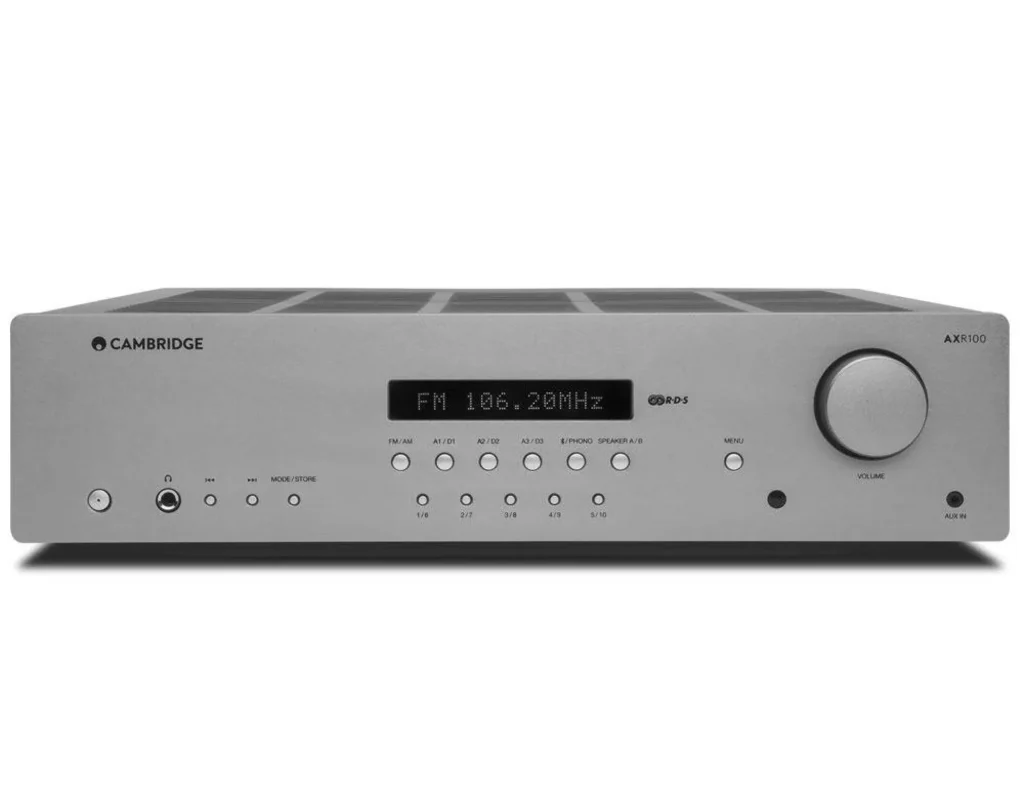
The Cambridge Audio AXR100 is a traditional stereo receiver for listeners who want radio, vinyl and ordinary digital sources in one full-width component. It includes speaker amplification and Bluetooth receiving, but it is not a network music system or a multichannel AV receiver. This review covers AXR100, not the separate AXR100D variant.
Cambridge Audio AXR100 — A receiver for a mixed music collection
The AXR100’s strongest argument is how naturally it fits a collection built over time. Records, a CD source and broadcast radio do not have to be replaced by a phone application to share one pair of speakers. A conventional display, source controls and remote provide a familiar route into listening. That can be more useful than an extensive software platform for someone who mainly wants the equipment to respond predictably.
It is a full-size receiver, so check the shelf depth with speaker cables and power connected. Leave room for ventilation and access to the rear panel. The front labels should also be readable from the intended position; Sound & Vision’s original review found some labelling and remote ergonomics less convenient than the performance itself. That is worth considering in a dim room or for an owner who changes sources frequently. A good amplifier should be comfortable to live with, not simply impressive on its first music demonstration.
Power and choosing speakers
Cambridge quotes 100 W per channel into 8 ohms. That manufacturer figure describes a useful conventional stereo power level, but it is not a guarantee for every loudspeaker or room. Sensitivity, listening distance and the way impedance varies with frequency affect the practical requirement. A speaker’s recommended amplifier range is only part of the matching decision. Think about the actual listening level and room before deciding that a larger wattage alone makes one receiver better.
The two sets of speaker terminals can be convenient for alternative pairs, but they are not separate independently controlled streaming zones. Using multiple pairs also changes the electrical load. Follow the receiver’s documented requirements rather than assuming that every terminal can be filled with an arbitrary loudspeaker. For many owners, one appropriately chosen pair placed well will be more satisfying than two pairs competing in the same room.
Room setup remains a major influence on bass and clarity. Try sensible speaker spacing and distance from walls before making large tone changes or raising the volume. A receiver can provide useful drive, but it cannot make an unsuitable loudspeaker placement disappear. A calm, well-planned two-speaker system is the AXR100’s natural setting.
Vinyl and analogue connections
The built-in phono stage is designed for moving-magnet cartridges. That is a useful inclusion for an appropriate turntable, but it should not be described as universal support for every cartridge. A low-output moving-coil model generally needs a suitable separate stage or other matching solution. Check the cartridge and output configuration rather than assuming that every RCA turntable lead belongs in the phono input.
If the turntable already has its phono stage switched on, use a normal line input. Passing an already equalised line-level signal through another phono stage is the wrong route. Conversely, a raw cartridge signal needs the phono function somewhere in the chain. Getting that distinction right has a much larger effect than selecting an expensive interconnect.
The regular analogue inputs also accommodate suitable players and external sources. That leaves a straightforward expansion route if a separate streamer is added later: it can feed a line input through its own DAC, or use a compatible digital output into the receiver. There is no requirement to replace the AXR100 just because the preferred music source changes.
Digital sources, Bluetooth and radio
The receiver provides two optical inputs and a coaxial digital input. It does not include a USB audio input for directly connecting a computer as a DAC source. A laptop therefore needs another suitable route rather than a cable selected only because both ends look familiar. Optical television audio should be configured as compatible stereo PCM, because the AXR100 is a two-channel receiver, not a surround decoder.
Bluetooth receiving offers convenient phone playback, but the official specification lists SBC support. Do not assume aptX HD, LDAC or lossless wireless merely from the Bluetooth version. A separate network player may be more appropriate when streaming services and library browsing are the main activity. Bluetooth still depends on the sending device for music and control.
The built-in tuner is FM/AM. That is distinct from DAB and internet radio, and the AXR100D should not be treated as the same model name. Reception depends on the broadcast coverage and aerial installation at the location. A suitable antenna and careful positioning can be more useful than comparing radio specifications without considering where the receiver will actually operate.
Sound quality and independent evidence
Sound & Vision’s original AXR100 review praised its solid, detailed reproduction and found both digital and moving-magnet phono use convincing. It also identified control ergonomics and missing newer computer and multiroom features as limitations. That supports a positive judgement for a traditional stereo role while keeping the recommendation tied to the intended sources. The review’s observations are not Audio Review measurements or listening sessions.
For a buyer, familiar music through the chosen speakers is the most useful comparison. Keep volume levels similar and include a recording with quiet passages, one with dense instrumentation and something with strong bass. Listen for comfort and intelligibility over time rather than an immediate impression of louder or brighter sound. A receiver that works well with one speaker and room may not be the best choice for a very different load.
The tone controls can provide broad adjustment, but they are not room correction or a detailed parametric EQ system. Use them for personal preference after establishing a good speaker position. If the bass is uneven across the room, a single adjustment cannot fix every listening location. The AXR100’s straightforward approach is appealing when the speakers and room already form a sensible foundation.
Subwoofer use and current value
An active-subwoofer output is available, following the receiver’s volume setting. That provides an expansion route but does not by itself guarantee good integration. Set the subwoofer’s crossover and level appropriately and listen to how the main speakers and sub overlap. Excessive bass is easy to add and harder to blend convincingly. The aim should be support below the speakers’ useful range rather than a separate source of constant rumble.
The AXR100 is strongest for a buyer who actually uses vinyl and broadcast radio and is comfortable adding network streaming separately if needed. Someone whose entire routine is television HDMI and app-based music may find a newer integrated streaming amplifier more convenient. Compare current EU pricing with all required sources included, and confirm the exact AXR model. A good offer can make this a very appealing conventional receiver; paying extra for workarounds to its missing functions can undermine that value quickly.
Alternatives to consider
WiiM Amp Pro: A different route for a buyer who prioritises network playback and television integration over an FM/AM tuner and traditional receiver layout.
Bluesound POWERNODE (2025): Consider this when the main requirement is an integrated streaming ecosystem rather than a conventional radio receiver with several legacy sources.
Cambridge Audio AXR100 key specifications
- Type
- Two-channel FM/AM receiver
- Rated output
- Manufacturer: 100 W/channel into 8 ohms
- Phono
- Moving magnet
- Digital inputs
- Two optical; one coaxial
- Bluetooth
- Receiving; official codec specification SBC
- Other outputs
- Headphone, recording and active-subwoofer connection
- Network / USB audio / HDMI
- Not included
Verdict
A well-rounded traditional stereo receiver with useful speaker drive, MM phono and FM/AM radio. It makes a strong case for a mixed music collection, while absent USB audio, network streaming and HDMI mean that a modern phone-and-TV system may fit another product better.
Primary documentation and independent reviews
Cambridge Audio official AXR100 EU/international specifications · Sound & Vision original AXR100 review · Sound & Vision AXR100 listening and ergonomics
Editorial record
Sources and updates
Product specifications and factual claims were checked against Official Cambridge Audio AXR100 product page ↗. Scores and buying advice follow our category-specific editorial methodology.
- Published
- November 8, 2026
- Last updated
- November 8, 2026