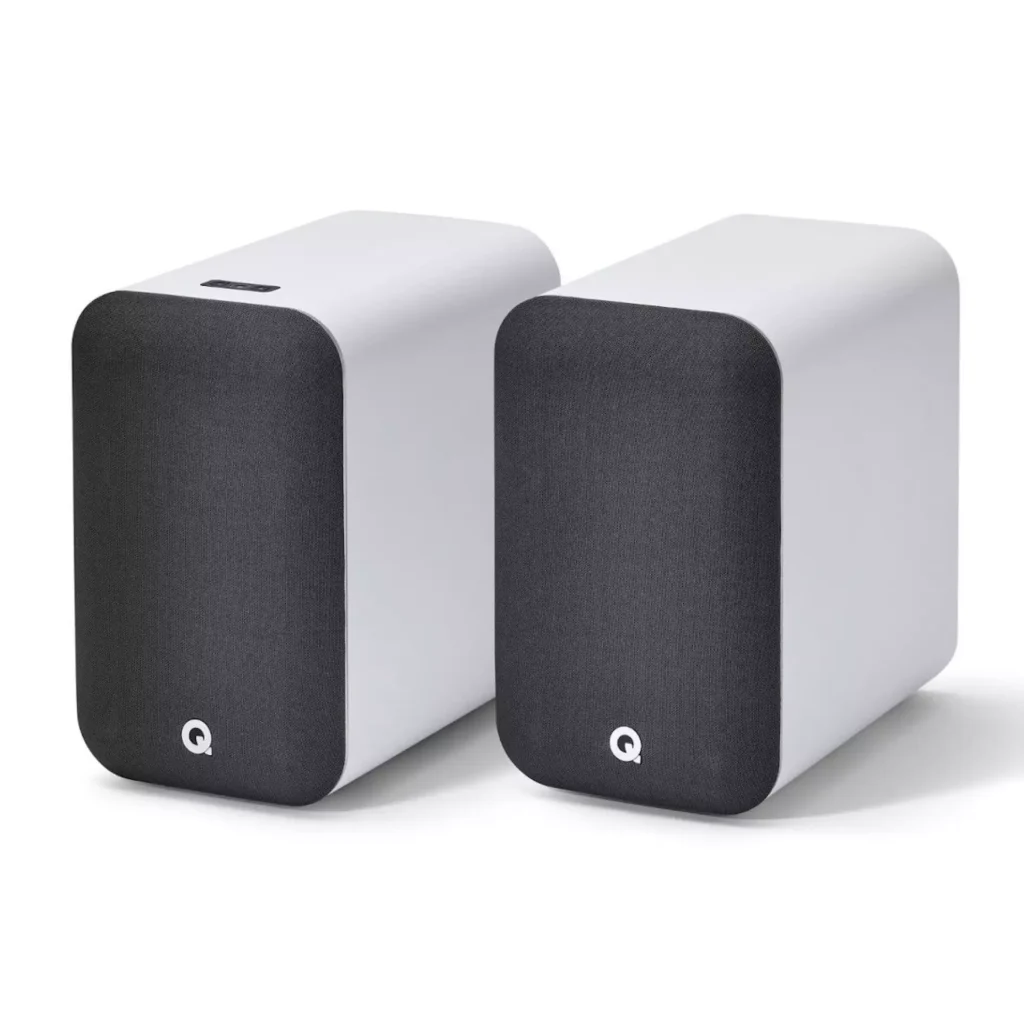
Q Acoustics M20 is a powered stereo pair that makes a sensible case for buying fewer separate boxes. It combines amplification, a USB computer input, optical and analogue connections, and Bluetooth in one cabinet, with an ordinary speaker cable feeding the passive partner. The wireless label describes a source option rather than a cable-free installation or built-in network service. Original review evidence is very positive about its musical balance and value. The question is whether its specific connections fit the intended sources without additions that change the price or convenience.
Research-based review. This assessment draws on manufacturer documentation and the original published evaluations linked below. Audio Review has not performed a hands-on test of this model.
Balance and musical scale are the main attractions
AVForums’ original evaluation describes a confident, well-balanced presentation with convincing tone and musical energy. It also finds useful scale for television, while reporting a loss of composure when pushed particularly hard. That supports ordinary home use more convincingly than an expectation of unlimited output.
Audition the pair at the actual sort of level used in the room. Start with a familiar voice and then something with a busy rhythm section. Check whether the bass remains in proportion and whether detail stays easy to follow without turning up the volume. A speaker that seems exciting for one minute should also remain comfortable over a longer session. Compare alternatives at similar levels, using the same source where possible. The M20’s appeal is a coherent complete system rather than a claim that every individual part exceeds more expensive separates. A modest, well-matched pair can be a better purchase than a collection of components chosen independently without checking their combined behaviour. The original evidence gives this system a clear reason to be on that shortlist.
Placement controls are useful, not automatic room correction
The main cabinet can be assigned to the left or right channel, which helps place the electronics near the sources. A three-position EQ switch addresses free-space, wall or corner positioning. These are practical starting settings, not a measurement-based room-calibration system.
Choose the main cabinet’s position from cable access and mains location, then follow the documentation for channel assignment. Keep the pair sensibly spaced and supported. Try the relevant placement setting before deciding that a change of speaker is required, but do not expect a switch to correct every awkward room resonance. A rear-ported cabinet still benefits from thoughtful positioning. On a desk, check height and the space behind the speakers with connectors attached. On furniture beside a television, avoid trapping one cabinet in a recess while leaving the other in open space. Make one change at a time with familiar material. This gives the simple controls a fair chance to improve the installation without turning setup into an endless search through unrelated adjustments.
USB-B makes the computer route particularly relevant
The dedicated USB-B input accepts PCM up to 24-bit/192 kHz. That is a computer-audio connection, not merely a charging socket. The computer’s selected output, application and file format still determine what is actually sent to the system.
Begin at a conservative level and select the correct output device before playing normal system audio. Check a music application, video playback and any calling software that will share the desk. Include wake from standby in the return-period checks: the original reviewer reported occasional inconsistency when restoring USB sound. That is a documented sample observation rather than proof that every unit behaves identically or that a current software combination will be unaffected. A source that reconnects reliably and offers comfortable volume adjustment matters more than routinely using the highest advertised sample rate. Avoid converting an ordinary library solely to match that maximum. The practical benefit is a direct route from an existing computer into a complete stereo, provided the daily operating sequence works consistently.
Optical television audio needs its own control plan
M20 provides an optical input rather than HDMI ARC. It should be configured as a stereo playback system, not expected to decode an arbitrary surround bitstream. The supplied remote and the television’s output options therefore deserve attention before it becomes the main TV sound system.
Confirm an appropriate stereo output from the display. Test an internal app, ordinary television and any external device that is used regularly. Establish how volume will be adjusted from the sofa and whether that process is easy for everyone in the household. Do not assume that a working optical link means television remote-volume commands will control the speakers. Place the pair far enough apart to make stereo worthwhile while keeping dialogue convincingly related to the screen. Listen from more than one seat if several viewers share the room. A music-first pair can be a satisfying television solution when this arrangement is convenient. Someone who prioritises automatic HDMI control or dedicated centre and surround channels should compare the corresponding system type instead.
Bluetooth and analogue sources have clear limits
Bluetooth offers direct playback from a compatible sending device, with available codecs determined by both ends. There is no built-in Wi-Fi music platform. The RCA and 3.5 mm inputs are line level, so a conventional turntable needs a suitable phono stage before feeding them.
For phone use, test pairing, source switching and ordinary reconnection with the actual handset. Do not assume that every phone can use the same aptX variant or that an HD codec means lossless transmission. For a record player, identify whether its internal stage is enabled or whether an external stage is required. The correct electrical route matters more than whether the cable has RCA plugs at both ends. A separate network streamer can add independent service access through a suitable input, but include that box and its control routine in the comparison. Buyers who mainly use a computer and occasional phone playback may need nothing extra. Buyers who want an app-led household music platform should compare a package designed around that requirement from the start.
Value comes from a complete and usable pair
The supplied speaker cable links the cabinets, and ordinary mains power serves the main unit. This is simpler than assembling a separate amplifier and speakers, while still allowing a dedicated subwoofer connection if a suitable bass-extension plan is required.
Compare current local offers with the accessories and support actually included. Add stands or brackets only where they improve a real placement problem, and include them in the total. Think about the likely listening distance rather than relying on headline power figures with different test conditions. A larger room or demanding volume requirement may justify another speaker format. In a modest room, the M20 can be attractive because it already supplies the essential electronics and several useful source routes. The best value is achieved when those routes correspond to the owner’s habits. It becomes less compelling if extra streaming and television-control hardware are needed to reproduce the basic convenience of a different complete system. Judge the finished installation, not just the attractive speaker-only footprint.
Alternatives to consider
KEF LSX II LT: Compare this compact connected system if network playback and its television connection offer enough extra convenience to justify the price. Include appropriate supports in both packages.
WiiM Amp: Pairing this amplifier with suitable passive speakers offers a different source and upgrade route. Compare the full speaker-and-amplifier cost rather than treating the amplifier as a complete stereo by itself.
Q Acoustics M20 key specifications
- Format
- Powered main speaker and passive partner
- Drivers
- 22 mm tweeter; 125 mm bass/mid per cabinet
- Inputs
- USB-B, optical, RCA line level, 3.5 mm line level, Bluetooth
- USB PCM support
- Up to 24-bit/192 kHz
- Bluetooth
- 5.0; supported codecs depend on source
- TV
- Optical stereo; no HDMI ARC
- Network
- No built-in Wi-Fi streamer
- Turntable
- Requires a suitable phono stage
- Placement
- Free-space / wall / corner EQ; main speaker left/right switch
- Subwoofer
- Dedicated output
- Supplied speaker cable
- 4 m
- Size per cabinet
- 279 × 170 × 296 mm (H × W × D)
- Power source
- AC mains at the powered speaker. The passive speaker connects via speaker cable.
Verdict
M20 is a strong affordable powered-stereo candidate with encouraging original evidence for balance, scale and musical enjoyment. USB-B, optical and placement controls give it practical flexibility. Its limits are equally clear: no HDMI ARC, no internal phono stage and no network streamer. Choose it when the supplied arrangement already meets the source plan and the computer or television routine works reliably.
Documentation and original reviews
Q Acoustics official M20 connections and placement specifications · AVForums original M20 sound and operation review
Editorial record
Sources and updates
Product specifications and factual claims were checked against Official Q Acoustics M20 product page ↗. Scores and buying advice follow our category-specific editorial methodology.
- Published
- November 17, 2026
- Last updated
- November 17, 2026