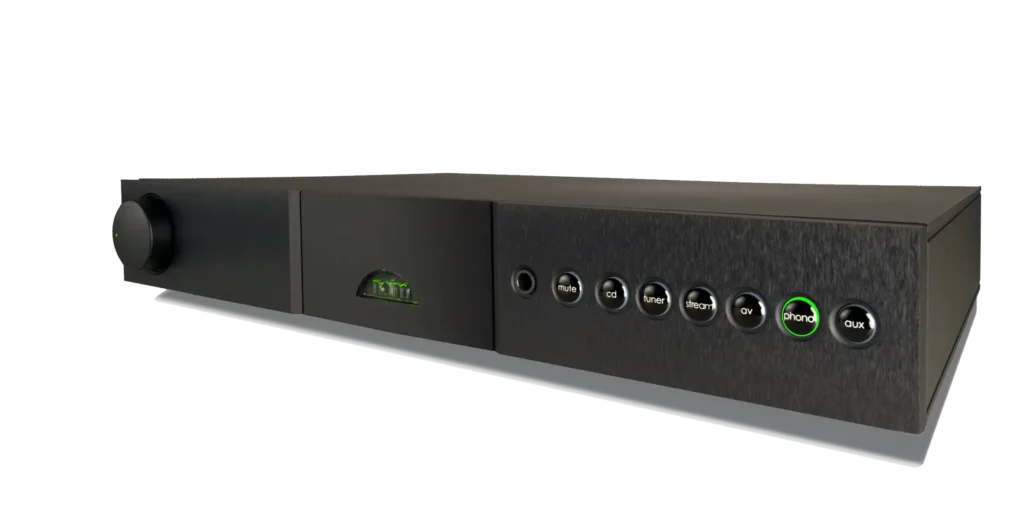
The NAIT XS 3 is an analogue integrated amplifier rather than a streaming system with a few traditional sockets added. Its moving-magnet phono stage and headphone connection make it useful for records and private listening, while digital sources need their own conversion. Naim’s official original-model page now marks it no longer available. This research-based review considers its established musical strengths alongside that more limited modern-source role, with particular attention to whether a separate streamer and DAC suit the buyer better than an integrated digital platform.
Research-based review. This assessment draws on manufacturer documentation and the original published evaluations linked below. Audio Review has not performed a hands-on test of this model.
Musical involvement is the main reason to audition it
What Hi-Fi’s original evaluation describes an agile, rhythmically convincing presentation with good insight and dynamic expression. It also identifies the limits against more muscular alternatives, including scale and bass authority. Its phono and headphone listening receive positive assessments. These are observations from that publication’s system, not measurements or listening results produced by Audio Review.
The buying implication is to compare complete musical passages rather than treating detail as an isolated competition. Follow how a bass line supports the vocal and whether a complex arrangement remains understandable at the ordinary listening level. A larger sound can impress immediately without necessarily making a familiar record more involving over an evening. Conversely, lively timing does not remove the need for sufficient headroom with the intended speakers. Use a level-matched demonstration, including a quiet recording and one with large dynamic changes. The published evidence supports a serious audition; personal preference, room behaviour and loudspeaker matching still decide the result.
The source list is deliberately analogue
The XS 3 accepts conventional line-level sources and provides moving-magnet phono input, but it has no onboard digital conversion, network player, Bluetooth receiver or HDMI television input. Its service USB connection should not be mistaken for computer audio.
That arrangement works particularly well when suitable sources already exist. A CD player with analogue output, an external DAC and a separate streamer can each fulfil a clear role without depending on the amplifier’s software platform. A new system assembled from scratch needs a more careful total-price comparison. Include the boxes, shelf space and control routine required to achieve everyday playback. For television, plan an appropriate external stereo conversion path instead of expecting direct ARC operation. Check which remote controls volume and how another household member selects the normal source. The XS 3 is convenient when the analogue chain is intentional. It becomes less convenient if the buyer discovers after purchase that several essential digital functions need separate equipment.
The MM stage deserves a proper cartridge match
A built-in moving-magnet stage is an important part of this generation’s appeal. Naim identifies its intended cartridge application, and the original review supports the quality of the phono input rather than treating it as a token extra. Low-output moving-coil operation should not be assumed from the presence of RCA phono sockets.
Confirm the cartridge output and loading requirements before deciding whether the built-in stage is suitable. A record player that already supplies line level belongs on a line input, unless its internal stage is deliberately bypassed for the appropriate connection. Arrange signal and mains cables sensibly and check hum with the normal listening position and source selected. Demonstrate a record with a quiet introduction as well as a more demanding cut. Cartridge condition and turntable setup can dominate a comparison, so keep them consistent. An external phono stage may still be useful for a different cartridge or preferred presentation, but buying one automatically would overlook a key reason to consider this particular integrated amplifier.
Preamp links and the subwoofer output require attention
The reference manual distinguishes fixed line outputs, variable preamplifier connections and the separate power-amplifier path. It also explains that the subwoofer output is a duplicate of the preamplifier signal without low-pass filtering. Supported external power-supply and amplifier arrangements have specific connection requirements.
Do not interpret a subwoofer socket as automatic crossover management for the main speakers. A suitable active subwoofer and careful level, crossover and placement adjustment are still needed. Keep the supplied linking arrangement appropriate for ordinary integrated operation and use the manufacturer’s exact diagrams for any supported system change. On a second-hand purchase, confirm that the required link plug is present and that the unit has not been left in an unexpected configuration. The upgrade options offer flexibility, but they should solve an identified need. Adding several expensive components can remove the simplicity that made an integrated amplifier appealing in the first place. Compare that full proposed system with other complete alternatives before committing to a long upgrade path.
Headphones and physical operation matter in daily use
The front headphone connection makes private listening possible without a separate desktop chain. The original review’s favourable headphone assessment is useful evidence, but it does not establish identical performance with every headphone. The slim enclosure also still contains a mains-powered speaker amplifier that needs an appropriate installation.
Try the actual headphones, assessing noise during quiet sections, useful volume adjustment and the ease of changing between speakers and private listening. Do not choose a headphone match solely from the nominal impedance or assume that a larger plug guarantees sufficient drive. At the rack, check access to source buttons and whether the remote gives comfortable fine adjustment from the sofa. Leave the ventilation and connection space required by the operating instructions. Avoid stacking other heat-producing components directly above it merely because the case is relatively low. These practical details affect ownership every day and deserve the same care as a short showroom demonstration of musical energy.
A retired premium amplifier needs a complete-value assessment
Naim’s current page marks this original model no longer available. That makes the actual offer, condition, accessories and support arrangements more useful buying information than an old award or launch price. Retirement does not itself establish that an individual unit is unsuitable, but it changes the questions to ask.
Confirm the regional mains version and obtain service-history information where relevant. Test every intended input, the headphone socket, controls and both speaker channels. Include a suitable remote and the required connection accessories in the comparison. An unusually inexpensive amplifier may be less attractive once missing sources, service and a phono solution for the wrong cartridge are added. Conversely, a well-maintained unit can fit an established analogue system neatly without replacing familiar source equipment. The XS 3 has the strongest value case when its musical presentation is preferred and its limited digital integration is already accounted for. Buy the system that makes listening easier now rather than paying primarily for a hypothetical future collection of upgrades.
Alternatives to consider
Cambridge Audio CXA81 Mk II: Compare its digital-source arrangement and presentation with the actual sources and speakers. Include any external phono equipment required by the competing system.
NAD C 389: Consider a different integrated platform when television or optional network and room-adjustment facilities are important. Price the exact configured system, including modules.
Naim NAIT XS 3 key specifications
- Role
- Analogue integrated stereo amplifier for passive speakers
- Manufacturer output
- 70 W per channel into 8 ohms at stated 0.1% THD+N
- Analogue sources
- RCA / DIN line inputs and MM phono
- Digital / wireless
- No digital audio inputs, Bluetooth or streaming
- Headphone output
- Front 6.35 mm
- Variable outputs
- DIN preamplifier and RCA subwoofer connections
- Subwoofer filtering
- Sub output duplicates preamplifier signal; not automatic bass management
- USB
- Service / diagnostic interface, not USB audio
- Dimensions / weight
- Approximately 432 × 70 × 301 mm; 8.5 kg
- Availability
- Official original-model page states no longer available
Verdict
The NAIT XS 3 remains a well-supported research recommendation for an analogue-centred system that values musical organisation, with worthwhile phono and headphone facilities. Its lack of digital connectivity is a concrete system-planning issue. Confirm condition and supported connections, audition the intended speakers and compare the complete cost. That approach makes its particular strengths more useful than reputation alone.
Documentation and original reviews
Naim official NAIT XS 3 specification and availability · Naim official integrated-amplifier reference manual · What Hi-Fi original NAIT XS 3 review
Editorial record
Sources and updates
Product specifications and factual claims were checked against Official Naim NAIT XS 3 product page ↗. Scores and buying advice follow our category-specific editorial methodology.
- Published
- November 17, 2026
- Last updated
- November 17, 2026