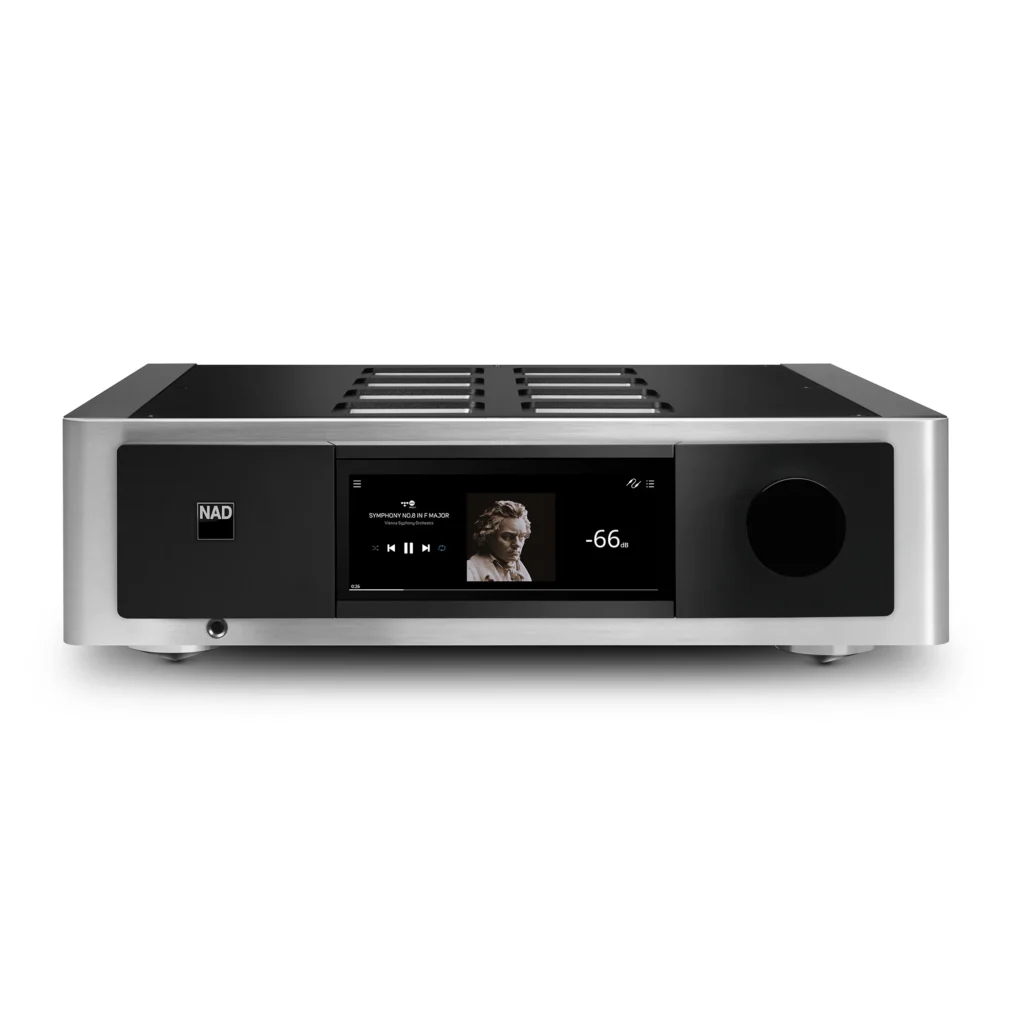
NAD M33 combines Purifi-based stereo amplification, BluOS streaming and Dirac Live in a premium integrated component. It is a full passive-speaker system hub rather than a source-only DAC, with phono, conventional digital connections and a television role alongside network music. The original generation should be distinguished from M33 V2 when reading specifications and comparing offers. This research-based review considers the original model’s published listening evidence and current official licence information, avoiding the assumption that a premium price automatically includes every Dirac upgrade or guarantees an ideal speaker-room match.
Research-based review. This assessment draws on manufacturer documentation and the original published evaluations linked below. Audio Review has not performed a hands-on test of this model.
A strong neutral and confident sound case
SoundStage Hi-Fi’s original evaluation is highly positive about the M33’s precision, ease and ability to communicate complex music. It regards the balance as notably neutral while recognising that some listeners may prefer a warmer alternative. The review also uses specific speakers and calibration choices, which should remain part of the context rather than disappear behind a universal sound claim.
Audition with the intended loudspeakers, using a familiar vocal, a dense arrangement and a recording with wide dynamic changes. Match levels and listen through complete passages. A revealing system should remain musically coherent, not merely expose more isolated detail. Speaker placement and room behaviour remain important even with sophisticated electronics. The research supports a serious premium shortlist, but the listener’s preference still decides whether the presentation feels engaging and comfortable over time. Compare another appropriately installed system at the complete current price rather than treating the original model’s status as proof that every alternative is inferior. Strong engineering and a positive review are reasons to investigate, not substitutes for the actual listening requirement.
Dirac is included, but its scope needs accurate description
The original M33 includes limited-bandwidth Dirac Live correction to 500 Hz. NAD’s current licence matrix also identifies paid full-bandwidth and supported Bass Control upgrades. Those are separate decisions, and an old review describing a future bass-management feature should not be repeated as today’s complete availability picture.
Check current firmware, the exact licence attached to the unit and the intended subwoofer configuration before purchasing an upgrade. A used example may have a different entitlement from a new standard package. Follow current measurement guidance with the microphone and normal listening positions, then compare known material carefully. Correction should address the room and chosen target rather than become a reason to ignore poor speaker placement. A broader correction range is not automatically the preferred result for every listener or speaker. Start by understanding the included facility and the actual problem to be solved. The premium value lies in having useful tools available and applying them sensibly, not in enabling every paid option without a listening or installation reason.
BluOS makes the M33 a genuine network hub
BluOS and AirPlay 2 are integrated facilities rather than additions that require a separate streaming module. The official design also supports compatible multiroom use and aptX HD Bluetooth with appropriate equipment. Current service availability and source-device support still matter more than a historical list of music logos.
Use the intended accounts and household phones during the return period. Test favourite music, handover between users, standby recovery and grouping with the actual compatible players. Do not assume every casting route provides the same format or that a service subscription is included. A large touchscreen can be useful for at-a-glance information, while the remote and app may handle most ordinary interaction. Decide which routine will be easiest for everyone using the system. The network platform is valuable when it reduces friction and extra equipment. A buyer already using another established source ecosystem should compare that practical arrangement rather than assuming an integrated platform must replace a familiar external player regardless of preference.
Analogue and television sources still need the right signal path
The original design provides broad analogue and digital connectivity, including selectable MM / MC phono and HDMI eARC. These facilities have distinct operating requirements. The standard USB local-media role is not a computer USB-B DAC input, and the television connection remains part of a stereo system rather than a complete surround decoder.
Match the phono setting to the cartridge and check whether a turntable already has an active stage. Avoid double amplification, and use a proper line input for line-level equipment. Set the television to an appropriate supported stereo output and test internal apps and external sources separately. Check synchronisation, volume control and standby behaviour. A computer needs a documented network or interface route, not an arbitrary service cable. Keep the system’s working settings clear enough to restore after a source change. The M33’s source breadth is a genuine advantage when it integrates existing equipment reliably. It should not encourage connection assumptions based only on the number of sockets or the product’s premium position.
Power and bass facilities do not remove matching requirements
NAD specifies substantial continuous stereo output for the Purifi-based amplifier, with preamp, headphone and dual bass connections adding system flexibility. Those are manufacturer facilities and ratings, not Audio Review measurements. Exact speaker loads, output settings and correction licences still define the installation.
Use suitable loudspeakers and follow the operating instructions for the selected arrangement. Do not treat additional terminal sets or a bridge option as permission for arbitrary wiring. For active bass, plan placement and the documented crossover and correction route before judging the benefit. Stronger low-frequency output is useful only when it joins the main speakers coherently. Check quieter listening and ordinary music as well as demanding passages. For headphones, assess the actual pair’s usable volume range, noise and tonal balance rather than applying the loudspeaker rating to a separate output. A capable premium amplifier can support a serious system, but the speakers and room still deserve an appropriate share of the budget and setup attention.
Original-generation ownership deserves a current-price comparison
The M33’s premium enclosure, touchscreen and integrated functions can replace several components, but the original and V2 versions should not be combined into one specification. NAD now marks the original product as archived. Current regional condition, support, firmware and licence details matter especially for an older high-value purchase.
Measure the furniture, connector clearance and ventilation requirements before finalising placement. Check the remote, microphone, accessories and actual display and source operation on a used unit. Confirm local warranty terms rather than borrowing those quoted in a review from another market and year. Compare the complete working system with speakers and any paid licences included. A lower-cost platform may meet the same source requirement if the premium interface is less important; another premium product may suit personal musical preference better. The original M33 is strongest when its particular combination of integrated streaming, correction and broad sources genuinely simplifies the installation. Its reputation should support that concrete fit rather than become the sole justification for a large expenditure.
Alternatives to consider
NAD M10 V3: Compare the smaller integrated platform, sources and correction requirements with the actual speakers. Judge the complete current configuration rather than assuming one NAD platform includes every feature of another.
NAD C 399: Consider a conventional amplifier and its exact optional streaming configuration if the premium enclosure and interface are less important. Include the module and any required licences in the price.
NAD M33 key specifications
- Generation
- Original M33, not M33 V2
- Current status
- Archived on official product page
- Role
- BluOS streaming DAC integrated amplifier; passive speakers required
- Amplification
- HybridDigital Purifi Eigentakt
- Manufacturer continuous output
- 200 W per channel into 8 / 4 ohms
- Network
- BluOS; AirPlay 2; compatible multiroom playback
- Wireless
- aptX HD Bluetooth with compatible equipment
- Analogue sources
- Line-level; balanced line; selectable MM / MC phono
- TV
- HDMI eARC; stereo-system role
- Other sources
- Optical; coaxial; AES/EBU; USB local media
- USB computer-DAC input
- Not a standard USB-B audio facility
- Outputs
- Speakers; preamp; dual subwoofer; headphones
- Dirac included
- Limited Bandwidth to 500 Hz
- Dirac upgrades
- Full bandwidth and supported Bass Control are separately licensed; check current conditions
- Dimensions (W × H × D)
- 435 × 133 × 396 mm
Verdict
The original M33 is a serious premium stereo hub with strong published evidence for clear, confident music reproduction. Integrated BluOS, phono and room correction broaden its role, while generation and licence boundaries need checking carefully. Compare the exact unit, speaker match and current complete price. It deserves consideration when those facilities improve the real system rather than simply expand its feature list.
Documentation and original reviews
NAD official original M33 design and source overview · NAD official current M33 product and licence description · NAD official current Dirac licence and paid-upgrade matrix · SoundStage Hi-Fi original Masters M33 listening evaluation
Editorial record
Sources and updates
Product specifications and factual claims were checked against Official NAD M33 product page ↗. Scores and buying advice follow our category-specific editorial methodology.
- Published
- November 17, 2026
- Last updated
- November 17, 2026