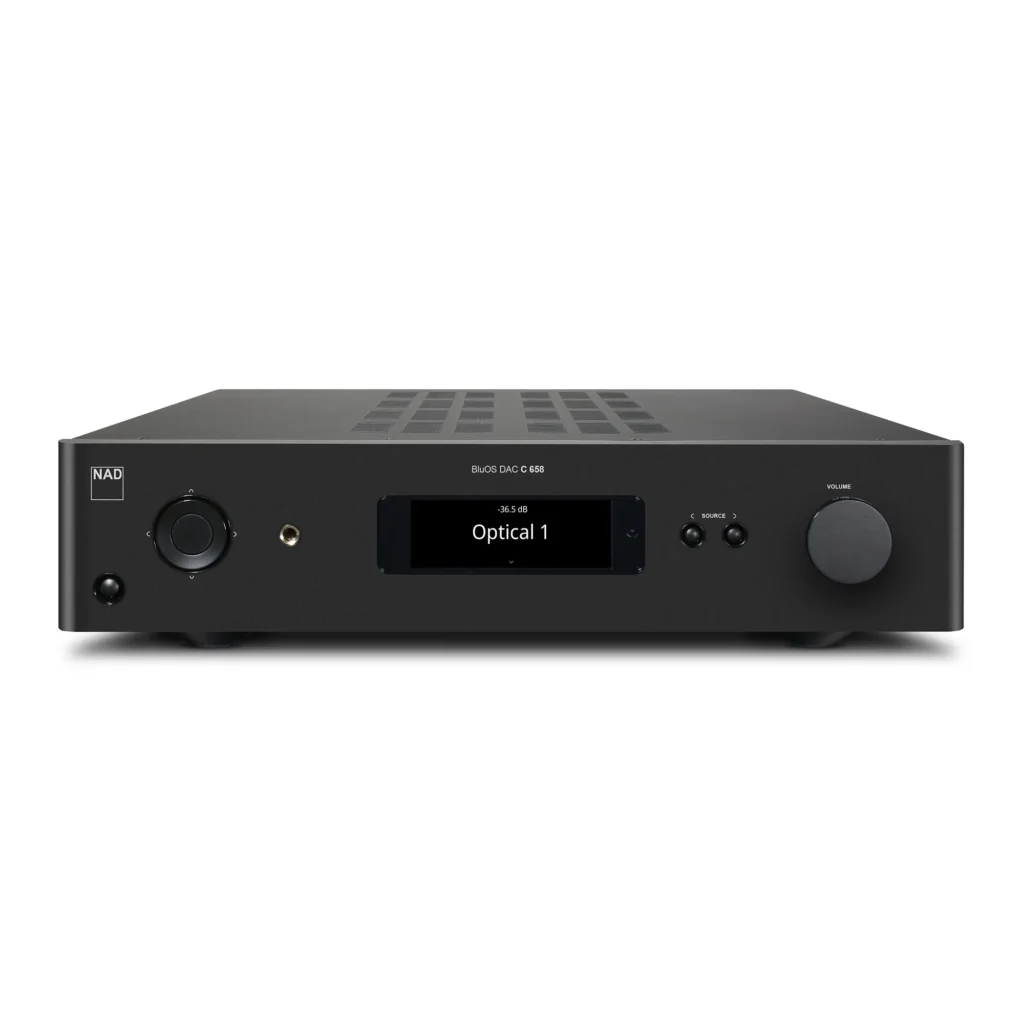
NAD C 658 combines BluOS streaming, digital conversion and stereo preamplifier functions, with phono and room correction adding flexibility. It does not power passive loudspeakers directly: a separate power amplifier or suitable active speakers complete the system. That distinction is fundamental when comparing it with NAD integrated amplifiers. This research-based review considers its published musical evidence, current Dirac licence information and practical output configuration, rather than treating a versatile source hub as a complete just-add-passive-speakers package.
Research-based review. This assessment draws on manufacturer documentation and the original published evaluations linked below. Audio Review has not performed a hands-on test of this model.
Strong musical evidence with a functional exterior
What Hi-Fi’s original evaluation finds an informative, energetic and musically convincing performance, with its room-correction filter improving spaciousness and involvement in the test system. It is less impressed by the physical finish and controls at the price. StereoNET also reports a fluid, cohesive and dynamically engaging presentation. Those are original assessments, not listening tests performed by Audio Review.
Audition through the actual amplifier and speakers if possible. Use a familiar vocal, a dense arrangement and quieter acoustic music at a matched level. Judge how naturally parts work together rather than simply whether more detail seems audible. A correction-enabled demonstration should be compared with the intended setup, not assumed to represent every room. The published evidence supports a serious shortlist for a mixed-source system. The remaining decision is whether its musical presentation, practical interface and current complete price make sense alongside the equipment already owned.
A preamplifier requires the correct volume arrangement
The C 658 provides balanced and single-ended analogue outputs rather than speaker amplification. The manual allows variable or fixed output-volume configuration. These settings serve different systems and should be chosen deliberately before normal playback, particularly with a power amplifier or active speakers.
For a preamp-led system, establish which device controls listening level and begin conservatively. Do not leave fixed output enabled by accident while expecting the C 658’s knob to behave as the main volume control. If feeding an integrated amplifier or processor, decide whether a documented line or bypass route is appropriate and avoid an unclear chain of competing controls. Balanced cabling is useful with suitable equipment, but does not guarantee an automatic sound improvement in every short domestic connection. Check connector compatibility and usable level range. The value of combining streamer and preamp duties is a simpler system; that benefit depends on understanding the output arrangement rather than assuming every line socket performs identically.
Dirac licence scope has changed beyond the early reviews
The standard C 658 includes limited-bandwidth Dirac Live correction to 500 Hz. Current official information also supports separately purchased full-bandwidth and Bass Control licences. An early review discussing future bass facilities should not substitute for checking today’s support, firmware and entitlement on the exact unit.
Confirm the microphone and existing licence contents, especially for used equipment. Follow current calibration guidance with the normal seats and speaker positions established first. Compare a known passage before and after applying a filter, with a clear reference setting available. Correction should address the actual room and desired balance rather than serve as a reason to ignore placement. A broader licence is a separate decision, not an automatic requirement for every listener. Similarly, Bass Control should be matched to the supported bass arrangement and actual need. Useful room tools can strengthen the system substantially, but only when their limits and setup are understood. Do not calculate value as though every paid upgrade is included in an ordinary base-price offer.
BluOS and conventional sources share the system
BluOS is built in, with network playback and compatible multiroom facilities rather than a required streaming expansion card. The base source set also includes optical, coaxial, analogue line and MM phono. USB local-storage playback is separate from the service port, which the manual identifies as unsuitable for consumer use.
Test the intended music accounts, local collection and household phones. Check discovery, handover, favourites and return from standby rather than assuming a service logo guarantees every format through every route. For records, match the cartridge and signal level correctly: a turntable already producing line level should not receive a second phono stage. A low-output moving-coil cartridge needs appropriate matching equipment. Network convenience and source breadth are most valuable when they remove duplicate boxes and confusing routines. A household that already owns a capable streamer may value the preamp and correction differently from someone starting a new system, so the comparison should reflect the actual equipment being replaced.
HDMI is an optional hardware question
The operating manual documents an optional original-MDC HDMI module rather than a standard HDMI connection on the base product. It describes the supported module’s switching and ARC facilities, which should not be confused with unrestricted current eARC or high-frame-rate gaming capability. Original MDC Classic is also distinct from newer MDC2 hardware.
Check exact compatibility, module availability, installed condition and current price before planning a television-centred system. Map which sources connect to the display and which require another route, then verify audio and picture requirements separately. A stereo preamp does not become a multichannel decoder merely because a suitable module can provide an HDMI path. If ordinary optical stereo already meets the requirement, another module may be unnecessary. If a particular television-control facility is essential, confirm it rather than relying on connector shape or a shared NAD product name. Modularity is a useful route when the required hardware exists and solves a specific problem, rather than a promise that every future connection will become available.
Complete-system value follows the equipment around it
The C 658’s main attraction is combining several source and control duties without replacing a suitable power amplifier or active-speaker system. Its functional appearance may matter less in that role than reliable operation, while a buyer starting from nothing must include the missing amplification and speakers in the budget.
Check furniture clearance, ventilation, remote operation and display readability. Try headphone listening with the actual pair if that facility is important, assessing noise and volume range independently of the speaker system. Confirm regional warranty, accessories, installed modules and software operation for used or remaining-stock purchases. Compare the complete current cost with alternatives, including any licences and hardware needed for the planned setup. An integrated streaming amplifier may be simpler when no separate power stage is already owned. The C 658 is strongest when its preamp, network and correction functions improve a concrete existing system. Its extensive facility list should support that practical fit rather than become the only reason to buy.
Alternatives to consider
Eversolo DMP-A10: Compare a premium source and preamp platform with the intended output arrangement, room tools and daily interface. Price the complete actual system rather than assuming all DAC-streamers perform the same role.
WiiM Ultra: Consider a less expensive hub if its connections and correction facilities meet the requirement. Check balanced-output needs, phono use and the intended amplifier or active speakers.
NAD C 658 key specifications
- Role
- Network streamer, DAC and stereo preamplifier
- Passive speaker drive
- Separate power amplifier required
- Network
- BluOS; Wi-Fi; Ethernet; supported multiroom and services
- Wireless
- Two-way aptX HD Bluetooth, compatible equipment required
- Analogue sources
- Two line inputs; MM phono
- Digital sources
- Two optical; two coaxial; USB local media
- USB
- Local storage role; service port is not consumer audio
- Outputs
- Balanced XLR; single-ended RCA; bass outputs; headphones
- Volume
- Variable or fixed configuration; select for the system
- Dirac included
- Limited Bandwidth to 500 Hz with calibration microphone
- Paid upgrades
- Full bandwidth and supported Bass Control licence
- HDMI
- Optional compatible original-MDC module; not standard
- Expansion
- Original MDC Classic; verify exact compatibility
- Dimensions (W × H × D)
- 435 × 100 × 405 mm
Verdict
C 658 is a flexible streamer, DAC and preamp with strong original evidence for musical performance and useful correction. It needs appropriate downstream amplification, deliberate volume configuration and accurate licence and module checks. Compare the complete current system cost. It is particularly persuasive when those combined functions improve equipment already worth keeping.
Documentation and original reviews
NAD official C 658 source, output and licence information · NAD official C658 manual, volume configuration and optional HDMI · NAD official current Dirac licence and Bass Control matrix · What Hi-Fi original C 658 sound and calibration review · StereoNET original C 658 listening review
Editorial record
Sources and updates
Product specifications and factual claims were checked against Official NAD C 658 product page ↗. Scores and buying advice follow our category-specific editorial methodology.
- Published
- November 17, 2026
- Last updated
- November 17, 2026