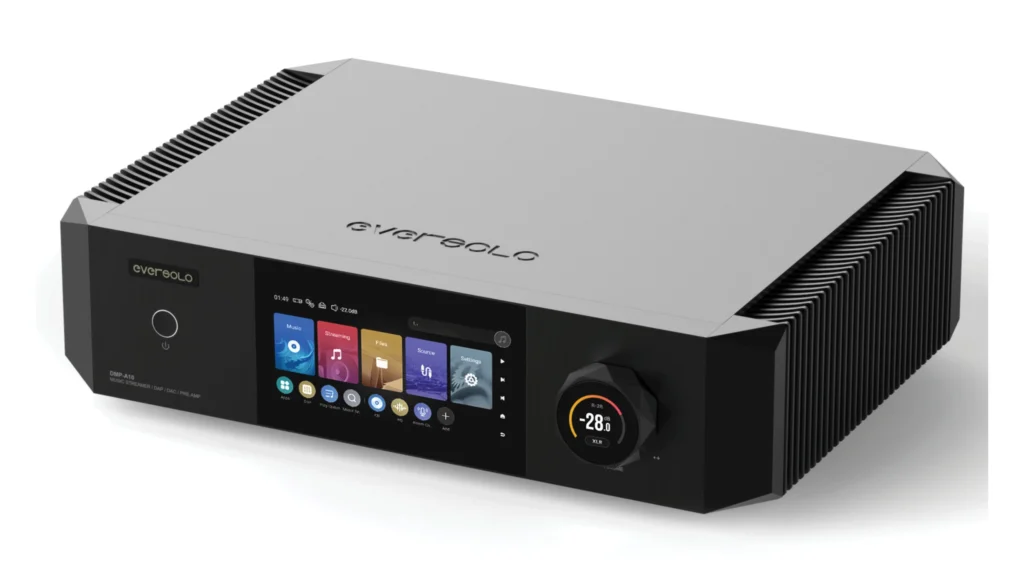
The Eversolo DMP-A10 is a streamer, DAC and analogue preamplifier designed to act as the control centre of a serious stereo system. It does not contain the power amplification needed for passive speakers. Its appeal is unusually broad source and processing flexibility, combined with a substantial interface and a strong independent technical foundation.
Eversolo DMP-A10 — System role and build
The DMP-A10 belongs ahead of a power amplifier or compatible active speakers. Calling it an all-in-one music source is reasonable; calling it a complete passive-speaker amplifier is not. That distinction changes the budget considerably. Include amplification, speakers and any necessary cabling before comparing it with an integrated streaming amplifier that can drive passive speakers directly.
The 6.5-inch touchscreen and smaller display in the volume control give the component a more elaborate physical interface than a basic network transport. It is suited to an installation where the front panel can be seen and reached. Consider viewing distance and touch access as well as shelf width. A large touchscreen is less useful if the unit is placed inside a low cabinet where everyday control always happens through a phone.
Streaming, library and storage
The product combines integrated music services with network-library access and app control. Check the current European service list and account requirements for the exact platforms used. Service availability and Connect support can change with software, so the current manufacturer support information is more useful than treating an early review’s feature list as permanent.
Two M.2 NVMe storage slots provide a route to a substantial local library; drives are additional purchases. The current European product description lists support for up to two 8 TB drives, which differs from smaller capacities quoted in some older coverage. Confirm the supported drive specification and current firmware before buying storage. Internal library convenience also does not replace a backup of the music collection.
A NAS or attached storage can suit a system with an existing library, while integrated streaming services suit listeners who rarely manage local files. Try browsing, search and queue handling with the preferred route. A rich feature set has little value if everyday album selection is awkward. The DMP-A10 offers many controls, so a short personal setup session is more informative than counting service logos.
Digital and analogue source flexibility
USB audio, optical, coaxial and HDMI ARC provide routes for external digital sources. Their supported formats and processing behaviour differ, so do not apply the highest USB file-rate claim to every input. A computer needs the correct output device and supported software configuration, while a television should provide a compatible stereo signal. ARC does not turn this stereo preamp into a surround decoder.
RCA and XLR analogue inputs give the DMP-A10 a genuine preamplifier role. A suitable external phono stage can feed one of those inputs, but a bare cartridge cannot: there is no built-in phono equalisation stage. Confirm source output level and volume behaviour before connecting a power amplifier directly to the Eversolo.
The analogue signal path can be configured for a direct route or digitised for processing. That choice is functional rather than merely philosophical. A direct path can keep an established analogue source chain simple, while the processed route enables useful equalisation. Compare the arrangements at matched levels and use the one that improves the actual system. There is no need to assume every owner benefits from the same processing setting.
Room correction and subwoofer integration
Room correction and equalisation are part of the DMP-A10’s attraction. The European product documentation supports measurement through compatible microphones and recommends a professional measurement microphone for better accuracy. A phone microphone can be convenient, but convenience should not be confused with a calibrated reference. Start with sensible speaker and seat placement before asking processing to compensate for the room.
Two subwoofer outputs support useful gain, crossover and delay adjustments, with documented signal restrictions. The European description limits the subwoofer function to PCM signals below 192 kHz. Verify the processing path with the files and inputs actually used, rather than assuming every high-resolution or DSD mode retains every bass function. The correct workflow matters more than the maximum format printed on the product page.
What Hi-Fi’s original evaluation found room equalisation potentially useful but preferred less processing in its treated room. That result should not become a universal instruction to disable correction. A domestic room with a strong bass resonance may benefit differently. Compare corrected and uncorrected playback at similar levels, concentrating on consistency, natural voices and bass integration rather than a visually flatter graph alone.
Preamp behaviour and independent evidence
The balanced analogue output and resistor-network volume control allow the DMP-A10 to connect directly to suitable power amplification. What Hi-Fi noted audible relay clicks as the volume changed, which some listeners may find distracting. Try small adjustments in a quiet room and decide whether the physical behaviour is acceptable. It is part of the ownership experience rather than a claim of an audio fault.
Hi-Fi News’ original laboratory report found very low distortion and a wide signal-to-noise ratio from the balanced output. That supports confidence in the conversion and output implementation, but those are the publication’s measurements under its stated conditions. They should not be rewritten as Audio Review laboratory results or as proof that the product is audibly superior in every system.
The original What Hi-Fi listening described a refined, full-bodied and organised presentation, while finding some rivals more exciting rhythmically. That is useful qualification alongside the strong technical evidence. A high-capability DAC and broad feature list do not remove differences in subjective preference. Use familiar lively material as well as quieter acoustic recordings when deciding whether the complete presentation suits the intended speakers and room.
Network choices and premium value
Ethernet, Wi-Fi and an optional-module SFP fibre connection give several installation options. Fibre can provide electrical isolation in a suitable network arrangement, but its presence is not a guarantee of an audible improvement over reliable ordinary Ethernet. Choose the connection that solves an actual installation requirement. Buying specialist network hardware should not take priority over speakers, room work or a reliable music backup.
The DMP-A10 makes its strongest case when it replaces a separate streamer, DAC and preamp while also supplying processing the system will use. With active speakers, that can create an elegant arrangement; with passive speakers, a suitable power amplifier remains essential. It has no conventional headphone output to replace a dedicated headphone amplifier, so private listening needs its own plan.
Compare current European offers against a complete system, including storage and microphone costs where relevant. Less expensive streamers can cover basic service playback very well. The Eversolo’s premium is easier to justify when the analogue preamp, touchscreen, local library and subwoofer facilities all have clear roles. Choose it for that breadth and its documented implementation, while accepting that a simpler system or another subjective presentation may suit a different listener better.
Alternatives to consider
Eversolo DMP-A8: Compare another streamer and preamp arrangement when the flagship interface and extra processing facilities are not essential.
Bluesound NODE ICON: A smaller streaming and DAC alternative when system simplicity and network-platform preference outweigh the DMP-A10 preamp and storage breadth.
Eversolo DMP-A10 key specifications
- Type
- Streamer / DAC / analogue preamplifier
- Speaker amplification
- None
- Display
- 6.5-inch touchscreen plus volume-control display
- Inputs
- USB audio, optical, coaxial, HDMI ARC, RCA and XLR analogue
- Analogue outputs
- RCA, balanced XLR and two subwoofer outputs
- Storage
- Two M.2 NVMe slots; drives extra
- Network
- Ethernet, Wi-Fi and optional-module SFP fibre
- Processing note
- Subwoofer function documented for PCM below 192 kHz
Verdict
An exceptionally flexible streamer, DAC and preamp with convincing technical evidence and a strong interface. It is most compelling when its source, analogue and bass-management capabilities replace several boxes; separate speaker amplification and a clear processing plan remain essential.
Primary documentation and independent reviews
Eversolo official DMP-A10 product page · Eversolo European DMP-A10 feature documentation · Eversolo official current firmware and manual support · What Hi-Fi original DMP-A10 review · Hi-Fi News original DMP-A10 laboratory report
Editorial record
Sources and updates
Product specifications and factual claims were checked against Official Eversolo DMP-A10 product page ↗. Scores and buying advice follow our category-specific editorial methodology.
- Published
- November 8, 2026
- Last updated
- November 8, 2026