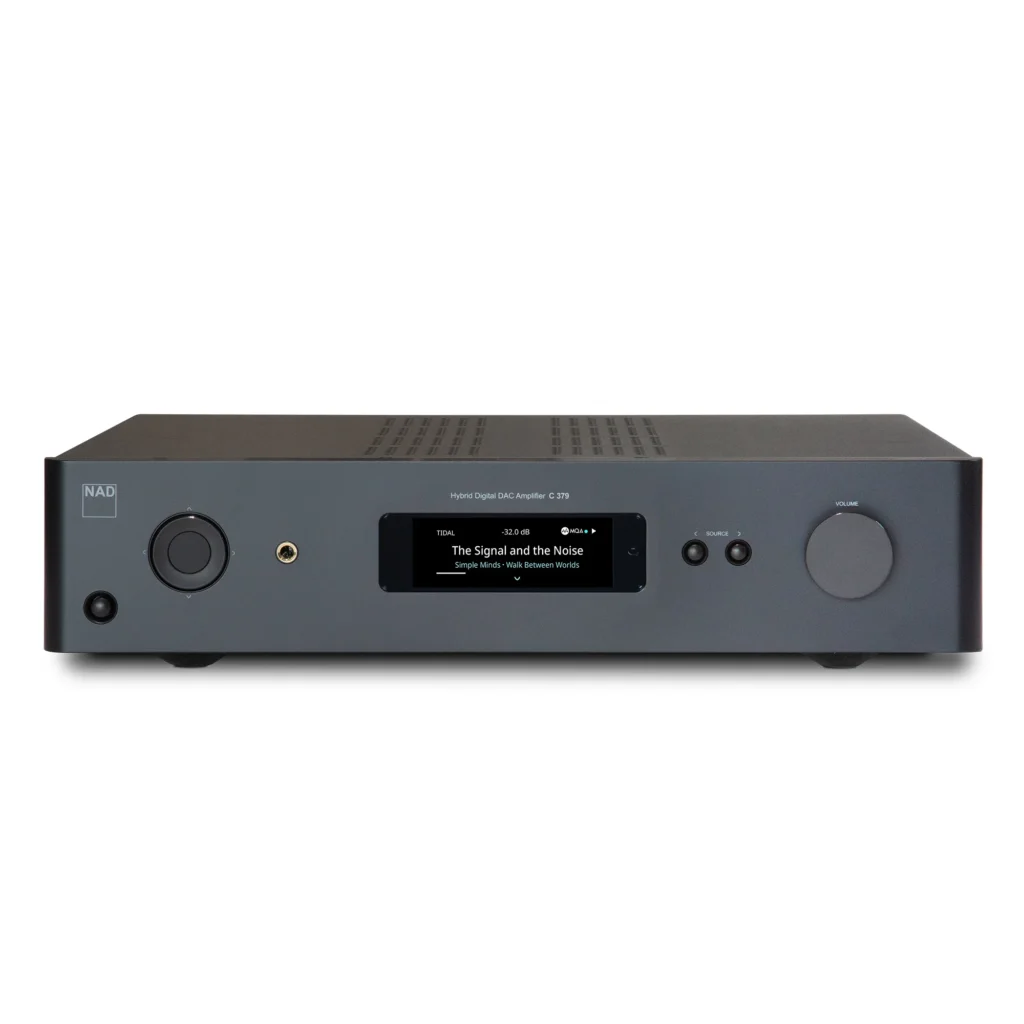
NAD C 379 is a conventional-looking stereo amplifier with a notably useful standard source set: eARC, digital inputs and MM phono all sit alongside Bluetooth. Optional MDC2 BluOS-D hardware adds independent streaming and Dirac Live, making the exact purchased configuration central to value. This research-based review distinguishes those optional facilities from the base product and separates the supplied limited-bandwidth correction licence from paid or unavailable Dirac features. Original listening evidence supports a strong musical case, while room fit and daily usability still deserve the usual care.
Research-based review. This assessment draws on manufacturer documentation and the original published evaluations linked below. Audio Review has not performed a hands-on test of this model.
A strong original evaluation of sound and system capability
SoundStage Access’s original review is positive about bass solidity, dynamic clarity and stereo imaging, including listening without Dirac engaged. It finds useful improvement from room correction with a personally chosen target and reports a capable headphone result, while qualifying a longer-than-desired switching mute. Those observations belong to the tested system and should not become a guarantee for every room or headphone.
Audition the intended speakers at the normal listening distance. Use a voice-led track, something rhythmically busy and a recording with demanding dynamic changes. Check coherence through complete passages rather than judging only isolated effects. Compare corrected and uncorrected playback sensibly if the module is fitted, with settings documented and levels controlled. A strong bass impression is useful only when it remains integrated with the rest of the music. Published evidence gives the C 379 a serious shortlist case, but it does not replace checking whether the actual speaker load, room behaviour and listening level match the system being purchased.
The module and licence boundaries are unusually important
BluOS streaming and Dirac require the optional MDC2 BluOS-D module. Its included Dirac Live licence covers correction up to 500 Hz, while full-frequency correction is an optional upgrade. NAD’s current matrix does not list Dirac Live Bass Control for C 379. These are distinct facilities, not interchangeable descriptions of one unlimited correction package.
Confirm whether the exact offer includes the module and microphone, and check any existing licence before buying used equipment. Price the intended configuration completely. A buyer mainly interested in low-frequency room behaviour may find the included scope relevant; another may have a reason to consider a broader licence. Neither should assume an upgrade is necessary before using the documented starting facility. Follow current installation and calibration guidance and compare a known passage after setup. Correction should address the real room and target preference rather than make the result louder or more spectacular. Modularity is most useful when the desired functions, hardware and total cost are clear before purchase.
eARC makes television a genuine standard source
Unlike some earlier NAD modular amplifiers, C 379 includes the television eARC connection in its base source set. Optical, coaxial, analogue line and MM phono inputs cover other equipment, while there is no standard computer USB-DAC input. A digital-source collection should be mapped against those actual sockets.
Set the television to the appropriate stereo output and test internal apps and external sources independently. The stereo amplifier should not be presented as an Atmos decoder simply because eARC is available. Check synchronisation, volume control and recovery after standby. For a computer, identify a supported output or interface rather than connecting an arbitrary service lead. Avoid buying converters before establishing what the existing equipment already supplies. The useful connection advantage is a system that needs fewer workarounds and fewer daily control changes. A source list looks impressive only when those inputs correspond to equipment that will actually be used. Check the complete route, including what happens when another household member switches from television to music and back.
BluOS adds network convenience to the equipped version
The optional module provides the BluOS platform and supported network playback, including documented connect and casting routes. The operating manual also distinguishes how source selection and Bluetooth handling change with the module installed. That is a reason to follow the correct configuration’s instructions rather than combining several generations of NAD guidance.
Use the actual service accounts and current household phones during setup. Check discovery, favourite music, handover between users and standby recovery. A service logo does not include a subscription or promise identical format support through every route. For multiroom use, test grouping with the intended compatible players instead of assuming every wireless speaker can join. Decide whether the app, remote or display is preferred for ordinary volume and source changes. A well-configured network module can remove another source box and simplify the room. It is less useful if the household already has a suitable external player and would not use the added correction or grouping facilities. Include that practical distinction in the price comparison.
Speaker, bass and phono connections need deliberate settings
The amplifier provides bass and preamp outputs alongside its speaker connections, with the manual covering stereo and bridge arrangements. The review sample’s initial bridge setting is a useful reminder to inspect configuration before ordinary two-channel use. Bridging is a separate documented system arrangement, not an automatic way to improve every pair of speakers.
Follow the operating instructions for the actual load and connections, and avoid improvised common-ground switching accessories. For active bass, use the documented output and crossover arrangement, then judge integration from the normal seats. Extra low-frequency output should support the speakers rather than sound like an unrelated effect. For records, choose phono only for an appropriate cartridge signal; a turntable already producing line level belongs at a line input. Avoid double phono amplification. These ordinary details have a direct effect on whether the system works correctly. They deserve more attention than assuming the amplifier’s expansion facilities make every speaker, cartridge and accessory combination interchangeable.
Full-size packaging and complete price determine value
The official gross dimensions are approximately 435 mm wide, 100 mm high and 410 mm deep, with a weight around 9.04 kg. That depth needs checking in furniture built around compact streaming amplifiers. The physical and menu interface also differs from a retro amplifier with dedicated knobs for every task.
Measure rear clearance and ventilation, and test the remote and display from the sofa. Check current regional warranty and the exact package contents. Compare the base unit and equipped version consistently against alternatives: a low base price should not be set beside a rival that already includes the required streamer or correction hardware. Conversely, do not pay for a module solely because it can be added if the actual system needs only existing analogue and digital sources. A strong value case combines useful standard connections, a suitable speaker match and an upgrade route that solves a real problem. The C 379 deserves attention on those grounds rather than an assumption that modularity guarantees every future function.
Alternatives to consider
NAD C 3050: Compare physical controls, appearance and exact source provision, pricing any optional BluOS-D configuration consistently for both products.
NAD C 389: Another conventional NAD platform to assess with the same speakers and module assumptions. Compare actual requirements and current total price instead of choosing by a higher model number alone.
NAD C 379 key specifications
- Base role
- HybridDigital UcD integrated stereo DAC amplifier
- Manufacturer continuous output
- 80 W per channel into 8 ohms, stated conditions
- Standard sources
- HDMI eARC; optical; coaxial; line; MM phono; Bluetooth
- Passive speakers
- Required
- Network / Dirac
- Optional MDC2 BluOS-D module required
- Module Dirac licence
- Limited Bandwidth to 500 Hz; full-frequency upgrade optional
- Dirac Bass Control
- Not listed as available for C379 in current official matrix
- USB computer audio
- No standard USB-DAC input
- Outputs
- Preamp; dual subwoofer; headphones; speaker connections
- Expansion architecture
- MDC2, not original MDC
- Gross dimensions / weight
- Approximately 435 × 100 × 410 mm; 9.04 kg
- Configuration note
- Confirm stereo / bridge setting and exact included module
Verdict
C 379 is a versatile stereo foundation with a strong original listening assessment and useful standard television and conventional sources. Its optional BluOS-D route can add substantial value when hardware and Dirac licence limits are understood. Confirm the exact configuration, speaker setup and complete current price. It is particularly persuasive when those facilities simplify a real mixed-source system.
Documentation and original reviews
NAD official C 379 base features and specifications · NAD official C379 operating manual and MDC2 requirements · NAD official current Dirac licence and upgrade matrix · SoundStage Access original C 379 with optional BluOS-D evaluation
Editorial record
Sources and updates
Product specifications and factual claims were checked against Official NAD C 379 product page ↗. Scores and buying advice follow our category-specific editorial methodology.
- Published
- November 17, 2026
- Last updated
- November 17, 2026