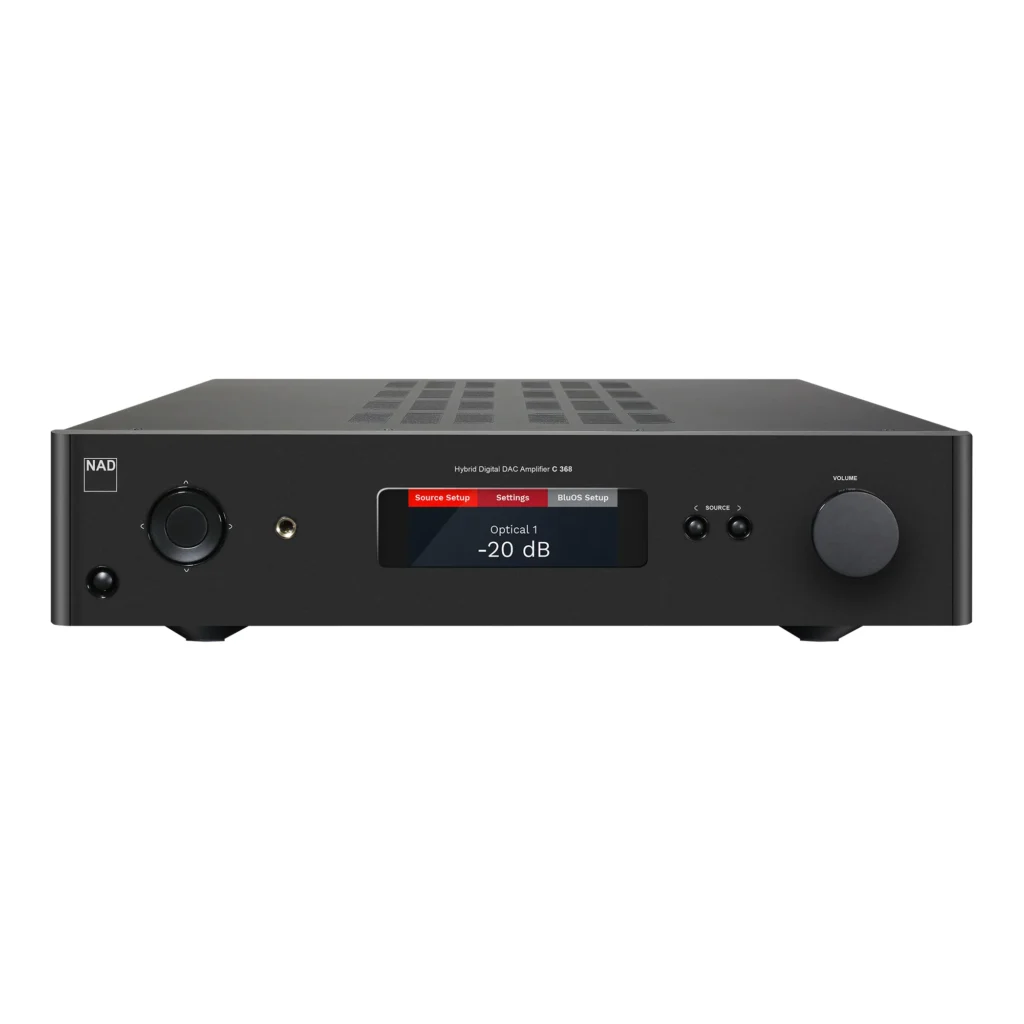
NAD C 368 is a HybridDigital stereo amplifier with a DAC, moving-magnet phono and optional modular expansion. The distinction between the base unit and an equipped example is central to understanding it: BluOS streaming, HDMI and computer USB facilities should not be assumed merely because they appear in a shared manual or demonstration. This research-based review considers the original-MDC platform, published listening evidence and the complete price of the intended configuration, while keeping the actual speaker and source requirements at the centre of the decision.
Research-based review. This assessment draws on manufacturer documentation and the original published evaluations linked below. Audio Review has not performed a hands-on test of this model.
Spacious refinement with a slightly restrained side
What Hi-Fi’s original evaluation hears a broad, full-bodied and refined sound, with useful detail and a comfortable presentation. It also finds the NAD less exuberant than a preferred rival with some upbeat material. That supports a strong easy-listening case while making rhythm and drive worthwhile comparative audition points.
Use familiar recordings with the intended loudspeakers, including a voice-led track and music whose momentum matters to the listener. Match levels sensibly and assess the complete passage rather than isolated effects. A warmer or more substantial presentation can be appealing without being the first choice for every collection. Another listener may reasonably value a more direct sense of attack. Speaker position and room bass remain important, so do not expect the amplifier alone to determine the final character. Published evidence is a way to identify what deserves attention, not a substitute for judging the actual system. The best choice remains satisfying over a long session and at the level normally used in the home.
The base amplifier and BluOS version are different offers
NAD’s official material makes BluOS an optional original-MDC addition. The base C 368 already has Bluetooth and conventional sources, but it should not be described as an independent network streamer without the appropriate installed hardware. A seller’s bundle name and photographs deserve checking.
Ask which exact module is fitted and confirm its present compatibility, condition and software operation before purchase. Test the intended service accounts, discovery and standby routine on an equipped example rather than assuming a menu item proves successful playback. If no module is installed, include its actual availability, installation and cost in the comparison. An external streamer may be a sensible alternative depending on the sources already owned. Do not treat original MDC as interchangeable with the newer MDC2 architecture, or infer Dirac and other facilities merely because they exist on another NAD product. Modularity is useful when a supported route meets a real requirement; it is less useful as an undefined promise of every future feature.
Analogue and digital sources are already well represented
The base amplifier provides line inputs, MM phono, optical and coaxial digital sources. Bluetooth with aptX offers another route with compatible equipment. HDMI and computer USB functions discussed in the manual belong to optional modules, rather than standard base connections.
Map each player, television and computer before choosing a configuration. A digital transport may connect directly to the DAC, while a television requires an appropriate stereo route unless a verified compatible HDMI module is installed. Check the exact video and audio capabilities of that module instead of assuming modern eARC or gaming facilities from its connector shape. A computer source likewise needs a documented interface rather than an arbitrary cable to a service socket. Compare the actual required routes and everyday controls. A broad base source set can reduce extra equipment, but its value depends on using those sources. There is little benefit in paying for modules that duplicate functions already supplied reliably by an external component.
Phono and headphone roles need the usual matching care
A moving-magnet phono stage and dedicated headphone output broaden ordinary stereo use. Their presence does not make cartridge or headphone matching irrelevant, and loudspeaker output figures should not be applied to these separate signal paths.
Check whether the turntable already has an active phono stage before choosing phono or line input. Avoid double amplification and equalisation, and use suitable matching equipment for a cartridge outside the internal stage’s intended range. Keep grounding and interference in mind during installation. For headphones, try the actual pair at low and ordinary levels, checking volume range, noise and tonal balance. Compare any proposed external stage or headphone amplifier for a specific reason rather than assuming another box is always an improvement. The integrated facilities are useful when they make the existing system simpler and comfortable to use. A carefully matched source and transducer arrangement is more informative than a generic claim that one product can drive every headphone or reproduce every cartridge equally well.
Configurable outputs offer flexibility with settings attached
The manual documents the shared preamp / subwoofer output configuration and full-range or high-pass options for the speaker route. These are useful system tools, but should be set according to the intended external equipment rather than treated as automatic room correction. Speaker A/B also requires attention to operating loads.
Decide whether the output is feeding another amplifier or active bass before selecting its function. Follow the documented filter arrangement and the subwoofer’s own crossover guidance, then assess integration from the normal seats. A stronger low end is not automatically a more coherent result. Keep a reference setting and change one variable at a time. Do not connect arbitrary speaker combinations merely because two terminal sets are provided, and avoid improvised bridging arrangements. The platform supports more elaborate configurations, but those require their own manufacturer instructions and compatibility checks. A simple stereo pair may already meet the requirement. Expansion should solve an identified problem rather than add components and settings that make the system harder to understand.
Complete-system cost and physical depth matter
The official dimensions are approximately 435 mm wide, 100 mm high and 390 mm deep, with a weight around 7.8 kg. The depth is significant in furniture designed around smaller network amplifiers, particularly with rear cables and any installed module connections.
Measure clearance and ventilation before ordering, and keep the remote sensor and display usable from the listening position. Check exact regional model, warranty, remote and module contents for used or remaining-stock offers. Compare the full intended configuration against newer integrated platforms, including speakers and any required accessories. An older base-unit price can look attractive while the desired optional module makes the final cost less competitive. Conversely, a buyer who needs only the existing phono and digital sources may have little reason to pay for another streaming platform. The C 368 is strongest when its source flexibility, speaker match and refined presentation already fit the room. Its expansion architecture should strengthen a concrete plan rather than become the only justification for purchase.
Alternatives to consider
NAD C 389: Compare the newer platform and its exact module requirements against the complete C368 configuration. Verify which functions are included in the actual offer.
Cambridge Audio CXA81 Mk II: Consider a different conventional integrated approach if network streaming will remain an external source. Compare musical character, inputs and current complete system cost.
NAD C 368 key specifications
- Role
- HybridDigital integrated stereo DAC amplifier
- Manufacturer continuous rating
- 80 W per channel into 8 / 4 ohms
- Base analogue sources
- Two line inputs; MM phono
- Base digital sources
- Two optical; two coaxial
- Base wireless
- Bluetooth with aptX support
- BluOS streaming
- Compatible optional original-MDC module required
- HDMI / USB computer audio
- Optional-module facilities, not standard base sockets
- Expansion generation
- Original MDC; do not assume MDC2 compatibility
- Outputs
- Speaker A/B; headphones; configurable preamp / subwoofer
- Bass setup
- Manual documents full-range / high-pass options; follow exact settings
- Dimensions / weight
- Approximately 435 × 100 × 390 mm; 7.8 kg
- Control
- Display; remote; supported integration connections
Verdict
C 368 offers a flexible stereo foundation with a credible case for spacious, comfortable music reproduction. Its optional original-MDC facilities require exact-model and price checks, especially when comparing a base unit with a network-equipped demonstration. Confirm the speaker match, output settings and complete configuration. That practical fit determines its value more reliably than an open-ended promise of upgrades.
Documentation and original reviews
NAD official C 368 base features and optional original-MDC modules · NAD official C368 manual, configurable outputs and module requirements · What Hi-Fi original C 368 listening review
Editorial record
Sources and updates
Product specifications and factual claims were checked against Official NAD C 368 product page ↗. Scores and buying advice follow our category-specific editorial methodology.
- Published
- November 17, 2026
- Last updated
- November 17, 2026