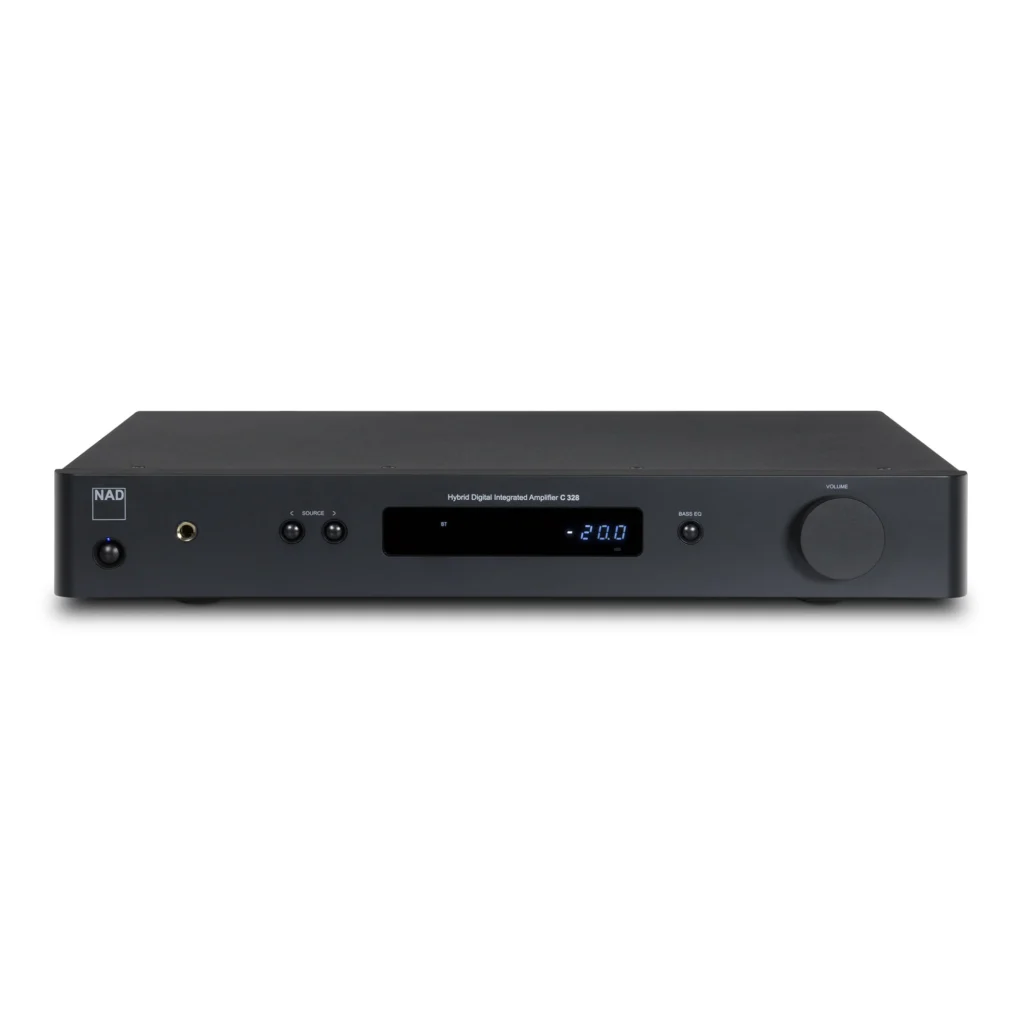
NAD C 328 combines HybridDigital stereo amplification with a built-in DAC, moving-magnet phono and Bluetooth. Its slim enclosure can reduce the equipment count for digital transports and records, while still requiring passive speakers and a separate network source if independent streaming is wanted. This research-based review also handles a documentation inconsistency carefully: the original manual states forty watts of continuous output per channel under defined conditions, while current product copy uses a fifty-watt headline. Those descriptions should not become an unsupported claim that every C 328 has received a new amplifier design.
Research-based review. This assessment draws on manufacturer documentation and the original published evaluations linked below. Audio Review has not performed a hands-on test of this model.
Detailed music with a leaner starting balance
SoundStage Access’s original evaluation describes a clear, detailed and initially lean presentation, with a positive assessment of phono playback and channel separation. The reviewer used Bass EQ with particular speakers rather than treating that balance as universally ideal. Those observations support a source-flexible stereo shortlist without promising the same tonal result in every room.
Audition a familiar vocal, a rhythmically busy arrangement and bass-led material with the intended speakers. Check the ordinary listening level and distance, not only a demonstration at a dealer. A cleaner apparent balance can reveal useful detail, but should still make complete songs engaging rather than simply sound lighter. Room placement and speaker character remain important. Compare Bass EQ only after establishing a sensible reference, using the same passage at an appropriate level. Published listening evidence is helpful for choosing what to examine, not a replacement for deciding whether the actual combination suits the listener. The strongest purchase is the complete system that stays comfortable and coherent over a long session.
Read the output rating with its conditions
The original NAD manual specifies forty watts of continuous output into eight- and four-ohm loads with both channels driven under its stated test conditions. It separately lists clipping and short-term dynamic figures. Current product text uses a fifty-watt description. Those are not interchangeable statements, and the difference alone does not verify a new hardware revision.
For a particular purchase, confirm exact model identification and current operating requirements with the supplier. Choose speakers and listening levels sensibly rather than relying on one number to establish universal compatibility. Speaker sensitivity, impedance behaviour, room size and distance all influence the practical demand. Do not use a momentary or clipping figure as though it were continuous output across the full audio band. Equally, a modest continuous rating need not rule out a satisfying domestic system. The useful assessment is whether the intended combination remains composed at the required level with appropriate headroom. A careful description of the rating makes comparisons more meaningful than presenting whichever figure looks largest.
Digital inputs are useful, but USB and HDMI are absent
The manual documents two optical and two coaxial source inputs alongside analogue connections. It does not provide a computer USB audio input or television HDMI route. An input labelled for a streaming source is an analogue connection for external equipment, not proof of an internal network player.
Map the actual sources before purchase. A compatible disc transport can use the built-in DAC, while a computer may need an appropriate external interface or source route. A television can use a supported digital output with suitable stereo settings, but that should not be described as ARC volume integration or surround decoding. Check synchronisation and everyday control with the actual display. A socket whose purpose is service or external control should not be repurposed as an assumed audio input. The source set can be efficient when it matches equipment already owned. It becomes less attractive when several extra boxes are required solely to obtain the connections another integrated amplifier supplies directly.
Phono and Bluetooth cover different listening habits
The C 328 includes moving-magnet phono and a Bluetooth source facility. A record player still needs the correct signal route, while phone playback depends on the handset and connection routine. Neither facility adds an independent Wi-Fi music platform or an unspecified multiroom ecosystem.
Check whether the turntable already outputs line level before selecting phono. Avoid double amplification, and use suitable matching equipment for a cartridge outside the phono stage’s intended type. For Bluetooth, test pairing, volume adjustment and reconnection with the actual phone, including handover to another household user. Do not infer every advanced codec or imperceptible delay from the existence of a wireless source. If direct service playback, network-library browsing or grouping with other rooms is essential, include a documented external streamer or compare another platform. Those additions can be sensible when chosen deliberately. Their cost and daily controls should belong in the initial system decision rather than appear as surprises after the amplifier arrives.
Bass EQ and external bass require different decisions
Bass EQ offers a simple tonal change rather than a complete set of bass, treble and balance controls. The manual also provides a separate RCA subwoofer output, describing a low-frequency feed up to 100 Hz. That is a connection facility, not a promise of fully adjustable room correction or cinema bass management.
Start with sensible speaker placement before applying a boost. Check whether the change improves the actual listening requirement without making bass dominate voices or reducing usable headroom. If an active subwoofer is planned, follow both manufacturers’ connection and crossover guidance and assess integration from the normal seat. More output is not automatically a better result. The smaller main speakers should remain coherent with the added bass at ordinary levels as well as during a demanding passage. Avoid using unverified speaker switching or common-ground accessories; follow the amplifier’s connection instructions. A simple stereo system can be satisfying without external bass, and the output should be treated as useful flexibility rather than an obligatory extra purchase.
Slim packaging and complete-system value
The official manual gives a gross footprint around 435 mm wide, 70 mm high and 285 mm deep, with a net weight around 4.9 kg. The low profile is useful, but it does not remove ventilation or cable-clearance requirements. A headphone output also provides private listening, whose suitability should be checked with the actual headphones.
Test low-level volume range, noise and tonal balance if headphone use is important, instead of applying loudspeaker power claims to that separate output. Confirm regional warranty, remote and condition for remaining-stock or used equipment. Compare the complete price with speakers and any required streamer or computer interface, not just the amplifier box. A buyer using records, digital transports and occasional Bluetooth may find the facilities well chosen. A household requiring app-based multiroom music or television HDMI may be better served by another starting platform. The C 328 is most persuasive when its documented inputs already match the task and the speaker combination suits the room. Its value should follow that practical fit rather than a disputed headline power figure.
Alternatives to consider
Cambridge Audio AXR100: Compare a conventional receiver with digital inputs and broadcast radio, checking speaker suitability and whether the larger physical format fits the room.
Denon PMA-900HNE: Consider an integrated network platform if independent streaming would otherwise require another source. Compare complete prices and the facilities actually used.
NAD C 328 key specifications
- Role
- Stereo integrated amplifier with DAC; passive speakers required
- Amplification
- HybridDigital UcD
- Manual continuous rating
- 40 W per channel into 8 / 4 ohms, both channels, stated conditions
- Rating note
- Current product copy says 50 W; do not conflate with manual continuous rating
- Digital audio
- Two optical and two coaxial inputs
- Analogue
- MM phono and line-level sources
- Wireless
- Bluetooth; no independent Wi-Fi streaming platform
- HDMI / USB computer audio
- Not provided
- Subwoofer output
- RCA; manual specifies low-frequency feed up to 100 Hz
- Tone adjustment
- Bass EQ; no full bass / treble / balance set
- Private listening
- Headphone output
- Dimensions / weight
- Approximately 435 × 70 × 285 mm; 4.9 kg
Verdict
C 328 provides a useful combination of digital inputs, MM phono and Bluetooth in a slim stereo amplifier. Original evidence supports clarity and detail, while the source omissions and documented power-rating context deserve attention. Confirm the exact equipment and speaker match, then compare complete prices. It is a practical compact hub when the intended sources fit its actual connections.
Documentation and original reviews
NAD official current C 328 product description · NAD official original C328 operating manual and rated-power conditions · SoundStage Access original C 328 listening and source evaluation
Editorial record
Sources and updates
Product specifications and factual claims were checked against Official NAD C 328 product page ↗. Scores and buying advice follow our category-specific editorial methodology.
- Published
- November 17, 2026
- Last updated
- November 17, 2026