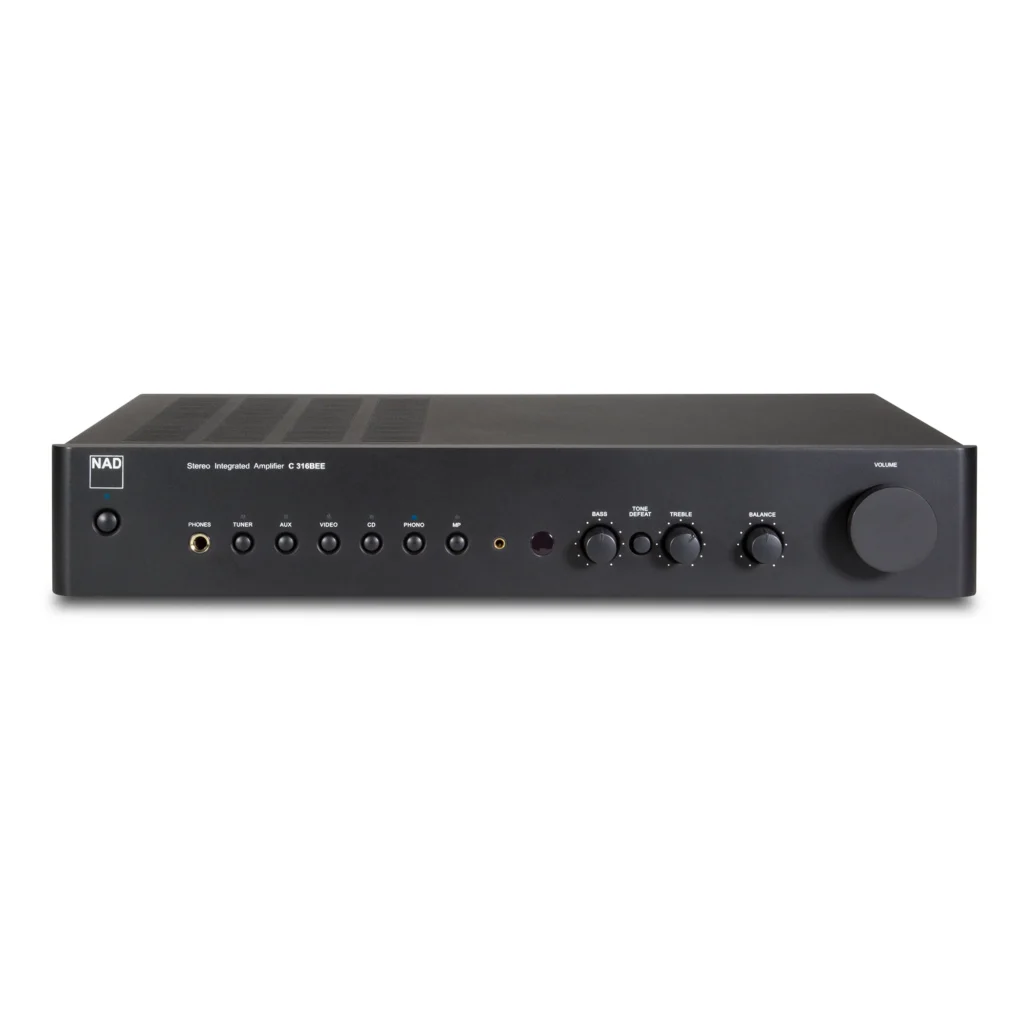
NAD C 316BEE V2 is a conventional analogue stereo amplifier with a moving-magnet phono stage and direct physical controls. It leaves digital conversion, Bluetooth and network streaming to separate sources, making it a deliberately focused starting point for passive speakers. The V2 identity matters because phono provision distinguishes it from the earlier model. This research-based review considers its published sound evidence, useful tone controls and practical system boundaries, without presenting an older simple amplifier as automatically better than more extensively equipped alternatives.
Research-based review. This assessment draws on manufacturer documentation and the original published evaluations linked below. Audio Review has not performed a hands-on test of this model.
A convincing modest-system case, with sensible limits
SoundStage Access’s original evaluation finds the C 316BEE V2 competitive in a system using revealing speakers, with relatively small character differences from the reviewer’s more expensive electronics. It also hears a softer phono presentation in one comparison and strain at unusually high playback levels. Those findings support an affordable stereo role rather than a claim of unlimited capability.
Audition the intended speakers at the actual listening distance and level. Use a voice-led recording, a busy arrangement and a passage with substantial bass to assess different demands. Listen for comfortable clarity and musical continuity rather than assuming that a simpler circuit necessarily produces more natural sound. A forty-watt-class amplifier can be sufficient for many domestic combinations, but speaker sensitivity, load and desired level remain relevant. The useful question is whether the system stays composed in the room where it will live. A short demonstration with easier speakers cannot establish that every loudspeaker is equally suitable. Choose the complete combination that remains enjoyable over an album, within the operating requirements of both components.
The source collection determines whether analogue simplicity helps
NAD documents line-level inputs and phono, without a built-in digital converter, wireless receiver or network platform. That is clear and manageable when existing sources already provide suitable analogue outputs. It creates additional requirements when the collection consists mainly of optical transports, computers or television apps.
Map each source before ordering. A CD player’s analogue output can connect directly, while a digital-only source needs an appropriate converter. A network player should provide a suitable line output if it is to feed this amplifier. Include those components and their daily control routine in the price comparison rather than assuming a low amplifier price represents a complete modern system. There is no reason to add equipment that duplicates a function already present in a source. Equally, there is little benefit in buying a simple amplifier and immediately surrounding it with several boxes solely to obtain facilities that another integrated product supplies. The best approach follows the equipment and listening habits already established.
V2 phono is useful when connected correctly
The built-in phono stage is intended for moving-magnet cartridges. That makes a straightforward record system possible, but it should not be confused with a normal line input or universal cartridge compatibility. The original evaluation’s phono comparison is useful context, not an independent measurement made by Audio Review.
Check whether the turntable already has an active phono stage before selecting the connection. A line-level turntable output belongs at a line input; a suitable unamplified cartridge signal uses phono. Avoid double equalisation and amplification, which can produce an obviously incorrect result. A low-output moving-coil setup needs appropriate matching equipment rather than an assumption that every cartridge works through the same sockets. Attend to grounding and position before concluding that audible hum is an unavoidable feature of records. Compare any external stage with sensible level matching and a real requirement. The included facility is valuable when it reduces the system to the components actually needed, instead of becoming a reason to add another stage automatically.
Tone controls can be practical rather than ideological
Bass, treble and Tone Defeat provide direct adjustment without an application. SoundStage Access found the controls useful for improving the balance of particular recordings, while noting that they must be operated at the amplifier rather than through the remote. Their existence is a practical option, not evidence that every recording should be altered.
Begin with a sensible speaker position and a reference setting. Make a modest change, replay the same passage and decide whether it improves the actual problem. A room-related bass excess and a deliberately warm recording are different things, so avoid settling on a strong permanent correction after hearing one track. Keep enough output headroom for the chosen level, particularly when increasing bass. Tone Defeat provides a straightforward comparison with the unadjusted route. The most useful setup is one in which another user can restore the normal setting easily. Physical controls may be appealing for their immediacy, but they should support informed listening rather than constant adjustment that obscures the underlying speaker and room match.
Headphones and future expansion need their own checks
A dedicated headphone output broadens private listening, but the presence of a socket does not establish an ideal match with every headphone. The receiver-style facilities of larger NAD products should not be assumed on this smaller analogue amplifier, either for source control or system expansion.
Try the actual headphones at low and ordinary levels, checking usable volume range, background noise and tonal balance. Do not apply a power claim measured for loudspeakers to a headphone output with different operating requirements. If an active subwoofer or other accessory is planned, establish the documented compatible connection before purchase rather than assuming a spare socket serves as a variable preamp output. Follow both manufacturers’ instructions and avoid improvised common-ground arrangements. A simple integrated amplifier may remain all the electronics needed for years, but an ambitious later upgrade plan can call for different outputs or processing. Settle which role matters now so the starting product is chosen for a real system rather than a vaguely defined path to something else.
Current complete price matters more than historical reputation
The official dimensions are approximately 435 mm wide, 90 mm high and 285 mm deep, with a weight around 5.5 kg. The understated enclosure and direct controls fit a traditional stereo arrangement, while suitable ventilation and cable clearance still need planning.
Check the exact V2 model, remote, condition and current regional warranty, especially when buying used or remaining stock. Do not use an original review’s old price as a permanent value statement. Add speakers, a source and any required converter or streamer before comparing alternatives. A listener with records, a suitable player and good passive speakers may find the NAD an efficient and familiar solution. A household expecting television ARC, app-based multiroom music and several digital inputs may be better served by another platform. Simplicity is an advantage when it matches the task. It is less convincing when the complete installation becomes more complicated and expensive solely to work around facilities omitted from the amplifier.
Alternatives to consider
Cambridge Audio AXR100: Consider a conventional receiver if broadcast radio and digital inputs are required, comparing the current complete price and intended speaker match.
Denon PMA-900HNE: Compare an integrated network and digital-source platform when those additions would otherwise need separate equipment. Account for the actual facilities used rather than feature count alone.
NAD C 316BEE V2 key specifications
- Model
- C 316BEE V2; phono-equipped version
- Role
- Stereo integrated amplifier; passive speakers required
- Manufacturer continuous rating
- 40 W per channel
- Analogue inputs
- Line-level sources including front portable input; MM phono
- Digital inputs / HDMI
- Not provided
- Bluetooth / network streaming
- Not built in
- Sound adjustment
- Bass and treble; Tone Defeat
- Private listening
- Dedicated headphone output
- Control
- Physical input buttons and volume; IR remote
- Dimensions
- Approximately 435 × 90 × 285 mm
- Weight
- Approximately 5.5 kg
- Expansion planning
- Verify exact output and load requirements before adding accessories
Verdict
C 316BEE V2 has a strong modest-stereo proposition when analogue sources, MM records and direct control fit the system. Original evidence supports its capability while preserving realistic output and phono qualifications. Audition the intended speakers, check headphone and expansion requirements, and compare the full source cost. It is a focused amplifier to choose for a clear role, not a universal answer to every modern connection need.
Documentation and original reviews
NAD official C 316BEE V2 features and technical specification · SoundStage Access original C 316BEE V2 evaluation · StereoNET original exact-model C 316BEE V2 review
Editorial record
Sources and updates
Product specifications and factual claims were checked against Official NAD C 316BEE V2 product page ↗. Scores and buying advice follow our category-specific editorial methodology.
- Published
- November 17, 2026
- Last updated
- November 17, 2026