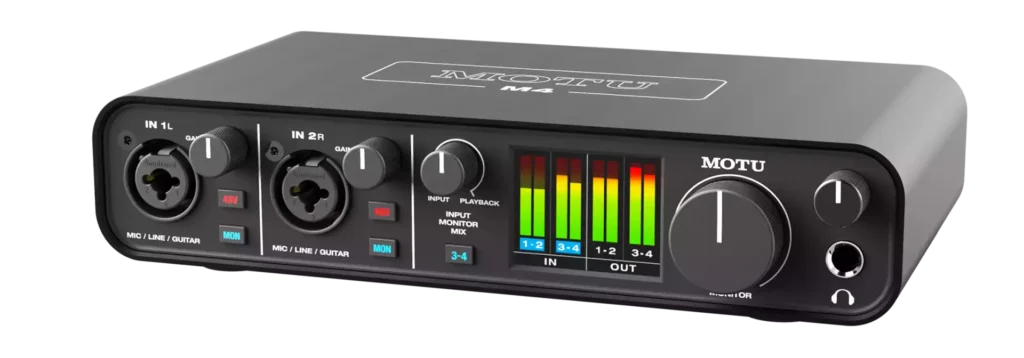
The MOTU M4 adds a pair of line inputs and extra outputs to the familiar two-preamp desktop interface format. That can make a practical difference for a small studio using a hardware synthesiser or other stereo source alongside microphones. Its colour meters and front-panel monitoring controls are workflow features worth considering separately from converter specifications.
MOTU M4 — Four inputs do not mean four preamps
MOTU lists two front XLR/TRS combination microphone, line or Hi-Z inputs, plus two quarter-inch line inputs. The extra pair suits an appropriate stereo line-level source; it is not another pair of microphone preamps for plugging in condensers without additional hardware.
Plan simultaneous sources before buying. A singer with guitar and a stereo keyboard has different requirements from a four-microphone drum session. The M4 may fit the first arrangement well while lacking the preamps needed for the second. Correct input count is more useful than simply choosing an interface with a larger number in its name.
The output connectors need careful counting
Four balanced TRS line outputs and four mirrored RCA outputs are documented, alongside a stereo headphone socket. Mirrored RCA sockets provide another connection format, not a new set of independent software-output channels.
This distinction matters when planning outboard processing or several monitor feeds. Check the DAW output assignment and physical connection diagram together. Balanced outputs can be appropriate for compatible monitors, while RCA may suit domestic equipment; neither connection should be sent into an ordinary microphone input at an unsuitable level.
Meters and direct monitoring help the session
The front display provides input and output level meters, while each of the first two inputs has its own gain, phantom-power and monitoring controls. An input-monitor mix control helps balance live sources with computer playback. Those are useful conveniences when recording without constantly opening software panels.
Direct monitoring avoids the full DAW path for the monitored input, but it does not make a plug-in effect return latency-free. For software instruments, amp simulations or vocal processing, the computer buffer and processing load still matter. Test the actual session rather than borrowing a manufacturer latency figure measured under different settings.
USB, MIDI and software ownership
The M4 uses USB-C with USB 2.0 audio-class operation and is bus-powered. USB-C describes the connector; it should not be sold as proof of USB 3 audio bandwidth. Check the current MOTU driver and operating-system requirements for the actual computer, especially as supported OS versions change.
MIDI input and output are useful for compatible hardware instruments, but MIDI carries control data rather than the instrument’s audio. A synthesiser may therefore need both MIDI and analogue audio connections. This is a common source of confusion when assembling a first hardware studio.
MOTU lists sample rates up to 192 kHz. Higher rates increase computer and storage demands and do not automatically improve a modest home recording. Choose settings for the project and workflow. We have not measured the M4’s converter performance or driver stability, so the review identifies a practical connection set rather than a verified performance ranking.
What to expect in a real setup
Can I record four microphones directly? The M4 has two microphone preamps. Its other two analogue inputs are line-level, so additional microphones need suitable external preamplification.
Do the RCA sockets create another four independent outputs? No. MOTU describes them as mirrored analogue outputs. Count independent channels separately from the number of physical sockets.
Alternatives to consider
MOTU M2: Compare the simpler MOTU interface when the extra line inputs and output routing are not needed.
Focusrite Scarlett 4i4 4th Gen: A relevant alternative for a similar small-studio source count with a different control and routing approach.
A keyboard-centred M4 setup
The extra line inputs make particular sense for a hardware keyboard that stays connected while the front channels handle a vocal and guitar. Record each source to its own track and check whether the keyboard’s left and right outputs are both required for the chosen patch. Keeping a stereo instrument connected can save repeated setup, but it also means planning the gain at the instrument itself. The rear line inputs do not acquire microphone gain controls simply because the application displays four input channels.
If the keyboard is sequenced over MIDI, preserve both the performance data and a recorded audio version when a project is ready to archive. MIDI editing offers flexibility, while the audio file protects the arrangement from later patch changes or unavailable hardware. Those are complementary roles. A cable carrying MIDI notes should not be expected to carry the sound heard from the keyboard.
Extra outputs need a defined purpose
A second line-output pair may be useful for suitable external processing or an additional playback destination, provided the DAW routing is correct. Name that pair clearly and start with connected equipment turned down. Do not assume it behaves exactly like the main monitor outputs under every control setting. Check which physical connectors mirror one another before assigning separate mixes; an RCA duplicate is another connector format for an existing signal, not an extra software bus.
For outboard processing, document the complete send and return path and leave a clean original track available. A routing mistake can produce feedback or a recording of the wrong source. Test with a short passage before committing a full project, then save the working configuration with descriptive track names.
M2 or M4 for a small studio?
Choose the M4 when its additional line inputs or playback channels remove a regular inconvenience. Choose a simpler arrangement when two sources and one stereo destination cover the work. Neither route replaces the need to test a real session with the intended buffer, virtual instruments and computer. The M4’s practical advantage is keeping a slightly more elaborate hardware studio organised within a compact interface, rather than promising that a larger model number alone will improve a recording.
MOTU M4 key specifications
- Analogue input channels
- 4
- Mic/line/Hi-Z inputs
- 2 XLR/TRS combo
- Additional line inputs
- 2 quarter-inch
- Independent line outputs
- 4 balanced TRS
- RCA outputs
- 4, mirrored
- Headphone connection
- 1 quarter-inch stereo
- Computer interface
- USB-C, USB 2.0 audio class
- MIDI
- Input and output
- Sample rates
- 44.1–192 kHz
- Power
- USB bus power
Verdict
The M4 is most attractive when its two-preamp-plus-line-input arrangement matches the instruments already in use. Its meters and monitoring controls can simplify sessions. Confirm current computer support and output routing, then test the desired DAW buffer and plug-ins before relying on it for a live task.
Primary documentation
Specifications and feature descriptions were checked against the following official documents on 6 November 2026. Compatibility advice is our interpretation of those documented capabilities; it does not establish measured sound quality. Regional bundles, software features and service availability can change, so verify the exact European model and current support information before purchase.
Editorial record
Sources and updates
Product specifications and factual claims were checked against Official MOTU M4 product page ↗. Scores and buying advice follow our category-specific editorial methodology.
- Published
- November 7, 2026
- Last updated
- November 8, 2026