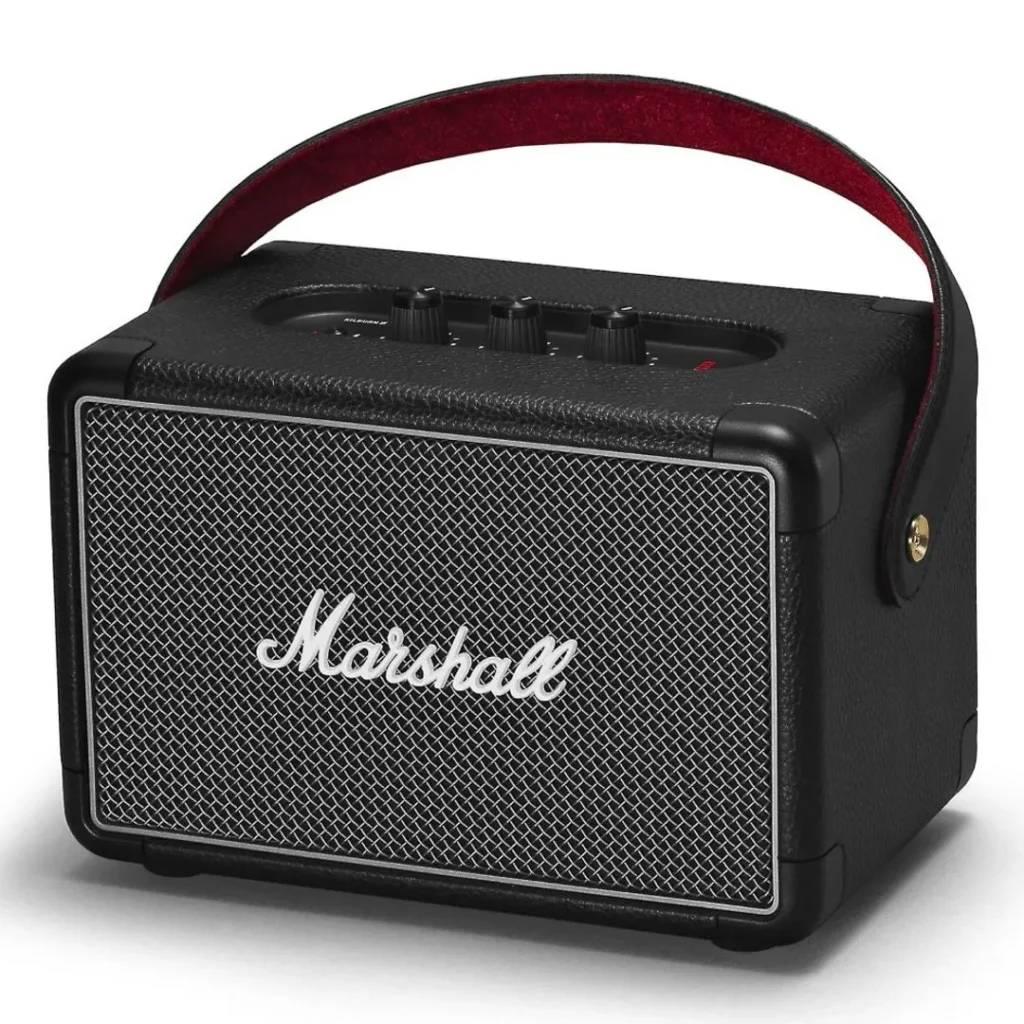
Marshall Kilburn II is an older battery-powered speaker with a deliberately tactile approach. Volume, bass and treble are adjusted on the cabinet, a strap makes it easy to move between nearby listening spots, and a wired input accommodates sources beyond Bluetooth. Its appeal is clear, but it should now be considered alongside newer models rather than treated as a current feature leader. The right buyer values its controls and appearance enough to accept the weight and limited weather protection.
Research-based review. This assessment draws on manufacturer documentation and the original independent evaluations linked below. Audio Review has not performed a hands-on test of this model.
A portable speaker with a different idea of portability
Marshall’s official specification gives a weight of two and a half kilograms. That is manageable for moving between rooms or carrying from a car to a nearby table, but a different commitment from a small speaker left in a backpack all day. Try the handle and the balance of the cabinet before deciding it suits a longer walk.
The rectangular cabinet also needs a stable place to sit. Avoid balancing it on an edge where the strap can catch on clothing or another bag. A speaker that sounds appealing at home is not automatically the best travel companion. Think about the actual distance it will be carried, the remaining space in the luggage and whether its physical controls will be easy to reach in the intended position.
Sound: energy with a bass qualification
TechRadar’s original review is positive about the Kilburn II’s volume, lively presentation and clear upper-frequency detail with guitar music. It also notes that bass can become muddy. That combination suggests an enjoyable social-listening speaker, with a reason to audition dense or bass-heavy recordings before buying.
Use several familiar tracks rather than one recording chosen to flatter the speaker. Listen for whether bass lines remain distinguishable beneath vocals, and whether cymbals become tiring at the level you normally use. The appeal of a strong initial impact can fade if it obscures the quieter parts of a mix. This review’s recommendation therefore depends on liking the overall balance, not on the assumption that a rock-associated brand must suit every listener or every genre.
Physical tone knobs are a real practical feature
The separate bass and treble controls are one of the Kilburn II’s clearest advantages. They make a quick adjustment possible without opening an app, which can be useful when moving from a small room to a larger shared space. Start near the middle and adjust for the placement and music rather than treating maximum bass as the default.
Tone controls cannot create unlimited low-frequency output from a compact cabinet. If the speaker sounds strained, reducing bass and overall level can be more effective than trying to force a larger presentation. A room corner can also change the apparent balance, so move the speaker before making an extreme adjustment. The controls are most useful as a simple way to refine the result, not as a substitute for a more suitable speaker size.
Bluetooth and the value of the wired input
Bluetooth handles ordinary wireless playback, while the three-and-a-half-millimetre input provides a route from an appropriate analogue source. The official specifications list neither Wi-Fi nor a microphone. This is not a network music system or a conference-call speaker.
The analogue input may be a decisive reason to choose this older model when many compact rivals focus solely on wireless use. Check the source output and start with conservative volume settings. A headphone output and a fixed line output behave differently, so use the source’s instructions to establish a suitable level. For video or an instrument-related setup, test the complete signal path; an input socket alone does not establish latency or make the speaker a dedicated performance monitor.
Battery life and the charging arrangement
Marshall advertises more than twenty hours of portable playback. Treat that as a manufacturer claim, not an independently repeated result from Audio Review. Actual endurance depends on volume, material, settings, battery age and temperature. An older unit may also have spent a significant period in storage before purchase.
Check the mains lead and regional supply arrangement with the seller, especially for imported or used stock. The charging system is different from carrying a small USB-powered speaker and topping it up from the same charger as a phone. A mains connection may be perfectly convenient for a room-to-garden routine, but less so on a trip without predictable sockets. Decide from that routine rather than the headline hour figure alone.
IPX2 is a meaningful limitation
The official water-resistance rating is IPX2. It should not be read as the more extensive protection found on speakers designed for poolside immersion or dusty travel. Keep it sheltered and follow the manufacturer’s care guidance rather than interpreting the rugged styling as an unrestricted outdoor guarantee.
This is particularly relevant when choosing a speaker for a beach, boat or unpredictable weather. The purchase price is only part of the decision if the intended environment regularly exceeds its protection level. An indoor-focused listener may rarely encounter that limitation, while someone wanting one speaker for every holiday should put it near the top of the comparison. Appearance, a carrying strap and a protective rating describe different aspects of durability.
How to judge an older model today
The Kilburn II can remain appealing without being the newest choice. Compare the current selling price with Kilburn III and with portable speakers built around more modern charging and outdoor features. Avoid using the original launch price as proof of a bargain; a discount matters only in relation to the alternatives available now.
For used units, inspect controls, sockets, strap attachments and the battery’s behaviour during a normal listening session. Ask about included accessories and return options. A clean-looking cabinet does not establish battery condition. For new remaining stock, warranty support and a reliable seller can be worth more than a small saving. This is a product to buy for a specific set of preferences, not simply because an older premium model has become cheaper.
Alternatives to consider
Marshall Kilburn III: Compare the newer Kilburn III before buying remaining Kilburn II stock. Look at the current connection and battery package, warranty and actual price gap; the older model should offer a clear reason to choose it rather than benefiting only from a familiar badge.
JBL Charge 6: Charge 6 is a different portability proposition. Compare it when weather resistance and carrying convenience take priority, while checking whether losing the Kilburn II analogue input or physical tone knobs would make your own setup less convenient.
Marshall Kilburn II key specifications
- Design
- Battery-powered bass-reflex Bluetooth speaker
- Wireless
- Bluetooth 5.0
- Wired input
- 3.5 mm analogue
- Tone controls
- Physical bass and treble knobs
- Battery claim
- More than 20 hours; manufacturer figure
- Water resistance
- IPX2
- Weight
- 2.5 kg, official specification
- Dimensions
- 243 × 162 × 140 mm
- Wi-Fi / microphone
- Neither
- Charging
- Mains connection
- Amplifier outputs
- Class D. 20 W for the woofer and 2 × 8 W for the tweeters.
Verdict
Kilburn II combines an attractive cabinet, useful physical tone controls and a wired input with an energetic presentation supported by the original review. It remains a plausible choice for moving music around the home or to a sheltered nearby listening spot.
Its weight, mains charging arrangement and IPX2 rating narrow that recommendation. Compare Kilburn III before buying and choose a more weather-focused rival for demanding outdoor use. The Kilburn II is most convincing when its tactile controls and analogue flexibility solve real needs, at a price that makes sense against current alternatives.
Primary documentation and independent reviews
Marshall official Kilburn II specifications · TechRadar original Kilburn II review
Editorial record
Sources and updates
Product specifications and factual claims were checked against Official Marshall Kilburn II product page ↗. Scores and buying advice follow our category-specific editorial methodology.
- Published
- November 17, 2026
- Last updated
- November 17, 2026