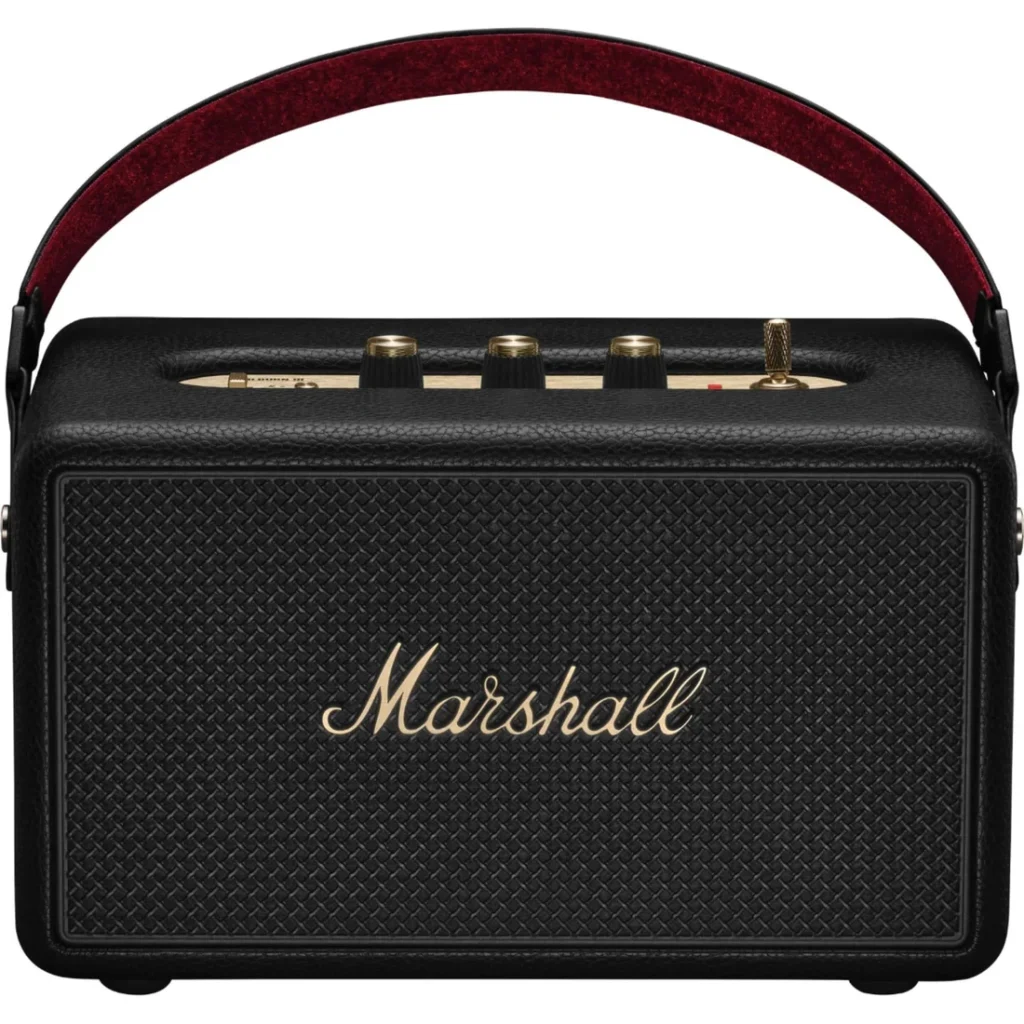
The Marshall Kilburn III combines familiar amplifier-inspired styling with a genuinely useful set of physical controls. It is a portable music speaker intended to move around a home or accompany a trip, rather than a pocket-sized travel device. Long battery potential and straightforward operation are its strongest attractions, while the price and splash-only protection deserve careful comparison.
Marshall Kilburn III — Design that serves everyday use
The Kilburn III’s top controls are part of its practical appeal. Volume, bass and treble can be adjusted without opening an app, and a separate playback control handles ordinary track tasks. This suits shared use where the phone supplying music may belong to someone else. Try reaching and reading the controls in the position where the speaker will normally sit.
The strap and compact-amplifier appearance make movement between rooms natural, but the 2.8 kg weight is substantial for a bag carried all day. It is better described as portable around a home or between destinations than as an ultralight companion. Check the available carrying space alongside the rest of the trip’s equipment rather than judging portability from the strap alone.
Marshall documents authorised repair options and replaceable-battery provision, with market availability requiring confirmation. That is worth investigating for long-term ownership, but should not be translated into an assumption that every repair is free or user-performed. Check current local support and parts arrangements before treating repairability as a decisive advantage over a cheaper alternative.
Sound layout and listening expectations
The manufacturer’s True Stereophonic design aims to spread sound around the enclosure using its woofer and full-range driver arrangement. That is useful for people moving around a room or sitting in a group. It does not create the same channel separation and stable seated image as two speakers placed apart. Choose the format for its intended shared-listening role rather than expecting miniature hi-fi separates.
AVForums’ original evaluation praised the speaker’s confident, energetic sound and useful controls, while noting some compression at the highest levels. That supports a strong portable-speaker assessment without repeating an unlimited clean-output claim. The original listening took place in that reviewer’s environment; Audio Review’s rating draws on that evidence and the documented features rather than a separate hands-on audition.
A useful personal comparison includes familiar vocals, rhythmically busy music and sustained bass at ordinary volume. Then check the loudest level actually required. A speaker that is enjoyable at moderate levels does not need to be judged solely at its limiting point, but an owner planning a noisy gathering should know how much balance changes near that point.
Tone controls and placement
Physical bass and treble controls encourage quick adjustment to the room. A corner or wall can reinforce low frequencies, while a more open location may sound lighter. Start with sensible placement and a moderate setting, then change one control at a time. Large bass boosts can use headroom without turning a portable speaker into a subwoofer.
The Marshall app adds configuration and a preset accessed through the M button. That lets an owner keep an alternate balance available while retaining simple physical operation. Try the current app with the phone used most often and check whether the settings remain understandable to other users. A useful preset should solve a real listening need rather than merely sound more dramatic during a short demonstration.
Dynamic Loudness is part of the product’s processing, but it should be judged by how the balance behaves across ordinary levels. A natural quiet setting and a lively louder setting are both relevant. When comparing speakers, match perceived volume carefully: a louder product can initially sound more detailed and exciting without necessarily being more balanced through a complete album.
Battery and charging reality
Marshall advertises more than 50 hours of playback. That is a manufacturer endurance claim, not an Audio Review battery measurement or a guarantee at maximum level. Content, volume, charging behaviour and battery age change the practical result. The long claim is attractive for infrequent charging, but a trip still deserves a margin rather than a plan built around the last advertised hour.
The official fast-charge figure is eight hours of playback from 20 minutes with a suitable 30-watt USB-C PD charger; a full recharge is quoted at around three hours under the stated setup. The charger is not listed among the included items. Check the supply rather than assuming any small USB adapter will reproduce the headline charging time.
The speaker can also charge a compatible phone, which is useful away from a socket. That energy comes from the same battery used for playback. Do not combine the longest playback claim and repeated phone charging as if they were independent resources. Decide whether music endurance or the phone top-up matters more for the trip, and pack the appropriate cable.
Connections, protection and limits
Bluetooth 5.3 and a 3.5 mm auxiliary input cover common wireless and analogue sources. The current official feature list also includes Auracast and supported modern codecs, but compatibility depends on the source and firmware. Try the intended broadcast or pairing workflow instead of assuming every Bluetooth device can provide every newer function. A protocol name alone does not establish universal interoperability.
There is no built-in microphone and no independent Wi-Fi music platform. This is a music speaker rather than a voice-controlled smart-home product. A phone can supply online music through Bluetooth, but that is different from the speaker itself joining a service and continuing independently. If whole-home Wi-Fi grouping is central, compare a product designed around that role.
IP54 provides limited dust ingress protection and resistance to splashes. It is not an immersion rating. The Kilburn III should therefore not be treated like an IP67 poolside speaker or deliberately submerged. This distinction is particularly important because its handle and battery can make it look ready for every outdoor task. Choose the environment according to the actual protection, not the portable styling.
Value and the best use case
The Kilburn III is strongest for someone who values a pleasant physical interface, distinctive appearance and movement around the home. An owner can change the balance without handing over a phone, and the long claimed endurance reduces charging frequency. Those practical advantages can justify a premium when they are used every day.
It is less obviously good value if the goal is the cheapest maximum output, the smallest bag or full waterproof protection. Compare current European offers with those priorities stated in advance. A lower-cost speaker may cover occasional outdoor background music adequately, while a Wi-Fi portable may serve a network-based household more effectively despite a shorter battery claim.
For an audition, use the physical controls and alternate between a close seated position and movement around the room. Check that voices remain clear and the bass setting works without masking detail. Choose the Marshall because the complete combination is enjoyable and convenient, while accepting the weight, lack of smart functions and splash-only protection as deliberate tradeoffs.
Alternatives to consider
Marshall Middleton II: Compare another Marshall portable if the carrying format and outdoor protection are higher priorities.
Sonos Move 2: Consider a Wi-Fi-oriented portable if independent network music and the home ecosystem matter more than analogue tone controls.
Marshall Kilburn III key specifications
- Type
- Portable Bluetooth stereo speaker
- Drivers
- One 4-inch woofer and two 2-inch full-range drivers
- Manufacturer amplifier layout
- 30 W woofer plus two 10 W full-range channels
- Sources
- Bluetooth 5.3 and 3.5 mm auxiliary
- Battery claim
- 50+ hours, condition dependent
- Fast charging claim
- 20 minutes for eight hours with suitable 30 W USB-C PD supply
- Protection
- IP54
- Weight
- 2.8 kg
Verdict
A very appealing room-to-room music speaker with useful physical controls and strong original sound evidence. Its long battery claim is attractive, but the weight, price and IP54 protection make it a deliberate lifestyle choice rather than a universal outdoor recommendation.
Primary documentation and independent reviews
Marshall official regional Kilburn III specifications · Marshall official Kilburn III launch details · AVForums original Kilburn III review
Editorial record
Sources and updates
Product specifications and factual claims were checked against Official Marshall Kilburn III product page ↗. Scores and buying advice follow our category-specific editorial methodology.
- Published
- November 8, 2026
- Last updated
- November 8, 2026