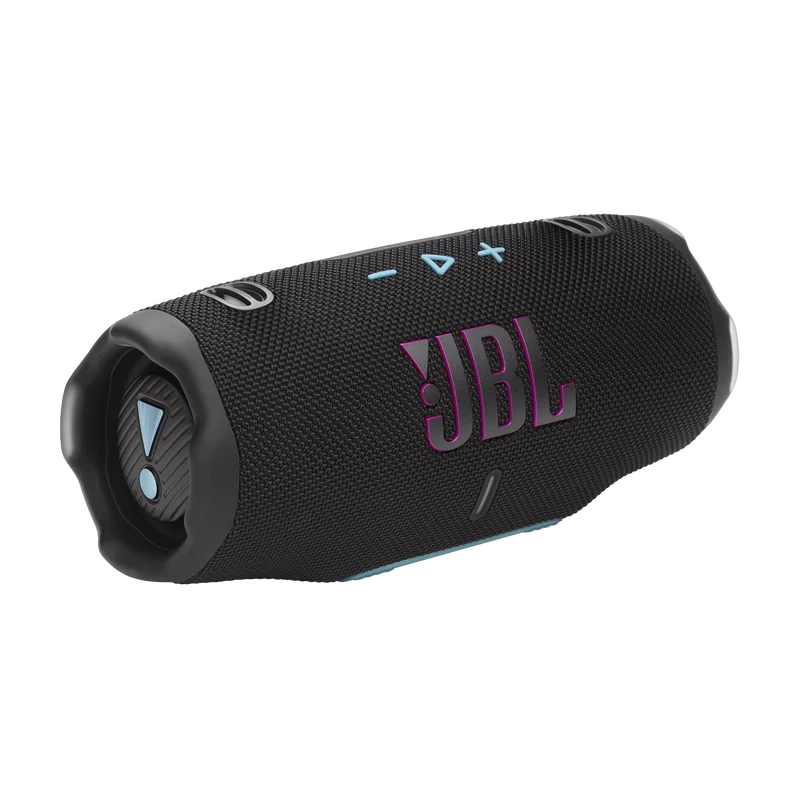
Research note: This is an independent, research-based assessment built from official specifications and product documentation. We have not claimed a hands-on laboratory test.
JBL Charge 6 key specifications
- Model
- JBL Charge 6
- Drivers
- 53 × 93 mm woofer; 20 mm tweeter
- Output power
- 30 W RMS woofer + 15 W RMS tweeter
- Frequency response
- 56 Hz–20 kHz (−6 dB)
- Signal-to-noise ratio
- >80 dB
- Bluetooth
- Version 5.4; A2DP 1.4 and AVRCP 1.6
- Battery
- 34 Wh Li-ion polymer (7.2 V / 4722 mAh)
- Battery life
- Up to 28 hours with Playtime Boost
- Charging time
- 3 hours; 10 minutes gives up to 2.5 hours playback
- Water and dust resistance
- IP68
- Connections
- USB-C charging, USB-C lossless audio and powerbank output
- Wireless features
- Auracast; JBL Portable app
- Dimensions
- 228.8 × 98.5 × 94 mm
- Weight
- 0.99 kg with handle
Sound and driver layout
A dedicated woofer and tweeter provide 45 W RMS combined output and a specified 56 Hz–20 kHz response. That two-way arrangement helps the Charge 6 deliver clearer upper frequencies than a single full-range driver while preserving the warm, punchy character expected from the series. It remains a compact mono speaker, so imaging is limited; two compatible units are needed for meaningful stereo width.
Size and practical portability
At 1.37 kg, Charge 6 is substantial in a backpack but far easier to move than Xtreme or Boombox models. The removable strap helps with short carries. Its cabinet has enough volume for useful bass without taking over a table, which explains the model’s broad appeal. Buyers who prioritize minimum weight should choose Flip 7, while those prioritizing outdoor loudness should step up to Xtreme 4.
Battery and power-bank function
JBL lists up to 28 hours when Playtime Boost is included; ordinary maximum playback is lower and actual endurance varies with volume, EQ and phone charging. A ten-minute fast charge can add up to 150 minutes under stated conditions. The USB power-bank function can rescue a phone, though using it naturally draws from the speaker battery and does not replace a high-capacity dedicated charger.
Durability and maintenance
An IP68 rating protects against dust and controlled water immersion, and JBL also claims survival after a one-metre drop onto concrete under test conditions. These are valuable safeguards for beaches, campsites and kitchens, not invitations to abuse the product. USB-C connections should be removed before exposure to water, and the port must be dry before charging or wired playback.
USB-C audio and wireless features
Bluetooth 5.4 covers normal streaming, and Auracast links compatible speakers for wider coverage. USB-C lossless playback from a compatible source is available through software support, giving laptop users a direct digital option. That feature matters most in quiet environments; outdoors, placement and background noise overwhelm small codec differences. Owners of older JBL speakers should verify linking compatibility rather than assuming PartyBoost and Auracast interoperate.
Value within the JBL range
Charge 6 occupies the useful centre of the range. Flip 7 is lighter and cheaper, Xtreme 4 delivers more scale, and Boombox 4 targets parties. Charge 6 is often the best single-speaker compromise because it adds power-bank utility without becoming cumbersome. Its price premium over basic Bluetooth speakers pays for durability, app support, ecosystem linking and a more capable two-way acoustic design.
Who should buy it?
Buy Charge 6 for holidays, gardens, kitchens and general travel when one speaker must balance output, battery life and packability. It is also a good choice for people who value a built-in emergency phone charger. It is less suitable for ultralight travel or large parties without additional speakers.
Alternatives to consider
JBL Flip 7 reduces size and weight, while JBL Xtreme 4 adds output and a replaceable battery. Bose SoundLink Flex 2nd Gen emphasizes simpler portability and positioning, and Soundcore Motion 300 is a budget alternative with app EQ and strong water resistance.
Verdict
JBL Charge 6 remains the range’s sweet spot. It is not the smallest or loudest option, but its 1.37 kg body combines useful bass, long quoted endurance, IP68 protection and genuinely practical extras. For many buyers, that balance is more valuable than chasing maximum specifications.
Primary source
JBL Charge 6 official product page
Editorial record
Sources and updates
Product specifications and factual claims were checked against Official JBL Charge 6 product page ↗. Scores and buying advice follow our category-specific editorial methodology.
- Published
- June 24, 2026
- Last updated
- July 25, 2026
Compare before choosing
Two strong alternatives from the same portable speakers category.