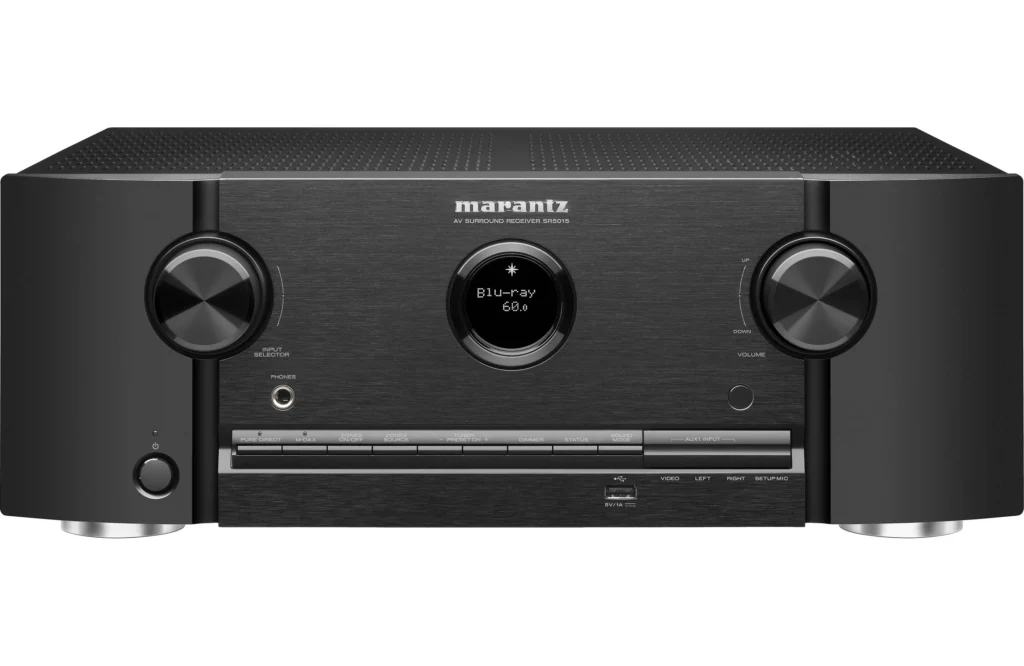
Marantz SR5015 is an archived seven-channel receiver that can still attract buyers through remaining stock or the used market. It combines network music, a phono input and multichannel pre-outs with Dolby Atmos and DTS:X support for a modest height-speaker layout. Its appeal needs current context. The receiver belongs to an earlier HDMI generation, and its original review is more enthusiastic about musical presentation than about unlimited multichannel muscle or price-to-feature leadership. A good purchase depends on the verified unit and system, not the original eight-K marketing position.
Research-based review. This assessment draws on manufacturer documentation and the original independent evaluations linked below. Audio Review has not performed a hands-on test of this model.
Seven channels remain seven channels
The natural immersive configuration uses five conventional speaker positions and a pair of height channels. Adding an external power amplifier through the pre-outs does not create extra processed speaker positions beyond the platform’s limit. That is a different capability from a receiver that processes more channels than it amplifies internally.
Decide the intended endpoint before buying. A seven-channel system can be enough for a suitable living room, but a future plan involving rear surrounds and four height speakers requires a different platform. Pre-outs are valuable for amplification flexibility, not a substitute for the missing processing. Write the speaker plan down and check the manual assignment rather than counting sockets and assuming that every desired layout can be activated later.
Sound: a music-oriented strength with a cinema caveat
HIFI.DE’s original test is positive about musical expression, construction and operation, while wanting more power for demanding surround use and a stronger value case. This supports a qualified music-and-cinema recommendation rather than a claim that the SR5015 is ideal for every large room or speaker load.
Try ordinary stereo music and a film scene at the levels you actually use. Listen for clear dialogue and a coherent transition between speakers rather than focusing only on impact. The speakers and subwoofer contribute heavily to the result, and the room changes the balance. A direct comparison should use similar levels and known settings, otherwise an apparently more impressive receiver may simply be playing louder or with different processing enabled.
The HDMI generation deserves a specific test
The official manual describes one dedicated high-bandwidth input. It is incorrect to assume that every HDMI input can handle the same highest video modes. For a modern console or computer, check the actual resolution, frame rate and HDR settings with the exact receiver and display.
For an older unit, confirm firmware and any relevant service history with the seller or manufacturer. Do not accept a broad statement that an update makes every high-frame-rate source combination work. A direct television connection with audio returned through eARC may be useful in some systems, but then the television’s audio pass-through must also be verified. The preferred route is the one demonstrated to work reliably with the sources that will be used every day.
Pre-outs: flexibility rather than automatic necessity
The multichannel pre-out arrangement permits external amplification where it serves an identified need. That could relate to a particular speaker load, desired headroom or an existing amplifier. It is not a reason to add another box before checking whether the internal channels already work satisfactorily in the room.
Include the amplifier, interconnects, power and ventilation in the budget. Confirm how levels and assignments are managed before connecting a mixed amplification setup. If the main objective is a larger speaker-channel layout, choose a receiver with the necessary processing instead. A careful distinction between power amplification and channel processing prevents an expensive upgrade path that cannot deliver the intended configuration.
XT calibration and physical installation
The official specification gives Audyssey MultEQ XT, distinct from the XT32 tier on higher models. Use the correct microphone and follow the measurement procedure before making detailed listening judgments. Inspect the channel identification, subwoofer operation and general balance after calibration.
Speaker placement still comes first. Keep the centre as unobstructed as possible and plan surrounds around the seating rather than convenient empty corners. Calibration is not permission to ignore ventilation or pack the receiver tightly into a cabinet. Check the available depth for plugs and cable bends as well as the front-panel width. A stable installation that works predictably is a more useful foundation than repeatedly changing software settings to compensate for physical problems.
Music, formats and the everyday interface
HEOS, AirPlay 2 and the analogue connections can make the SR5015 a useful music hub. Verify current service availability and the correct phono or line connection for a turntable. An existing built-in phono stage changes the required input, even when both cables use familiar RCA plugs.
The official feature table does not include IMAX Enhanced or Auro-3D, despite conflicting claims in some secondary descriptions. Treat supported formats as model-specific rather than importing a feature from a higher receiver in the range. Also try the small porthole display, remote and on-screen information from the listening seat. A receiver’s daily value includes an input-selection routine that the household can repeat comfortably, not only the longest possible decoder list.
Buying an archived receiver responsibly
Inspect HDMI sockets, speaker terminals, remote, antennas and the calibration microphone. Test the network connection and several sources before accepting a used unit. Check regional identity and power requirements if it has been imported, and verify the terms of any warranty rather than assuming the original coverage follows the product indefinitely.
Compare current CINEMA 60 and X2800H offers with the full older-model cost, including any necessary switching or accessories. A meaningful saving can make SR5015 attractive, while a small discount may leave a newer platform the more convenient choice. Its value lies in a verified seven-channel system with a presentation you enjoy. The original launch price and the Marantz badge are context, not a substitute for those checks.
Alternatives to consider
Marantz CINEMA 60: CINEMA 60 is the important newer-platform comparison. Check the precise HDMI sources, warranty and current price; a small saving on an older receiver may not compensate for a connection layout that immediately needs a workaround.
Denon AVR-X2800H: X2800H offers another seven-channel route. Compare actual calibration, inputs and daily operation, with the speakers and levels held consistent for any audition rather than assuming a brand name alone determines the listening result.
Marantz SR5015 key specifications
- Generation
- Archived SR5015, 2020-era platform
- Amplified speaker channels
- Seven
- Immersive layout
- Up to five bed channels plus two height channels
- Formats
- Dolby Atmos and DTS:X
- IMAX Enhanced / Auro-3D
- Neither, official specification
- Room correction
- Audyssey MultEQ XT
- HDMI
- Six inputs, two monitor outputs
- High-bandwidth input
- One dedicated 8K input; verify source/unit compatibility
- TV return
- eARC
- Pre-outs
- 7.2-channel arrangement
- Network music
- HEOS, AirPlay 2, Wi-Fi and Ethernet
- Phono
- MM input
- Dimensions (W × H × D)
- 440 × 161 × 348 mm with antennas horizontal; height 231 mm with antennas upright
- Weight
- 10.1 kg
Verdict
SR5015 remains a plausible older seven-channel choice for someone who values its music presentation, XT calibration and pre-out flexibility. The original evaluation supports those strengths while setting useful power and value qualifications.
Confirm HDMI behaviour on the exact unit and keep the processing limit clear. Compare newer alternatives whenever the price gap is modest. The right SR5015 purchase is a well-checked receiver for a defined room and layout, with condition and compatibility reflected in the price.
Primary documentation and independent reviews
Marantz official archived SR5015 information · Marantz SR5015 European technical sheet · Marantz SR5015 official HDMI and feature explanation · HIFI.DE original SR5015 listening evaluation
Editorial record
Sources and updates
Product specifications and factual claims were checked against Official Marantz SR5015 product page ↗. Scores and buying advice follow our category-specific editorial methodology.
- Published
- November 17, 2026
- Last updated
- November 17, 2026