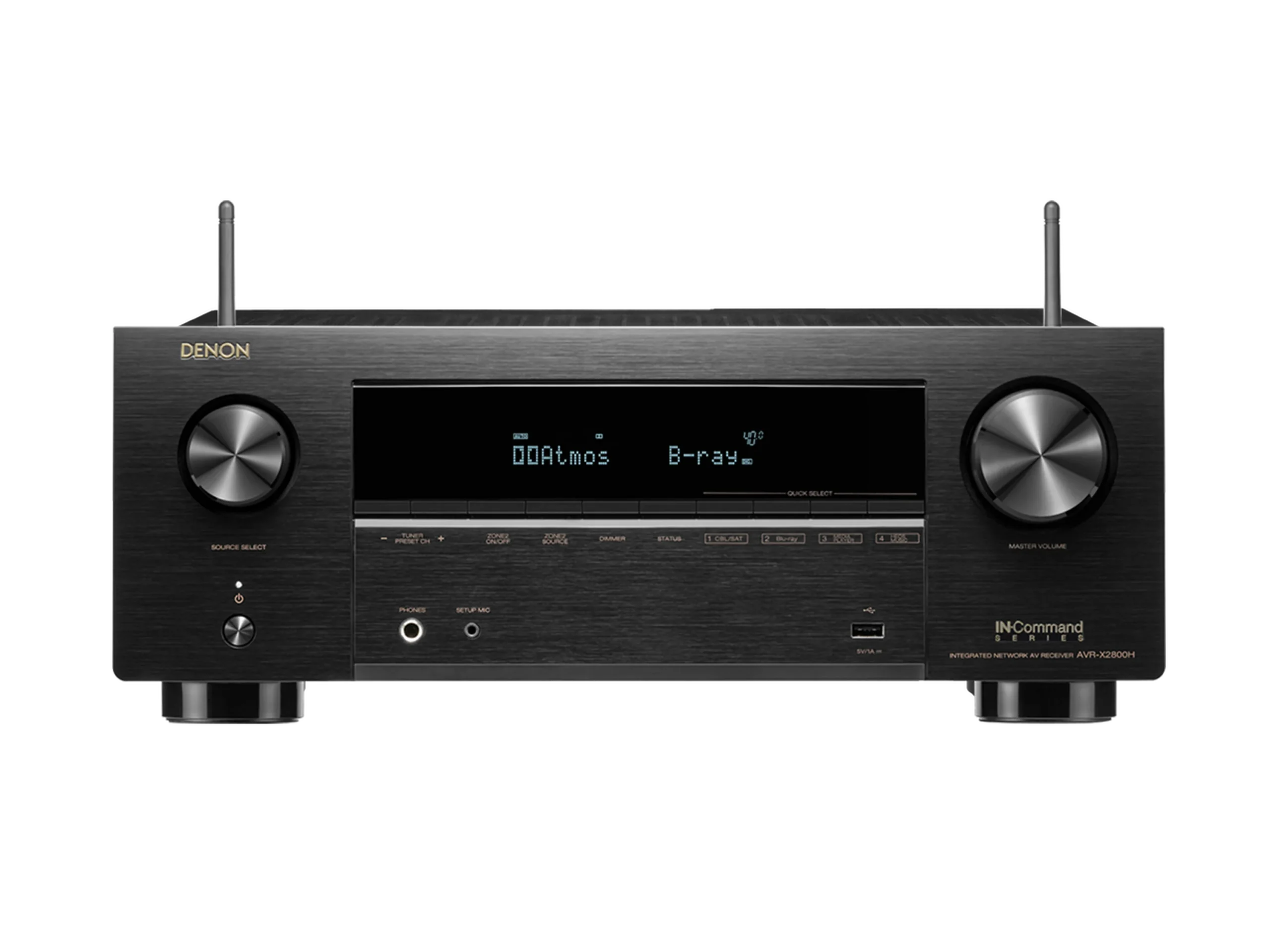
The Denon AVR-X2800H is a seven-channel receiver for buyers building a separate-speaker system without immediately moving into large immersive layouts. Its value depends on matching the intended speaker count and HDMI sources. The useful question is whether its channel and connection limits are sufficient for the room, rather than whether a newer or more expensive receiver exists.
Research-based review. This assessment examines manufacturer documentation and the product’s suitability for different systems. We have not carried out hands-on listening, laboratory measurements or a battery test of this model. Performance figures below are manufacturer claims, not independently measured results.
Choose the speaker layout first
Denon identifies the AVR-X2800H as a 7.2-channel receiver. Seven amplifier channels must be divided between ear-level and height duties: a 5.1.2-style layout uses the available seven, whereas seven ear-level speakers plus four height speakers requires a different class of system.
Subwoofer outputs are line-level connections for powered subwoofers, not additional amplified passive-speaker channels. The dot notation can obscure this distinction for first-time buyers. Draw the intended room layout, count each speaker and identify cable routes before choosing a receiver by a headline number.
HDMI routing and television audio
Denon’s UK specification lists six HDMI inputs. The EU manual distinguishes source inputs from the TV connection and documents ARC/eARC. An external source can connect to the receiver, or in a suitable setup connect to the TV and return compatible audio through eARC.
Check which sockets support your required video mode, rather than assuming all HDMI inputs have identical high-frame-rate capabilities. A console’s resolution, refresh rate and HDR requirements need to match the chosen port and cable path. Ordinary film streaming and high-refresh gaming can place different demands on the same installation.
Calibration is part of setup, not a substitute for it
Audyssey MultEQ XT is included according to Denon. Use the supplied microphone and follow the placement instructions carefully. Measurements taken from an unsuitable position or with a noisy room create a poor starting point, even if the receiver completes the process successfully.
After calibration, check speaker assignments, distances, levels and crossover choices for obvious errors. Room correction cannot move a speaker away from an obstruction or eliminate every seating-position difference. A sensible layout and subwoofer placement should come before treating software as a solution to all acoustic problems.
Power, streaming and long-term value
Denon’s 95 W figure is specified into eight ohms over 20 Hz to 20 kHz at 0.08 percent distortion with two channels driven. It is not a measured all-seven-channel output claim. Compare amplifiers using similar conditions and consider loudspeaker sensitivity, distance and the desired listening level.
HEOS adds network music functions, but current services and account requirements should be checked for your country. With newer Denon models available, compare actual local offers and warranty rather than old launch prices. This receiver is most attractive when the planned system already fits its limits and the saving can go towards speakers, a subwoofer or careful installation.
What to expect in a real setup
Can seven amplifier channels power a 7.1.4 system? No. That arrangement requires eleven main and height speaker channels. Subwoofer-output notation does not add extra speaker amplifiers.
Does 95 W mean every channel delivers that simultaneously? No. Denon states the conditions for that rating as two channels driven. It should not be re-labelled as an all-channel measurement.
Alternatives to consider
Denon AVR-X2900H: Compare the newer model on the particular connection or software changes you need and the actual local price difference.
Denon AVR-X1800H: A useful lower-tier comparison if the intended layout is straightforward and fewer features already meet the requirements.
Denon AVR-X2800H key specifications
- Configuration
- 7.2 channels
- Amplified main/height channels
- 7
- Power rating
- 95 W/ch, 8 ohms, 20 Hz–20 kHz, 0.08% THD, 2ch driven
- UK HDMI inputs
- 6
- TV audio return
- ARC/eARC
- Room correction
- Audyssey MultEQ XT
- Network music
- HEOS
- Immersive formats
- Dolby Atmos, DTS:X
Verdict
The AVR-X2800H works best as the centre of a deliberately bounded system. Its documented HDMI and calibration tools are useful, but speaker layout and source routing should drive the purchase. We have not bench-tested its power or auditioned its sound, so no tonal or output ranking is claimed.
Primary documentation
Specifications and feature descriptions were checked against the following official documents on 6 November 2026. Compatibility advice is our interpretation of those documented capabilities; it does not establish measured sound quality. Regional bundles, software features and service availability can change, so verify the exact European model and current support information before purchase.
- Denon AVR-X2800H official UK product specifications
- Denon AVR-X2800H EU connection manual
- Denon AVR-X2800H EU HDMI format guidance
Editorial record
Sources and updates
Product specifications and factual claims were checked against Official Denon AVR-X2800H product page ↗. Scores and buying advice follow our category-specific editorial methodology.
- Published
- November 6, 2026
- Last updated
- November 6, 2026
Highly ranked reviews in this category
Selected by category rank and editorial score within av receivers. Check each product's design and intended use before adding it to your shortlist.