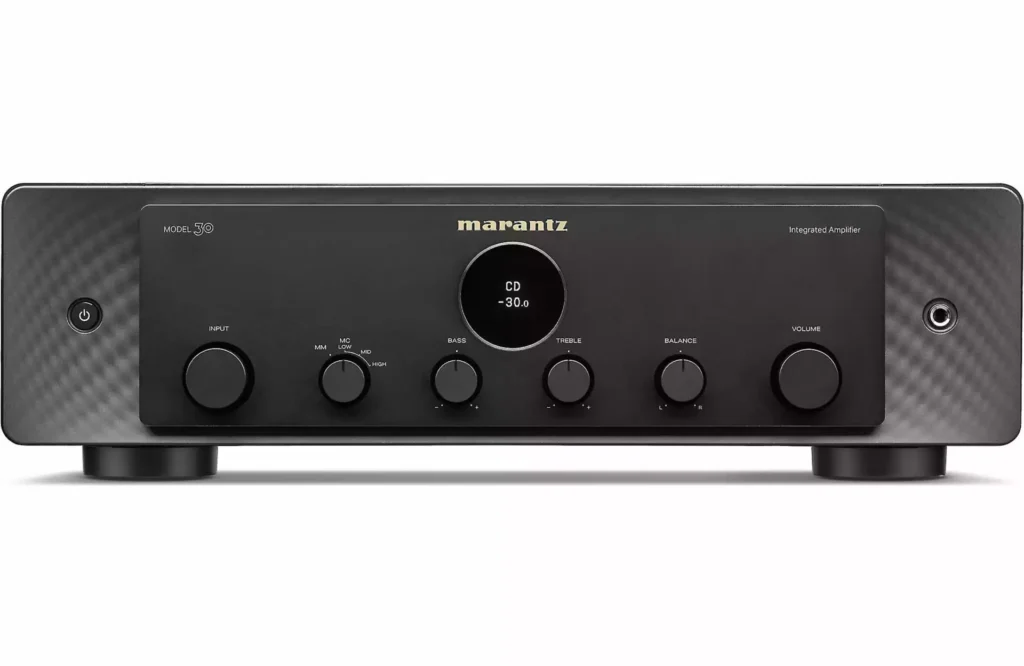
Marantz MODEL 30 is an analogue integrated amplifier with a Class-D power stage and a flexible MM/MC phono section. Class D does not mean it accepts digital audio: network playback and conversion remain external tasks, often handled by the separately named SACD 30n partner. This research-based review considers its positive original musical evidence, adjustable cartridge loading and practical expansion limits. The useful buying question is whether a premium analogue hub suits the existing sources, rather than whether its styling resembles a complete modern streaming system.
Research-based review. This assessment draws on manufacturer documentation and the original published evaluations linked below. Audio Review has not performed a hands-on test of this model.
The original evidence supports a musically capable analogue hub
Secrets of Home Theater and High Fidelity’s original review describes tuneful bass, dynamic midrange and convincing performance across a wide selection of music. It also notes some uncertainty about treble presentation between recordings. Its phono account includes feedback from another listener rather than the main reviewer’s own record collection. Those evidence boundaries should remain clear.
Audition the amplifier with the actual source and speakers, matching levels against the alternative. Include a familiar bright recording, natural voices and music with complex rhythmic interplay. Listen for phrasing and tonal consistency over a longer session instead of judging only the first dramatic passage. A positive original evaluation supports taking MODEL 30 seriously, but it does not establish universal preference or justify replacing a well-matched existing amplifier automatically. The source and room can change the result substantially. Its strongest musical case is a coherent analogue system where the owner appreciates the presentation and the included phono and control facilities are genuinely useful.
Class D is not the same as a digital-source input
The power amplifier uses switching amplification, while the accepted music sources remain analogue. MODEL 30 has no built-in DAC, USB computer input, HDMI interface, Bluetooth receiver or HEOS network player. The matching source component performs different jobs.
List the actual digital transports and decide where conversion belongs. A streamer or player with suitable analogue output can feed the amplifier directly; a digital-only transport needs an appropriate external DAC. That modular arrangement can be attractive when the buyer wants software platforms and conversion to change independently of amplification. It adds cost, shelf space and another interface if starting from scratch. Do not infer network playback from generic promotional material shared across a manufacturer’s website. Confirm the exact product specification and rear connections. A conventional amplifier can remain useful for years without service software of its own, but the complete system should still provide an understandable daily route from the household’s music collection to the speakers.
The phono stage offers meaningful cartridge flexibility
The official EU sheet identifies MM and MC support, including selectable MC input resistance. That is more flexible than a simple moving-magnet-only input, but the correct setting still depends on the cartridge’s documented output and loading requirements.
Check those requirements before selecting a setting and demonstrate the actual turntable where possible. A player whose internal stage remains enabled should provide line level to a line input. Keep cartridge alignment, tracking and record condition consistent during comparisons. Assess hum with a quiet passage and suitable separation from power supplies. Loading adjustment is a compatibility tool, not a guarantee that every setting provides a desirable sound change. An external stage can remain worthwhile for a particular cartridge or preferred presentation, but should solve a real issue. The built-in provision is a substantial part of MODEL 30’s value when it eliminates another box without compromising the intended analogue system. It should neither be dismissed automatically nor treated as universal support for every cartridge.
Pre-out and power-amplifier input are not a general effects loop
The model includes variable preamplifier output and a direct power-amplifier input, with distinct operating modes. The original review specifically finds that these do not provide the simultaneous routing expected of a conventional insert loop for an external equaliser or crossover.
Plan the exact expansion before buying. A separate power amplifier or appropriately controlled source has a different role from a processor that needs to sit between continuously active pre and power sections. Follow the documented connection and volume-control arrangement instead of assuming that two RCA pairs can perform any desired routing. For a subwoofer, confirm suitable stereo input and crossover controls rather than expecting a dedicated automatic bass-management system. Do not join outputs with an improvised passive adapter. A variable pre-out is useful flexibility, but it should not be advertised as an all-purpose solution to every active-system plan. Clear signal routing prevents an otherwise appealing integrated amplifier from being selected for an installation it cannot support as expected.
Physical controls and private listening deserve attention
MODEL 30 provides source and volume operation, bass, treble, balance and direct listening controls, with a headphone connection and remote. Its distinctive illuminated styling is part of its appeal, but practical operation should be checked from the normal chair.
Try fine volume adjustment at quiet levels, input selection and the visibility of the display under normal lighting. Demonstrate the actual headphones for useful gain, noise and balance rather than assuming speaker performance transfers unchanged to every pair. Begin tonal controls at neutral and make small changes if useful for the room or a particular recording. They are not automatic room correction. Leave ventilation and connector clearance according to the instructions, and use suitable support for a substantial component. Another household member should be able to return to the normal source after private listening. A premium finish is enjoyable when the ordinary routine remains direct and understandable long after the first visual impression has faded.
Complete current pricing is more useful than a matching-stack assumption
The manufacturer’s rated output is one hundred watts per channel into eight ohms and two hundred into four ohms. Compare output claims with their conditions and consider speaker load, sensitivity and listening distance rather than treating a larger number as a complete quality judgement.
Price the actual source arrangement, including an external converter or streamer and any specialist phono requirement. A buyer with excellent existing analogue-output sources may gain more from MODEL 30 than someone needing a new television and network platform. Check regional mains, remote, condition and support on a used or demonstration offer. The SACD 30n may be an attractive partner, but it is not mandatory and its functions should not be assigned to the amplifier. Compare a different source platform if its interface suits the household better. MODEL 30 has the clearest value case when its analogue flexibility, musical evidence and physical usability improve the real system together. Brand symmetry alone is a weaker reason to purchase a complete stack.
Alternatives to consider
Marantz MODEL 50: Compare the precise phono and source requirements rather than assuming every analogue Marantz integrated has the same power stage or cartridge support. Use complete current prices.
Audiolab 9000A: Consider a different premium integrated arrangement when digital conversion and interface preferences are central. Include a suitable phono solution wherever required.
Marantz MODEL 30 key specifications
- Role
- Analogue integrated stereo amplifier
- Power stage
- Class D; distinct from digital audio input capability
- Manufacturer rated output
- 100 W/channel into 8 ohms; 200 W/channel into 4 ohms
- Analogue sources
- RCA line inputs and MM / MC phono
- MC input resistance
- Selectable 33, 100 or 390 ohms
- Outputs
- Passive speakers; headphones; variable stereo pre-out; recording connection
- Expansion
- Power Amplifier Direct input; documented operating modes apply
- Controls
- Volume, source, bass, treble, balance and Source Direct
- Digital / network
- No DAC input, USB audio, Bluetooth, HEOS or HDMI
- Model distinction
- MODEL 30 amplifier is separate from SACD 30n source
- Dimensions (W × H × D)
- 443 × 130 × 431 mm
- Net weight
- 14.6 kg
Verdict
MODEL 30 is a persuasive research-based choice for premium analogue stereo with appropriately matched vinyl and external digital sources. Its adjustable phono section and conventional controls are useful strengths. Keep streaming and conversion in the correct external component and verify expansion routing. A complete-system audition is the best way to establish whether its particular approach earns the current price.
Documentation and original reviews
Marantz official MODEL 30 product and comparison specification · Marantz official EU MODEL 30 technical information sheet · Marantz official MODEL 30 EU owner manual · Secrets of Home Theater and High Fidelity original MODEL 30 evaluation
Editorial record
Sources and updates
Product specifications and factual claims were checked against Official Marantz MODEL 30 product page ↗. Scores and buying advice follow our category-specific editorial methodology.
- Published
- November 17, 2026
- Last updated
- November 17, 2026