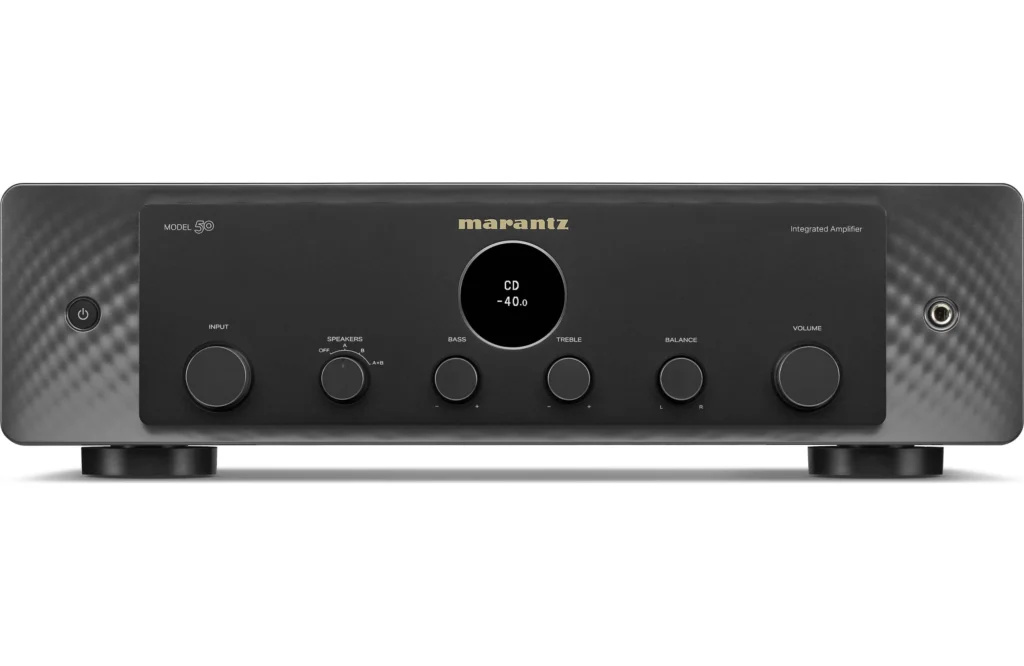
The Marantz MODEL 50 takes a deliberately traditional approach to a modern stereo system. It concentrates on analogue amplification, leaving streaming and digital conversion to separate components. That is attractive when sources are already owned, but less convenient for someone expecting a television and streaming system straight from the box.
Marantz MODEL 50 — Design and the role in a system
The MODEL 50 has the substantial, symmetrical appearance associated with Marantz’s current range. Its small central display and large controls suit someone who changes volume and source from the front panel rather than managing everything through an app. The enclosure is part of the attraction, but check shelf depth, rear cable clearance and ventilation before making it the centrepiece of a cabinet.
An analogue amplifier can remain useful while a separate streamer changes over time. That flexibility is a sound reason to choose this design. It also creates more boxes, more connections and potentially another remote control. Neither arrangement is universally preferable. Draw the complete system before comparing prices: a bare amplifier cannot fairly be compared with a streaming amplifier without including the missing source and digital functions.
Amplification and speaker matching
The European manual rates the MODEL 50 at 70 watts per channel into eight ohms and 100 watts into four ohms, with both channels driven across the audio band. These are useful conventional ratings rather than a headline assembled from a single high-distortion test condition. They still do not predict how every loudspeaker behaves in every room.
Speaker sensitivity, listening distance and impedance demands determine how much practical headroom is available. An easy speaker at moderate levels is a different task from a difficult load played loudly across a large room. Use the published rating to establish a sensible shortlist, then assess the intended combination. Do not infer that a change from 70 to 100 printed watts necessarily transforms the maximum comfortable listening level.
The speaker A/B facility is useful for selecting between suitable pairs, but it is not a second independently powered listening zone. Follow the manual’s impedance requirements when both pairs are connected. Parallel speaker loads can be more demanding than either pair alone, so adding another room should not begin with the assumption that spare terminals mean unlimited additional capacity.
Analogue sources and vinyl
The MM phono input makes the MODEL 50 a straightforward partner for a moving-magnet turntable system. The important word is MM: a low-output moving-coil cartridge needs a compatible external stage or other appropriate gain arrangement. If a turntable already supplies line level through its own enabled phono stage, connect that to a line input instead. Applying phono equalisation twice produces the wrong result.
Ordinary RCA sources can include a CD player with analogue output, a streamer with its own DAC, or an external converter. This flexibility is the purpose of the design. The amplifier does not supply optical, coaxial, computer USB, HDMI or network playback, so each digital source needs an appropriate route before reaching it. A television’s optical output cannot connect directly to an analogue RCA socket through a passive cable.
Tone controls and a direct listening option allow some choice in everyday use. Begin with sensible loudspeaker positioning and a neutral setting, then adjust for the actual room and recording. Tone adjustment should be judged by whether it makes listening more balanced and comfortable, rather than by an assumption that every control must be bypassed to qualify as serious hi-fi.
Outputs and expansion
Preamp and subwoofer outputs help the MODEL 50 fit a system that may expand. A subwoofer output is a connection opportunity, not an automatic promise of room correction or independently calibrated bass. Choose the subwoofer’s level, phase and crossover with the main speakers in place, and assess the result from the listening seat. More bass is not necessarily better integration.
The dedicated power-amplifier input can be useful in a larger system, but read the relevant operating instructions before connecting a variable-level source. Input roles and volume behaviour matter when another component controls gain. Label the connection and explain the operating sequence to anyone else using the system, particularly if ordinary music sources and a separate processor share the amplifier.
A front headphone output adds practical private listening. It should be assessed with the headphones actually intended for use; the speaker power rating is not a headphone amplifier specification. Similarly, the presence of a recording output should not be mistaken for an independently adjustable preamp feed. Matching the connection to its intended purpose prevents avoidable level and control problems.
Sound quality and independent evidence
Fairaudio’s original MODEL 50 evaluation described a relaxed, slightly warm presentation that favoured comfortable long listening, while placing limits on ultimate bass authority and explosive dynamics. That supports a positive assessment for a music-first system, with the caveat that an owner seeking maximum aggression and impact should audition carefully. Those are the original reviewer’s listening observations, not measurements or listening sessions conducted by Audio Review.
The useful implication is to choose speakers and recordings that represent ordinary ownership. A demonstration built only around polite vocals may not answer questions about dense rock, large orchestral peaks or bass-heavy electronic music. Equally, a short loud comparison can obscure whether an amplifier remains pleasant through an entire album. Match volume when comparing alternatives and assess both low-level clarity and the loudest realistic passages.
Do not buy an amplifier solely to counteract a speaker problem inferred from a description such as warm or bright. Room reflections, speaker position and the recording itself can dominate the balance. The MODEL 50’s reported character is useful context for a shortlist, but a suitable speaker load and coherent room setup remain the foundation of a convincing system.
Value and the right buyer
The MODEL 50 makes the strongest case for someone with established analogue sources or a preferred external streaming platform. It avoids paying for a second network system that may never be used and leaves digital upgrades separate from amplification. That can be a satisfying long-term arrangement when equipment flexibility matters more than the smallest possible box count.
Its value is less obvious for a new buyer who needs streaming, television return audio and room adjustment immediately. Include a suitable streamer, DAC and control arrangement in the total cost, along with the shelf space required. Current European offers can change the comparison substantially. Choose this Marantz because the complete analogue system fits the way you listen, not because omitting digital connections automatically guarantees superior sound.
Alternatives to consider
Marantz MODEL M1: A compact streaming and television-oriented alternative for a system built around fewer boxes.
NAD C 700 V2: Compare an integrated network approach when an app and digital sources are central to daily use.
Marantz MODEL 50 key specifications
- Type
- Class AB analogue integrated amplifier
- Rated output
- 70 W/channel at 8 ohms; 100 W/channel at 4 ohms, 20 Hz–20 kHz, both channels
- Phono
- Moving magnet
- Digital / network
- None built in
- Outputs
- Speaker A/B, preamp, subwoofer, record and headphones
- Additional input
- Power amplifier input
Verdict
A well-built analogue amplifier with a convincing role in a vinyl and separates system. Its comfortable original review evidence is appealing, while the absence of digital and network inputs makes total system planning essential.
Primary documentation and independent reviews
Marantz official MODEL 50 European manual · Marantz official MODEL 50 specifications · Fairaudio original MODEL 50 review · Fairaudio original review conclusion
Editorial record
Sources and updates
Product specifications and factual claims were checked against Official Marantz MODEL 50 product page ↗. Scores and buying advice follow our category-specific editorial methodology.
- Published
- November 8, 2026
- Last updated
- November 8, 2026