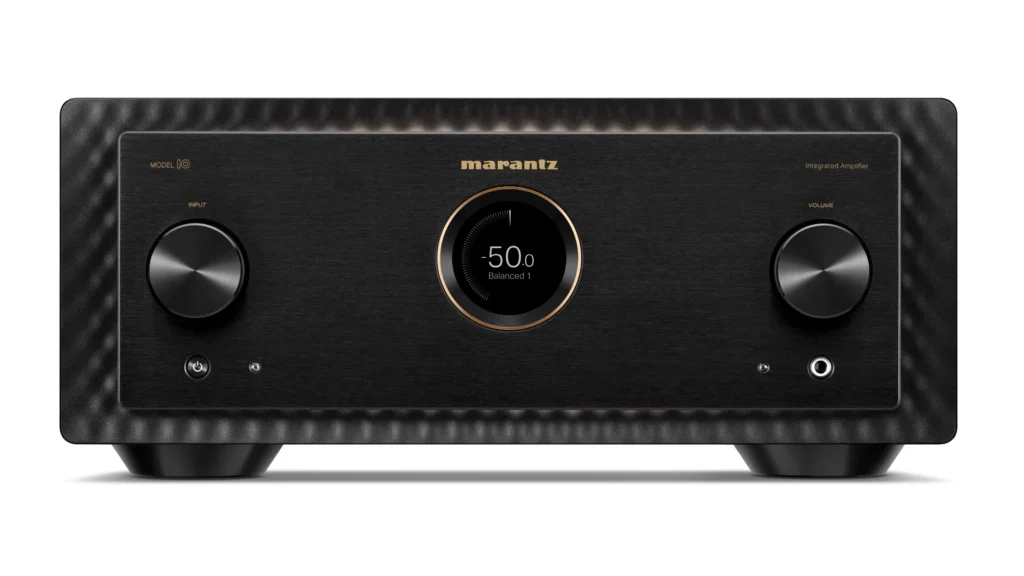
Marantz MODEL 10 is a reference analogue integrated amplifier with substantial dual-mono Class-D output, balanced connectivity and a flexible MM/MC phono section. It is separate from the LINK 10n streamer and SACD 10 source components, so digital conversion and network playback should not be assigned to the amplifier itself. This research-based review considers unusually strong original evidence for coherent detail and dynamic authority alongside the very high price and physical demands. Its appeal depends on a carefully matched complete system rather than a general assumption that the largest flagship is the best choice for every room.
Research-based review. This assessment draws on manufacturer documentation and the original published evaluations linked below. Audio Review has not performed a hands-on test of this model.
The original evaluation emphasises coherence rather than excess character
Simon Lucas’s StereoNET evaluation describes a neutral, authentic balance with extensive detail, confident bass control and strong dynamic contrast. It also finds the presentation coherent rather than a disconnected collection of impressive details. Its practical reservations concern the difficult physical installation and a busy, unlit system remote. These are the reviewer’s findings, not Audio Review testing.
For an audition at this level, use familiar music and the source equipment that will actually remain in the system. Match levels against the alternative and follow whole phrases, quiet intensity changes and the organisation of a complex ensemble. An expensive amplifier should not require every recording to be immaculate before listening becomes enjoyable. At the same time, revealing playback may expose differences in source and production that a softer system conceals. The original evidence supports a serious reference-system comparison. It does not establish that spending this amount is necessary for satisfying music or that every buyer will prefer the same balance over a less expensive, well-matched arrangement.
Substantial rated output must serve an actual speaker requirement
The EU manual specifies two hundred and fifty watts per channel into eight ohms and five hundred into four ohms, both with the stated full-bandwidth, two-channel distortion conditions. These are manufacturer ratings rather than measurements performed by Audio Review.
Consider the loudspeaker load, sensitivity, listening distance and desired headroom. A demanding system may use that capability meaningfully without playing loudly all the time, while an efficient pair in a modest room may not need it. Compare the intended speakers during complex and dynamic material at sensible levels. A volume-display number is not a direct reading of the fraction of power remaining. Avoid reducing a reference purchase to the largest output specification or assuming it corrects a difficult bass resonance. Speaker placement, room behaviour and source level remain relevant. The MODEL 10’s capability is a tangible advantage when it produces controlled, stable playback with the actual load. Unused reserve alone is a less persuasive reason to accept its cost and size.
Analogue architecture keeps digital sources external
The model provides balanced and RCA source connections plus phono, but no built-in digital audio input section, HDMI interface or HEOS service player. The separately named source partners provide different functions. A digital-looking display does not imply digital music-input capability.
Map the actual streamer, disc player and converter before buying. A suitable analogue-output source can connect directly, while digital-only equipment needs appropriate conversion. The modular arrangement can preserve source flexibility over time, but the complete price includes those additional components and interfaces. Matching Marantz source models are options rather than requirements. Compare the preferred network platform’s browsing, accounts and ordinary control routine as carefully as amplifier sound. A system at this price should be easy to start and restore after standby. Do not infer network playback from a system-bus connection or generic brand promotional material. The amplifier has a clear analogue role and should be chosen because that role suits the installation.
Phono and balanced integration offer specialist flexibility
The official specification documents MM and selectable MC loading, while preamplifier outputs and power-amplifier inputs are provided through appropriate RCA and XLR routes. F.C.B.S. supports specific multi-unit arrangements described in the manual rather than ordinary network music playback.
Check cartridge output and loading requirements before selecting the phono setting. Compare quiet and demanding record passages with consistent turntable setup and suitable separation from power equipment. For expansion, establish where volume is controlled and follow the exact pre/power diagrams. Do not remove or insert connection accessories experimentally or treat every similar-looking socket as interchangeable. Balanced cabling can be useful in an appropriate system, but its presence does not automatically make every source better. A multi-unit bi-amp arrangement is a substantial additional purchase and should solve a demonstrated need. The flexibility is meaningful for specialist installations, yet many owners will obtain the most coherent result from a straightforward source, integrated amplifier and well-positioned speaker pair.
Weight and remote usability are part of reference ownership
The official manual lists a weight around thirty-three-point-seven kilograms. That is a major installation consideration rather than a minor footnote. The enclosure, illumination and display contribute to a premium physical experience, but should be judged alongside ordinary operation.
Arrange suitable support, handling and the required ventilation before delivery. Check shelf depth with plugs attached and access for speaker and source cables. Demonstrate display visibility from the normal listening position and the ease of changing source or adjusting volume in low light. The original review’s remote reservation is particularly relevant if another household member uses the system. Try the actual headphones separately for noise and comfortable volume range instead of assuming speaker performance applies identically. A large reference component should remain pleasant to use after the initial visual impression has faded. The most expensive construction does not compensate for a rack that cannot support it or a control routine that makes spontaneous listening awkward.
Reference value requires a complete installed comparison
MODEL 10 is a very high-budget amplifier whose value cannot be described convincingly by counting inputs or repeating a flagship claim. Its construction, output and analogue integration should be useful together in the actual system.
Compare complete current offers with the required streamer, DAC, phono arrangement, speakers and furniture included. A buyer who already owns excellent sources may place greater value on a dedicated analogue platform than someone seeking to reduce the number of boxes. A lower-priced integrated system with room adjustment may solve a difficult domestic installation more effectively. Check regional mains, remote, accessories and support on a demonstration or used offer, with careful confirmation of condition. Do not treat a positive reference review as evidence that a financial stretch is required for good music. The strongest case is a suitably resourced buyer who prefers the demonstrated musical result and has a real use for the amplifier’s capabilities. That is a narrower but more honest recommendation than calling a flagship universally essential.
Alternatives to consider
Audiolab 9000A: A substantially more affordable integrated approach to compare when the reference model’s particular power, construction and analogue integration are not required. Price all sources consistently.
Yamaha R-N2000A: Consider a differently focused premium system with network and room-adjustment convenience if reducing boxes matters more than reference analogue architecture. Compare the actual installation.
Marantz MODEL 10 key specifications
- Role
- Reference analogue integrated stereo amplifier
- Power stage
- Dual-mono Class D
- Manufacturer output, 8 ohms
- 250 W/channel, both channels 20 Hz–20 kHz at 0.05% THD
- Manufacturer output, 4 ohms
- 500 W/channel, both channels 20 Hz–20 kHz at 0.05% THD
- Analogue sources
- Balanced and RCA line sources; MM / MC phono
- MC loading
- Selectable low / mid / high resistance settings per manual
- Expansion
- RCA / XLR preamp output and power-amplifier input
- System options
- Documented F.C.B.S. multi-unit integration; not a network music input
- Private listening
- Front 6.3 mm headphone connection
- Digital / network
- No built-in DAC inputs, HDMI, Bluetooth or HEOS player
- Model distinction
- LINK 10n and SACD 10 are separate source components
- Weight
- Approximately 33.7 kg; substantial installation required
- Dimensions (W × H × D)
- 440 × 192 × 473 mm
Verdict
MODEL 10 has strong research support as an assured reference analogue amplifier with substantial capability and specialist flexibility. Its cost, weight and separate digital-source needs are central to the decision. Compare complete installed systems, audition the intended speakers and test ordinary operation. It is compelling when its particular strengths are genuinely useful within a carefully matched high-budget system.
Documentation and original reviews
Marantz official MODEL 10 product and architecture · Marantz official MODEL 10 EU owner manual · Marantz official MODEL 10 rated output and interface specification · StereoNET original MODEL 10 evaluation by Simon Lucas
Editorial record
Sources and updates
Product specifications and factual claims were checked against Official Marantz MODEL 10 product page ↗. Scores and buying advice follow our category-specific editorial methodology.
- Published
- November 17, 2026
- Last updated
- November 17, 2026