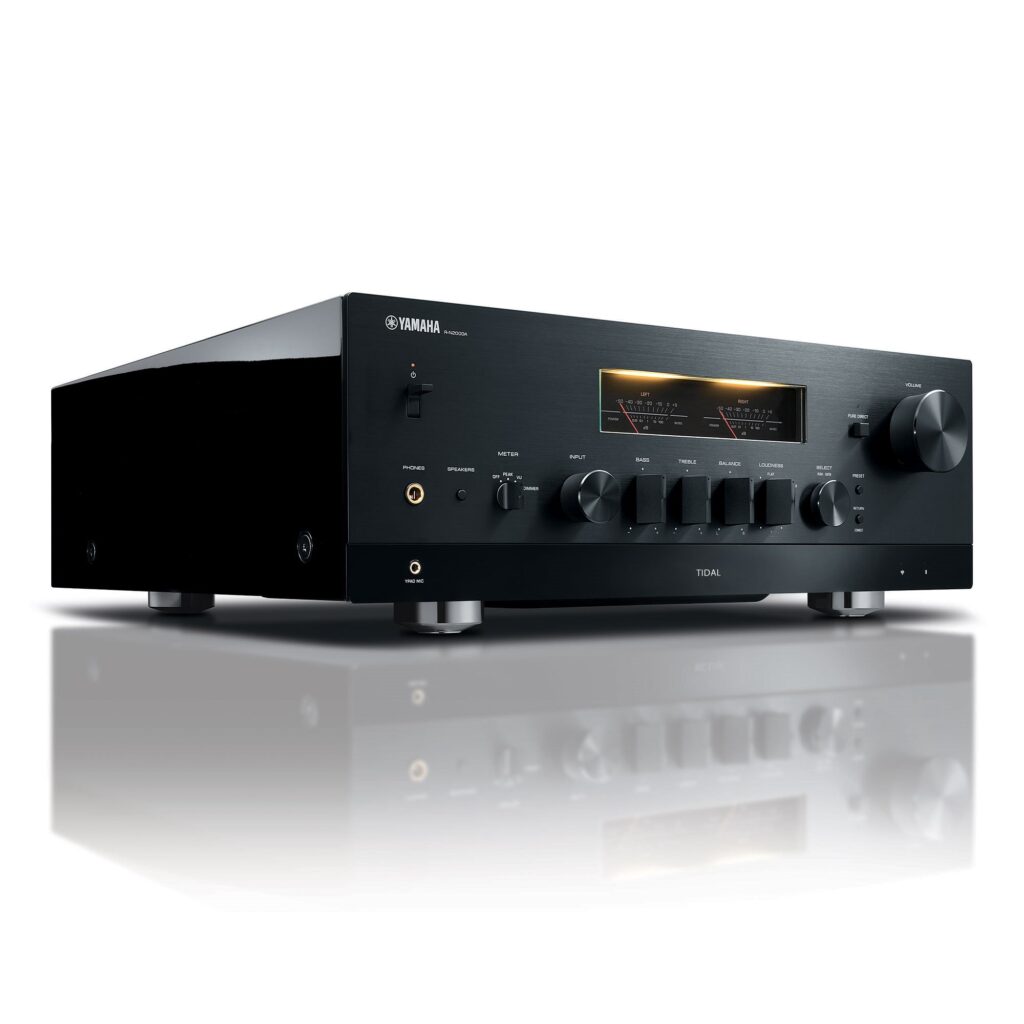
The Yamaha R-N2000A combines a premium traditional amplifier presentation with network playback, digital inputs and television access. It is a substantial two-channel component rather than a compact streaming box. Its value depends on wanting both the physical quality of a serious hi-fi amplifier and the convenience of an integrated source system.
Yamaha R-N2000A — Design and the ownership experience
The meters and traditional Yamaha control layout give the R-N2000A a clear visual identity. This is a component likely to be displayed rather than hidden, and the tactile experience is part of the purchase. That is a legitimate reason to choose an amplifier, provided it is considered alongside room fit and practical function rather than treated as evidence of better sound by itself.
The European specification lists a weight of 22.1 kg and a depth of 473 mm, so installation deserves more thought than with a small streamer. Check the shelf’s support and usable depth, including rear plugs and ventilation. Moving the system to reach a forgotten source connection should not become a routine job. Plan the cable layout before final placement and keep the controls accessible. A premium component should make the room easier to enjoy, not turn every source change into an exercise in rearranging furniture.
Power: use the rated figure
Yamaha’s European specification gives rated output of 90 W per channel into 8 ohms and 145 W into 4 ohms, across 20 Hz to 20 kHz at 0.07 percent THD. It separately lists a 120 W maximum into 8 ohms at one kilohertz and ten-percent distortion. Those figures are not interchangeable. Our description uses the low-distortion rated output rather than presenting the larger maximum number as continuous clean power.
The available drive should be assessed with the chosen speakers, room and listening level. A lower printed rating than another model does not automatically mean a less suitable amplifier, just as a heavier enclosure does not guarantee a better match. Sensitivity, impedance behaviour and desired headroom matter. Compare ratings under equivalent conditions and avoid treating a short-term maximum as the same thing as full-bandwidth performance.
The R-N2000A’s intended appeal is a complete premium stereo experience, not a watt-per-euro contest. Someone who mainly needs inexpensive output power may find another product more rational. Someone who wants the build, controls, source integration and listening performance together has a clearer reason to shortlist it.
Network and digital sources
MusicCast network playback is included, so the system does not need a separate streaming module to begin. A phone or tablet can handle browsing while the receiver plays from the supported network source. Check the services and library workflow you actually use, because everyday software fit matters as much as the amplifier’s front-panel appearance. Wired Ethernet is useful where practical, while Wi-Fi makes placement less dependent on a network socket.
The European connection list includes USB-B DAC input, two optical inputs and one coaxial digital input. A compatible computer can therefore connect directly, while other digital sources retain their own routes. High-resolution compatibility is useful, but ordinary recordings do not need to be converted to the maximum supported rate. Stable playback and the intended source selection are the basic priorities.
Bluetooth is a convenience option rather than a replacement for the network platform. Yamaha lists SBC and AAC in the regional specification. The transmitting source and negotiated codec determine the actual connection; do not assume every premium receiver supports every Bluetooth format. Likewise, older reviews can describe software capabilities that later change, so current firmware and service support should guide a purchase rather than an old list of absent app features.
Television, vinyl and analogue integration
HDMI ARC allows a compatible television to share the main speakers and offers a more integrated control route than a separate optical DAC arrangement. It is ARC, not a promise of HDMI video switching or a full multichannel processor. Configure the television for the supported stereo audio path and verify volume and power behaviour before assuming the system is ready for everyday use.
The analogue sources include an MM phono input and ordinary line connections. Moving-magnet compatibility should not be expanded into a claim of support for every moving-coil cartridge. A low-output MC model requires suitable gain and loading elsewhere. If the turntable already delivers line level through an enabled stage, use a line input instead of applying phono equalisation twice.
The built-in headphone connection is convenient for occasional private listening, but a demanding headphone deserves its own matching check. A speaker amplifier’s power rating does not describe the capability of its headphone socket. Treat the headphone stage as a separate part of the system, especially if it will be used as often as the loudspeakers.
YPAO and sound quality evidence
YPAO setup provides a way to account for the speakers and listening environment. Use the supplied measurement procedure carefully, with sensible speaker placement already established. Calibration can help with certain room effects, but it is not a way to make every seat identical or force a small speaker to reproduce deep bass without limits. Compare corrected and uncorrected playback at similar levels and judge the result on coherence and comfort.
AVForums’ original R-N2000A review praised its confident, refined presentation and the combination of functionality with high build quality. It also found MM phono gain worth considering with some cartridges. That supports a strong all-round assessment while keeping source matching in view. The review’s listening observations are not our own hands-on test, and its 2023 software comments should not be treated as a complete current feature list.
For an audition, use both the source you expect to play most often and one secondary source. A streaming demonstration alone does not tell a vinyl-focused owner everything needed, and a turntable demonstration does not establish television-control convenience. Match levels when comparing amplifiers and assess sustained listening rather than only the first impressive passage.
Subwoofer planning and premium value
Preamp and subwoofer connections offer expansion, but the presence of an output does not complete subwoofer integration. Position the sub appropriately, choose a sensible crossover and level, and assess the blend at the listening seat. The goal is support and consistency, not simply more bass. A well-placed modest system can be more satisfying than an expensive one adjusted to exaggerate every low note.
The R-N2000A is strongest for a buyer who wants a substantial, tactile amplifier without giving up integrated streaming and television use. Compare current EU offers with the full source and control requirements included. A smaller network amplifier may provide much of the functionality for less, leaving more budget for speakers and room work. The Yamaha justifies its premium when the physical quality and complete ownership experience are central, rather than when the purchase is reduced to one output number or DAC specification.
Alternatives to consider
Naim Uniti Atom: A premium integrated streaming alternative for an owner who prefers a smaller enclosure and a different control experience.
NAD C 700 V2: Compare this when compactness and included network playback are higher priorities than the Yamaha’s substantial traditional presentation.
Yamaha R-N2000A key specifications
- Type
- Premium network stereo receiver
- Rated output
- 90 W/channel at 8 ohms; 145 W/channel at 4 ohms, 20 Hz–20 kHz, 0.07% THD
- HDMI
- ARC input
- Digital sources
- USB-B DAC, two optical, one coaxial
- Analogue
- MM phono and line inputs
- Network / setup
- MusicCast and YPAO
- Weight
- 22.1 kg
- Dimensions
- 435 × 157 × 473 mm, antenna down
Verdict
A refined and unusually complete premium stereo receiver for listeners who value traditional build and integrated modern sources. Its size and cost need justification in the room, and the buying decision should use the proper rated output and actual cartridge, speaker and software requirements.
Primary documentation and independent reviews
Yamaha official European R-N2000A specifications · AVForums original R-N2000A review
Editorial record
Sources and updates
Product specifications and factual claims were checked against Official Yamaha R-N2000A product page ↗. Scores and buying advice follow our category-specific editorial methodology.
- Published
- November 8, 2026
- Last updated
- November 8, 2026