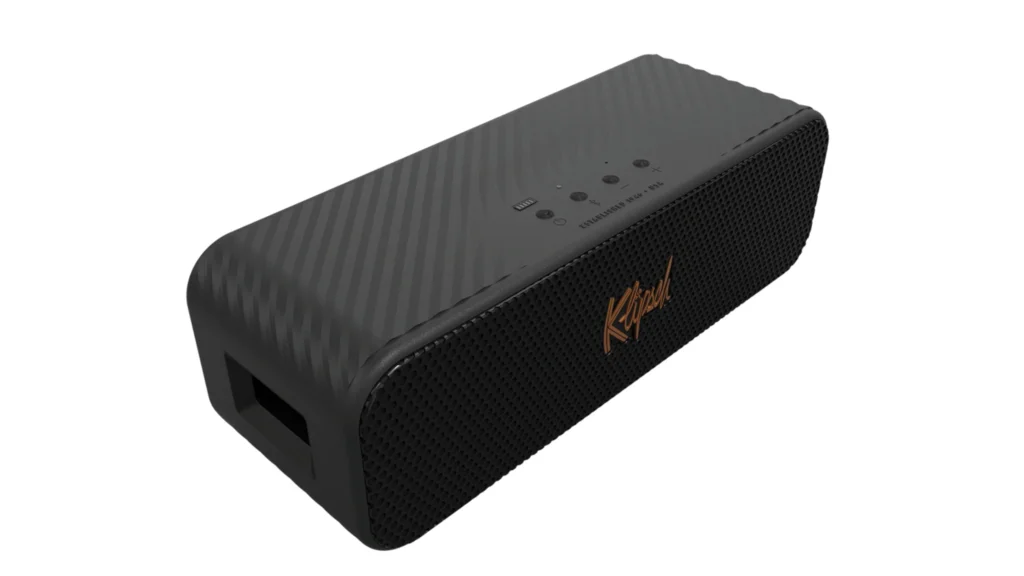
Klipsch Detroit is a sizeable battery-powered Bluetooth speaker with an emphasis on a musical presentation rather than an extensive collection of inputs. It combines a removable strap, substantial driver arrangement and protected enclosure with USB-C charging. The original independent review is particularly enthusiastic about its balance and dynamics, while noting a sparse feature package. That makes the Detroit an interesting shortlist choice, provided the buyer wants its particular sound and accepts carrying a speaker weighing more than two kilograms.
Research-based review. This assessment draws on manufacturer documentation and the original independent evaluations linked below. Audio Review has not performed a hands-on test of this model.
A substantial portable with a clear purpose
The official specification puts Detroit at two-point-four-six kilograms. Its removable carrying strap helps with movement, but this remains a deliberate item of luggage. Check how it fits with the rest of the equipment for a picnic, holiday or garden gathering rather than judging portability from a photograph.
The elongated enclosure needs a stable surface with its radiators and drivers free to operate. Position it where the listeners can hear it directly without people repeatedly passing between the speaker and the group. A more powerful compact system is not necessarily more convenient than bringing two smaller items, and a larger speaker can become poor value if it is left at home. Consider the actual carrying distance and listening area together.
Sound quality: the strongest reason to audition it
HIFI.DE’s original test praises a relatively neutral, dynamic and spacious presentation, with controlled bass rather than an exaggerated low-frequency emphasis. It also cautions that listeners wanting the strongest bass impact have other options. This is a useful distinction between musical balance and the immediate impression of a party speaker.
An audition should include both quiet material and dense recordings. Check whether voices remain understandable and whether percussion is comfortable over a longer session. Then compare a bass-heavy track at a realistic outdoor level. A speaker that sounds refined in a quiet room may not supply the physical impact someone expects in an open garden. Equally, extra bass is not automatically an improvement if it overwhelms the material you normally play.
Driver count does not replace an audition
The official specification lists two three-inch drivers, two one-inch tweeters and four passive radiators. That arrangement explains some of the product’s physical scale, but the number of components alone does not establish tonal quality, bass extension at every level or a wide listening area.
Move around the intended listening space during a demonstration rather than remaining directly in front of the cabinet. Listen from the side and from the distance at which a small group would gather. A single enclosure also should not be expected to reproduce the same left-right separation as two correctly placed loudspeakers. Treat its internal stereo arrangement as part of a portable design, not a replacement for a conventional room stereo built around separated speakers.
Bluetooth and the missing analogue route
Detroit is centred on Bluetooth playback. It has no analogue auxiliary input or Wi-Fi streaming platform. That simplicity may suit music from a phone, but it is a real limitation for a source that provides only a wired analogue output.
Do not assume the USB-C connector is a USB audio input; the documented role here is charging and reverse charging. A record player, television or computer may therefore need a different connection solution, and the result should be checked for the intended use. If a cable connection is an essential part of the plan, compare a speaker that includes one rather than buying an attractive wireless model and trying to recreate a missing input with extra adapters.
App adjustment and speaker linking
The supported Klipsch app offers EQ and firmware updates. Try the app on your own phone where possible, including reconnection after standby and changing a setting. A useful control system should be predictable during ordinary listening, not merely provide many options on a specification page.
Broadcast Mode is intended to expand coverage with compatible speakers. The official sheet describes mono signals being sent to additional broadcast devices. That is different from a cinema surround system, and the shared Bluetooth version does not imply universal compatibility with another brand’s linking feature. Check the exact speakers and firmware together before purchasing a second unit. For background music across a gathering, consistent coverage may be more useful than chasing a stereo label that does not describe the selected mode.
Battery and reverse charging in practice
Klipsch claims up to twenty hours of playback, and specifies USB-C charging at up to eighteen watts. It also lists reverse charging at up to ten watts for a compatible phone or device. These are manufacturer specifications rather than new endurance or charging measurements from Audio Review.
Using the speaker battery to replenish a phone competes with playback endurance, so treat reverse charging as a useful fallback rather than free extra capacity. Begin a long outing with both devices charged and keep a suitable cable available. High volume, temperature and battery age can alter the result. If an event absolutely depends on continuous playback, allow a margin and verify a practical power arrangement instead of scheduling to the maximum advertised hour figure.
Protection and the value decision
IP67 protection is a helpful advantage for a speaker expected to travel beyond a living room. Follow the care instructions and dry the port before charging; a protected enclosure is still an electronic product with a battery and connectors. Inspect strap attachments and the charging socket if buying used.
Detroit is most persuasive when its listening balance is the reason to choose it. Compare Nashville for a smaller carrying requirement and larger party-focused rivals when bass impact is the priority. Current local pricing, support and a return opportunity are more meaningful than the launch position alone. A simpler connection package can be entirely sufficient, but only when it matches the sources and activities that will actually use the speaker.
Alternatives to consider
Klipsch Nashville: Nashville is worth comparing if a smaller carrying load matters more than maximum scale. The useful question is how much sound you need at the normal listening distance, not simply which Music City model sits higher in the range.
Tribit StormBox Blast: The original StormBox Blast offers a different large-portable approach. Compare bass impact, practical carrying requirements, charging and protection, then choose from the actual listening and travel routine rather than a brand reputation or maximum-output headline.
Klipsch Detroit key specifications
- Design
- Portable Bluetooth speaker
- Wireless
- Bluetooth 5.3
- Drivers
- Two 3-inch drivers and two 1-inch tweeters
- Passive radiators
- Four
- Battery claim
- Up to 20 hours; manufacturer figure
- Charging
- USB-C, up to 18 W input
- Reverse charging
- Up to 10 W over USB-C
- Protection
- IP67
- Weight
- 2.46 kg
- Dimensions
- 334 × 107 × 119 mm
- Analogue input / Wi-Fi
- Neither
Verdict
Detroit is a strong audition candidate for a listener seeking a balanced and dynamic portable speaker rather than maximum bass emphasis or a comprehensive hub. Its protected enclosure, app EQ and USB-C charging are useful everyday features.
Accept the carrying weight and check the Bluetooth-only source plan before buying. Compare a smaller Nashville if portability dominates, and a bass-focused rival if the goal is a larger outdoor party. The Detroit’s strongest case is a listening presentation you prefer, supported by a connection and travel routine that suits its design.
Primary documentation and independent reviews
Klipsch official Detroit information · Klipsch Detroit official specification sheet · HIFI.DE original Detroit evaluation
Editorial record
Sources and updates
Product specifications and factual claims were checked against Official Klipsch Detroit product page ↗. Scores and buying advice follow our category-specific editorial methodology.
- Published
- November 17, 2026
- Last updated
- November 17, 2026