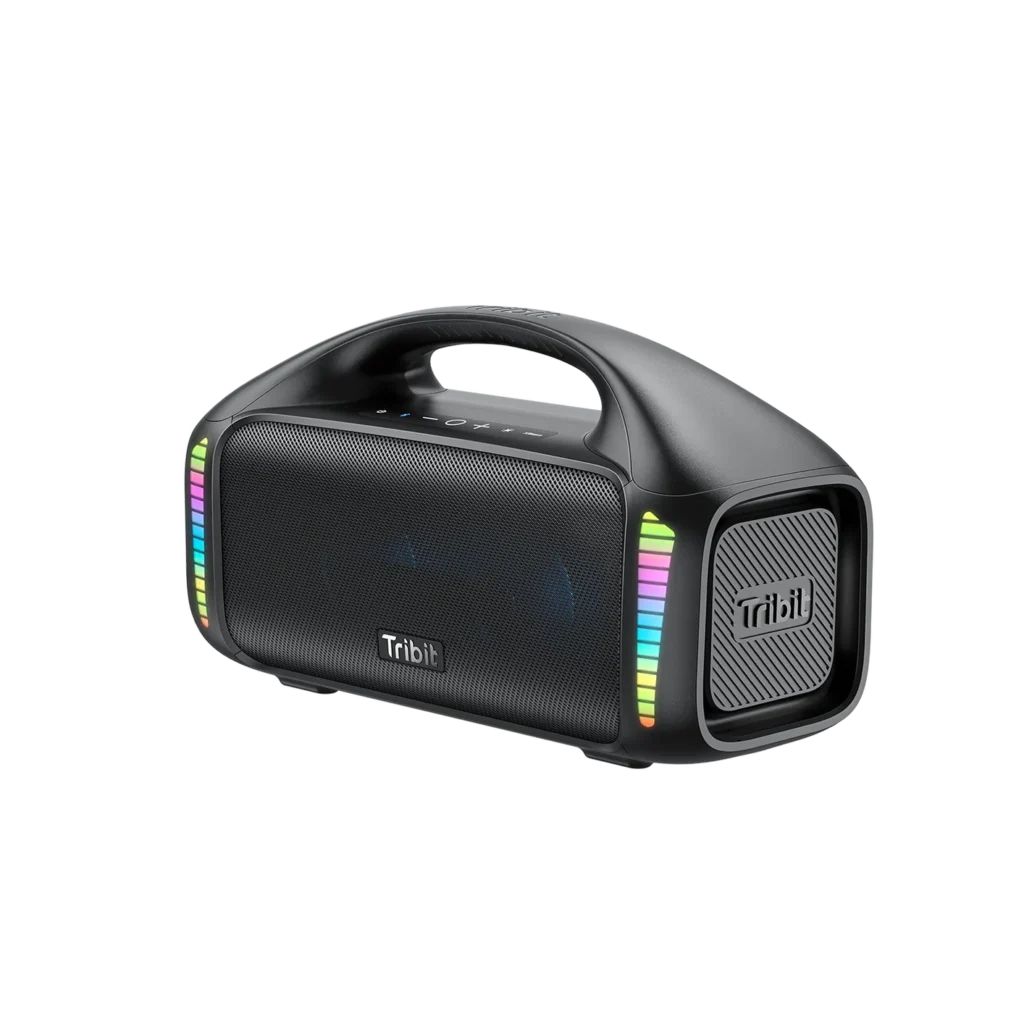
The original Tribit StormBox Blast is a transportable party speaker rather than a small everyday travel speaker. It combines a substantial enclosure with a carry handle, bass adjustment and integrated lighting. Its appeal is useful output and long battery potential for the money, provided the size, mains charging and original-generation feature set suit the intended use.
Tribit StormBox Blast — Original Blast, not Blast 2
This review covers the original StormBox Blast with a manufacturer-rated 90-watt amplifier system. The Blast 2 is a different product with a different feature set, so its microphone inputs and later-generation specifications should not be added to the original model’s description. Check the exact model name on a listing and on the box, particularly when a discounted older version appears alongside its successor.
The handle makes the original easier to move, but the manufacturer lists roughly 12 pounds of weight. That is a meaningful load when walking some distance with food, bags and other equipment. Think of it as something carried from a car to a gathering or moved around a home. A compact speaker may be more useful if the journey matters as much as the destination.
Build and outdoor suitability
IPX7 supplies documented water resistance, while the X leaves dust protection unspecified. Do not reinterpret it as IP67 or a guarantee against sand entering every exposed area. Keep covers in the required position, avoid charging a wet unit and follow the care instructions after outdoor use. A protective rating is a useful practical feature, but not permission to ignore the condition of the sockets.
The wide enclosure needs a stable surface. Avoid placing it where a heavy speaker can be pulled down by a charging lead or knocked off a narrow table. The front-facing arrangement also makes placement relevant to the audience: a strong result directly in front does not mean identical tonal balance behind the unit or through obstacles.
Integrated LEDs give it a clear party identity. Lighting can be enjoyable at a gathering but unnecessary for quiet home listening. Try the available controls and decide whether the visual effect adds value. The important design question is whether the enclosure, handle and controls make the intended use easier, rather than whether a speaker carries the largest number of lights.
Sound quality and independent findings
RTINGS’ original evaluation found an energetic balance with extra emphasis at the bass and treble ends, useful loudness and adjustable EQ, while noting limited deepest bass and some compression at maximum output. That supports a positive party-speaker assessment without repeating the manufacturer’s claim of distortion-free sound as an independently established fact at every level.
The practical distinction is between punch and extension. A speaker can make drums feel lively without reproducing the lowest cinema effects or electronic sub-bass like a much larger system. Listen to familiar bass lines and check that voices remain intelligible as volume increases. If the balance becomes hard or compressed near the limit, reducing level can give a more enjoyable result than continuing to chase maximum loudness.
XBass and app EQ offer ways to adapt the balance. Outdoors, the lack of room boundaries changes the apparent low end compared with a corner indoors. Try the speaker in a sensible position before applying large boosts. More bass adjustment can consume output headroom, so the best setting for background music may differ from the one used for louder gatherings. These recommendations follow the documented role and original test evidence, not an Audio Review hands-on session.
Soundphile Review was more critical of dense material, finding that complex tracks could become muddy and that XBass sometimes reduced midrange clarity. That makes a familiar busy recording a useful part of a personal comparison, rather than judging the speaker only from simple bass-heavy demonstration music.
Battery life and the mains-charging distinction
Tribit advertises up to 30 hours, explicitly noting that music and volume affect the result. RTINGS obtained more than 30 hours under its own test conditions, which supports strong endurance potential but should not be rewritten as a guaranteed high-volume party duration. Lights, bass settings and content can all change the practical time away from a socket.
The original speaker charges through its supplied mains connection. The USB-C facility can charge another compatible device; it is not a substitute USB-C charging input for the speaker itself. That distinction matters on a trip where a phone power bank is available but a mains outlet is not. Pack the correct regional lead and plan charging before leaving.
Using the battery to top up a phone reduces the energy left for music. That may be worthwhile in an emergency, but include it in the expected runtime rather than treating phone charging and the longest speaker endurance as simultaneous guarantees. A clear charging plan is more useful than choosing only from the largest advertised hour count.
Sources, pairing and feature limits
Bluetooth and the app supply the normal music and adjustment workflow. There is no built-in microphone for calls or independent voice-assistant system according to the manufacturer’s FAQ. A microphone-shaped expectation created by another speaker’s feature set should not be transferred to the Blast simply because it is a large party product.
A suitable analogue auxiliary source offers another route, with the ordinary requirement that the source actually has an audio output. A charging connector does not automatically carry analogue music, and a passive adapter cannot create a missing DAC. Check the intended source and connection before assuming that every phone, television or instrument can plug straight in.
Two suitable matching speakers can form a stereo arrangement, but that is distinct from unlimited cross-generation party linking. Confirm the specific compatibility before buying another unit. If multiple speakers are intended to cover a large area, assess placement and synchronisation needs rather than expecting arbitrary Bluetooth products to work together because they share the same brand. The original model’s limits matter more than its resemblance to its successor.
Who should buy it
The original Blast is persuasive for a garden gathering, occasional party or room-to-room use where strong output, useful bass and battery potential justify the weight. It is less appropriate for a small commuting bag, discreet desktop calls or an installation that needs regular USB-C input charging. Those are different jobs, not minor details to discover after purchase.
Compare current European offers with the newer Blast 2 and other large portables, including local warranty terms and the correct plug. The original can be attractive if discounted sufficiently and if the extra functions of its successor are unnecessary. A newer model is not automatically better value for a listener who will never use the added features, but a small price difference can change that judgement.
For a demonstration, use ordinary music at the level expected outdoors and assess clarity as well as bass quantity. A short indoor maximum-volume burst is a poor substitute for the actual use case. Choose the Blast as a practical transportable speaker with known compromises, keeping its original-generation identity, substantial weight and mains-charging requirement central to the decision.
Alternatives to consider
Tribit StormBox Blast 2: Compare the newer generation directly if its additional party functions and current price are relevant.
Soundcore Boom 2 Plus: Consider another large portable approach with the charging method, weight and intended linking arrangement checked.
Tribit StormBox Blast key specifications
- Version
- Original StormBox Blast
- Manufacturer amplifier rating
- 90 W total
- Bluetooth
- 5.3
- Battery claim
- Up to 30 hours; content and level dependent
- Speaker charging
- Mains AC connection
- USB-C role
- Output charging for another compatible device
- Protection
- IPX7; dust grade unspecified
- Weight
- Approximately 12 lb / 5.4 kg
Verdict
The original Blast remains a strong-value transportable party speaker when output and endurance outweigh weight. Its mains charging and original-generation limitations need to be understood, and maximum-volume or deepest-bass performance should not be exaggerated.
Primary documentation and independent reviews
Tribit official original StormBox Blast specifications and FAQ · RTINGS original StormBox Blast review · Soundphile Review original StormBox Blast test
Editorial record
Sources and updates
Product specifications and factual claims were checked against Official Tribit StormBox Blast product page ↗. Scores and buying advice follow our category-specific editorial methodology.
- Published
- November 8, 2026
- Last updated
- November 8, 2026