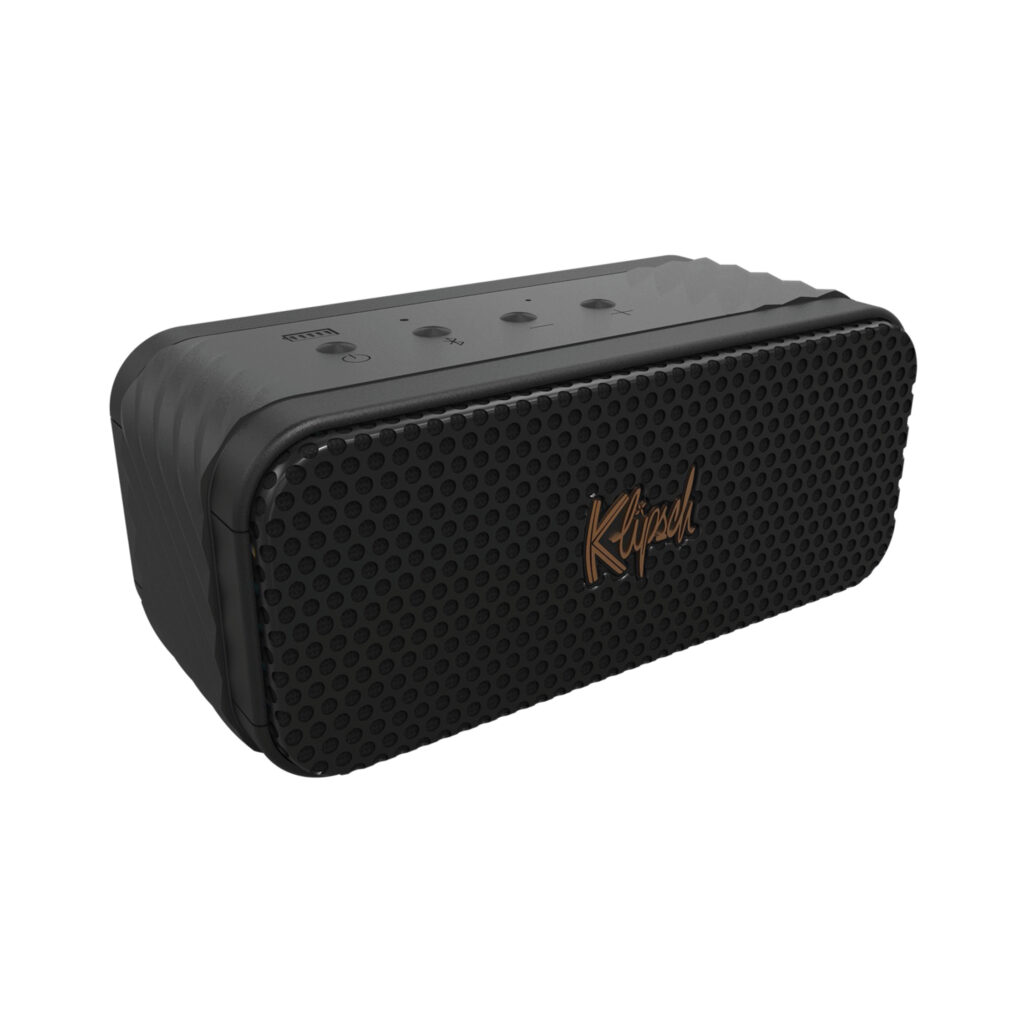
The Klipsch Nashville is a compact portable speaker with a practical mix of ruggedness, calls and USB-C power sharing. It aims to spread sound from both sides of the enclosure rather than behave like a conventional front-facing miniature hi-fi system. Its appeal is everyday usefulness, while bass expectations, control visibility and current price determine how well it compares with crowded portable-speaker rivals.
Klipsch Nashville — Design and handling
The Nashville’s rubberised body and grilles give it an outdoors-oriented appearance. It is small enough for a sensible travel bag, although not weightless. The current official specification sheet lists 851 grams; some original reviews quote different weights, so the manufacturer figure is the clearer reference for the documented product. Try handling it with the rest of the equipment normally carried.
The top controls cover basic operation, but their contrast and layout deserve a personal check. Stereo Guide’s original review found them harder to recognise in dim light. This is relevant for a speaker used at an evening gathering or beside a bed: an app can provide another route, but reaching for a phone is less immediate than finding a visible button.
Consider how the speaker will be held, placed and protected in a bag. A sturdy enclosure does not remove the inconvenience of an awkward carrying arrangement. The strongest design is the one that fits the actual routine, whether that means moving between rooms, taking it to a desk or packing it for an occasional weekend.
Protection and sensible outdoor use
IP67 supplies documented dust and water protection, including the manufacturer’s stated immersion conditions. That is a useful practical advantage over speakers rated only for splashes. It does not establish resistance to every chemical, saltwater exposure or impact. Keep the connection cover correctly positioned and let the speaker and socket dry before charging.
A stable location matters because sound comes from both front and rear. Leaving it pressed directly against a wall can change the balance and reduce the usefulness of its broad-output concept. Give the enclosure breathing room and compare placement before changing EQ. A shelf corner may add bass while also making voices less clear, so more low-end quantity is not necessarily better sound.
For outdoor background music, moving the speaker closer to the listeners can improve clarity without forcing maximum volume. A small enclosure is not intended to cover a very large gathering with deep bass. Choose the size for the required area rather than assuming a rugged rating also establishes party-speaker output. Durability and acoustic capability are separate parts of the purchase.
Sound quality and the coverage distinction
Stereo Guide’s original listening found a generally balanced and capable presentation for the size, with useful bass definition but more limited dynamic freedom at higher levels. It also found sound changes with listening angle and proximity to a rear wall. That qualifies the broad 360-degree description: output in more than one direction does not mean identical tonal balance everywhere.
A single Nashville should not be assumed to provide a widely separated stereo image simply because it contains two drivers and two amplifier channels. The manufacturer describes broad coverage, while the original review treated the single enclosure’s presentation as effectively mono. A genuine left/right arrangement uses the documented pairing mode with suitable matching speakers.
For a personal audition, check voices from the positions where people will actually sit or move. Then include a busy song and a sustained bass line at the expected level. Listen for clarity and a natural overall balance rather than the deepest possible rumble. The original observations belong to the linked reviewer; Audio Review has not independently listened to or measured the Nashville.
Bluetooth, the app and linking
Bluetooth 5.3 is the normal source connection. There is no analogue auxiliary input, and the USB-C socket should not be described as a general computer DAC interface. A laptop or phone therefore needs the appropriate Bluetooth route rather than simply a charging cable. Check the source and reconnection behaviour before assuming it will replace a wired desktop speaker.
The Klipsch Connect app provides EQ and firmware support. Modest adjustment can help adapt the balance to a location, but it cannot remove the limits of a small driver and enclosure. Compare at ordinary volume and avoid boosting every low-frequency setting in pursuit of output the speaker cannot comfortably supply. A small reduction in a prominent region can be more useful than a large boost elsewhere.
The manual distinguishes True Wireless Stereo pairing from Broadcast Mode. The former establishes a left/right arrangement with suitable units; the latter distributes audio to compatible additional speakers and should not be confused with multiple independent stereo zones. Confirm exact model and firmware compatibility before buying another speaker for a group. A common brand name does not establish universal wireless linking across the entire range.
Battery, calls and power sharing
Klipsch advertises up to 24 hours of playback. That is a conditional claim rather than an Audio Review endurance measurement. Volume, content and battery age affect the result, and use as a power source for another device reduces the energy available for music. Leave a margin on a trip rather than assuming the longest advertised time will be available in every mode.
The documented USB-C arrangement supports 18-watt input charging and up to 10-watt reverse charging for a compatible device. A suitable supply and cable matter to the charging result. A phone top-up can be genuinely useful, but it should be treated as a shared battery resource rather than a free extra alongside maximum speaker runtime. Keep all charging connections dry.
A built-in microphone allows speakerphone calls, which is a useful distinction from portable speakers focused only on playback. It does not make the Nashville a professional conference system. For regular work calls, try microphone pickup, echo handling and intelligibility in the intended room, and remember that a shared speaker makes the conversation audible to others. Music performance alone cannot establish call suitability.
Value and the right expectations
The Nashville is most persuasive when its protection, calls and power sharing all have practical jobs. A person who only wants music at home may value tonal balance or Wi-Fi functions more, while someone who travels light may prefer a smaller speaker without phone-charging capability. Decide which features will actually be used rather than treating the longest list as automatically best.
Stereo Guide’s original evaluation found the product priced against larger or stronger rivals, which makes current European offers important. A discounted Nashville can be a different value proposition from its launch positioning, but local support and return arrangements still belong in the comparison. Do not assume that an older review’s price is the current market price.
Compare familiar music at matched levels with a similarly sized alternative, then test the call and charging functions if they matter. That full routine is more useful than a short bass demonstration. Choose the Klipsch for a coherent everyday portable package, accepting that its broad output concept, small enclosure and restrained high-level dynamics impose limits. The recommendation is positive when those tradeoffs fit the intended use, rather than because the brand’s larger loudspeaker reputation automatically transfers to a small Bluetooth product.
Alternatives to consider
Bose SoundLink Flex Gen 2: Compare a compact portable alternative with the sound balance, carrying arrangement and desired source functions considered.
JBL Charge 6: Consider another robust portable with power-sharing features, comparing current pricing and the exact call and connection requirements.
Klipsch Nashville key specifications
- Type
- Portable Bluetooth speaker
- Drivers / amplification
- Two 2.25-inch full-range drivers; two 10 W RMS channels
- Bluetooth
- 5.3
- Battery claim
- Up to 24 hours
- USB-C
- 18 W input charging; up to 10 W reverse charging
- Protection
- IP67
- Microphone
- Built in for speakerphone calls
- Weight
- 851 g in current official specification sheet
Verdict
A useful rugged portable with calls, app adjustment and USB-C power sharing. It suits everyday moderate-level listening, while a personal comparison should check control visibility, off-axis balance and whether larger rivals offer better sound for the current price.
Primary documentation and independent reviews
Klipsch official regional Nashville product details · Klipsch official Nashville specification sheet V03 · Klipsch official Nashville operating manual · Stereo Guide original Nashville review
Editorial record
Sources and updates
Product specifications and factual claims were checked against Official Klipsch Nashville product page ↗. Scores and buying advice follow our category-specific editorial methodology.
- Published
- November 8, 2026
- Last updated
- November 8, 2026