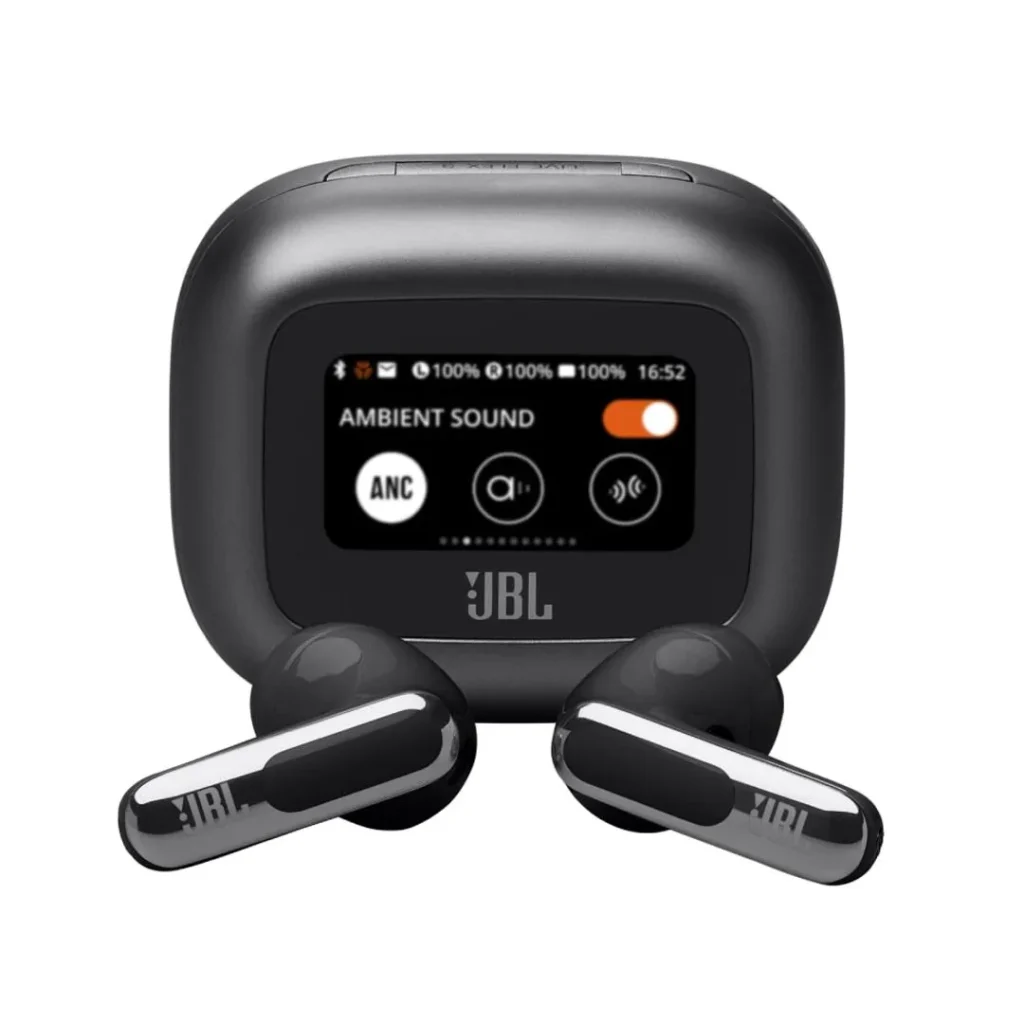
JBL Live Flex 3 combines an unsealed stem-style earbud with a touchscreen charging case. It aims at people who do not enjoy silicone tips sealing the ear canal, while still offering ANC and extensive app adjustment. The distinction is central to the recommendation: original evaluations find appealing sound for the format but weak noise isolation. It is an open-fit choice to make deliberately, not an automatic substitute for sealed ANC earbuds on a noisy journey.
Research-based review. This assessment draws on manufacturer documentation and the original published evaluations linked below. Audio Review has not performed a hands-on test of this model.
The fixed open fit is the main buying condition
Live Flex 3 rests in the outer ear without the sealing tips supplied with Live Buds 3 or Live Beam 3. JBL lists a 12 mm driver and a low 4.5 g earbud weight. This is a different arrangement from an over-ear hook or a clip-on cuff.
Try both ears for a realistic session. There is no alternative tip size to rescue an unsuitable shell contact, so personal ear shape matters. Check normal movement, conversation and looking down at the phone. HIFI.DE finds a comfortable fit on its sample while recognising that retention depends on the listener. That is encouraging evidence rather than a universal guarantee. Someone who strongly dislikes inserted tips may find the format especially appealing. Someone whose ears do not hold the shell consistently should compare another open construction rather than accepting constant adjustment because the screen case and feature list look attractive.
Sound needs to be judged in the intended surroundings
HIFI.DE is positive about the strength and enjoyment of the sound for an unsealed design. Les Numériques describes a full, bright consumer balance with some softness and reduced precision in the bass. These accounts support an engaging presentation with meaningful limitations rather than a neutral-reference claim.
Listen to voices, a bass line and an acoustic recording at an ordinary level. Check how small changes in resting position affect the result. Then repeat in the environment where the earbuds will actually be used. Outside noise becomes part of the listening experience when there is no seal. A good impression in a quiet room should not be promised unchanged beside traffic. EQ can align preference, but it cannot make surrounding noise disappear. The strongest case for Live Flex 3 is enjoyable music within an open fit the listener deliberately wants, not a claim that the construction has no trade-offs compared with sealed alternatives.
ANC is the principal practical weakness
Both HIFI.DE and Les Numériques are critical of the cancellation’s effectiveness. The open fit gives it less passive support than a sealed earbud, and the original evidence does not justify repeating the manufacturer’s strongest isolation language as a guaranteed daily result.
Compare ANC on and off beside the relevant background noise. Check whether the difference is useful enough to justify the feature for the real routine. A person wanting awareness may be satisfied with an open format even when cancellation is limited. A frequent traveller seeking separation from engine rumble should start with a different expectation and compare sealed products. Do not select the Flex because the word ANC appears in its name while assuming it performs like the Buds or Beam. The right choice begins with the desired fit. Noise control can support that choice, but it should not obscure the main consequence of leaving the canal unsealed.
The case display is useful when it reduces friction
The Smart Charging Case provides access to supported settings through a touchscreen, alongside the official app. Its attraction is the ability to manage ordinary functions without returning to a phone interface every time. It is not automatically a reason to pay more for the whole package.
Set the earbuds up and test the commands needed most often from the case. Check readability and response in normal light. Consider whether the case is easier to reach than the phone or watch during actual listening. Someone using a laptop or television may appreciate a separate control surface. Someone carrying a phone in hand may prefer a smaller simpler case. Do not assume every screen case offers wired audio transmission merely because another JBL model does. The useful value is a more convenient routine with supported functions, not the novelty of displaying information that is rarely needed.
Battery life includes an important mode difference
JBL claims up to ten hours from the earbuds with ANC off and up to seven with it on. The 50-hour total combines the ANC-off earbud interval with additional case charges. Wireless and USB-C charging provide two ways to replenish the package.
Plan around the longest continuous interval needed and the mode actually used. Calls, volume, software options and battery age can reduce runtime, so an up-to number is not a guarantee. A large case total also assumes breaks for recharging rather than one uninterrupted journey. Check how both earbuds seat after use and establish a simple charging routine. The larger total may be genuinely useful for several days of intermittent listening. It should not outweigh a poor fit or an isolation requirement the design cannot meet. Compare alternatives using the same distinction between earbud endurance and accumulated case capacity.
Controls, calls and ownership finish the comparison
JBL includes multipoint and extensive app personalisation, with an IP54 earbud rating. The open fit still needs practical testing for calls because surrounding sound can reach the listener even when microphone processing is active. Microphone count should not become a blanket promise of effortless conversations in wind.
Test the actual phone and computer, including a meeting and a return to music. Check touch control access and whether the essential commands require the case or phone. Ask the other person about speech clarity from the normal calling location. Keep charging equipment dry and follow the product’s care limits. Compare current European offers, warranty and return terms with other unsealed options. Live Flex 3 makes most sense when comfort without tips and case controls are genuine priorities. A different open design may fit better, while a sealed pair is more appropriate when privacy and stronger travel isolation lead the decision. The touchscreen should support the correct format rather than persuade someone to buy the wrong one.
Alternatives to consider
Apple AirPods 4 with Active Noise Cancellation: A relevant existing comparison for an unsealed listening preference, subject to the exact reviewed variant and phone integration. Compare retention and the functions available on the actual phone before choosing.
Bose Ultra Open Earbuds: A different open support style if a fixed stem-style shell does not remain comfortable. Compare the practical fit and current price rather than expecting the same isolation from every open design.
JBL Live Flex 3 key specifications
- Design
- Unsealed open-stick wireless
- Driver
- 12 mm dynamic
- Earbud weight
- 4.5 g each
- Bluetooth
- 5.3 earbuds
- Fit
- Fixed shell without sealing tips
- Noise control
- True Adaptive ANC and ambient options
- Connections
- Multipoint
- Battery claim, ANC off
- Up to 10 h earbuds; 50 h including case
- Battery claim, ANC on
- Up to 7 h earbuds
- Case
- Touchscreen Smart Charging Case
- Charging
- USB-C and wireless
- Resistance
- IP54 earbuds
- High-resolution Bluetooth codec
- LDAC with a compatible source
Verdict
Live Flex 3 offers a comfortable-weight unsealed design, useful controls and long manufacturer battery claims. Original evidence supports enjoyable open-fit listening but repeatedly identifies ANC as a weak point.
Choose it after confirming the shell fits and the case interface is useful. Compare another format when stronger isolation or more adjustable retention is needed. Its appeal rests on the open listening role, not on a promise of sealed-earbud cancellation.
Documentation and original reviews
JBL official Live Flex 3 product information · JBL official Live Flex 3 technical sheet · HIFI.DE original Live Flex 3 fit, sound and ANC evaluation · Les Numériques original Live Flex 3 sound and isolation evaluation
Editorial record
Sources and updates
Product specifications and factual claims were checked against Official JBL Live Flex 3 product page ↗. Scores and buying advice follow our category-specific editorial methodology.
- Published
- November 17, 2026
- Last updated
- November 17, 2026