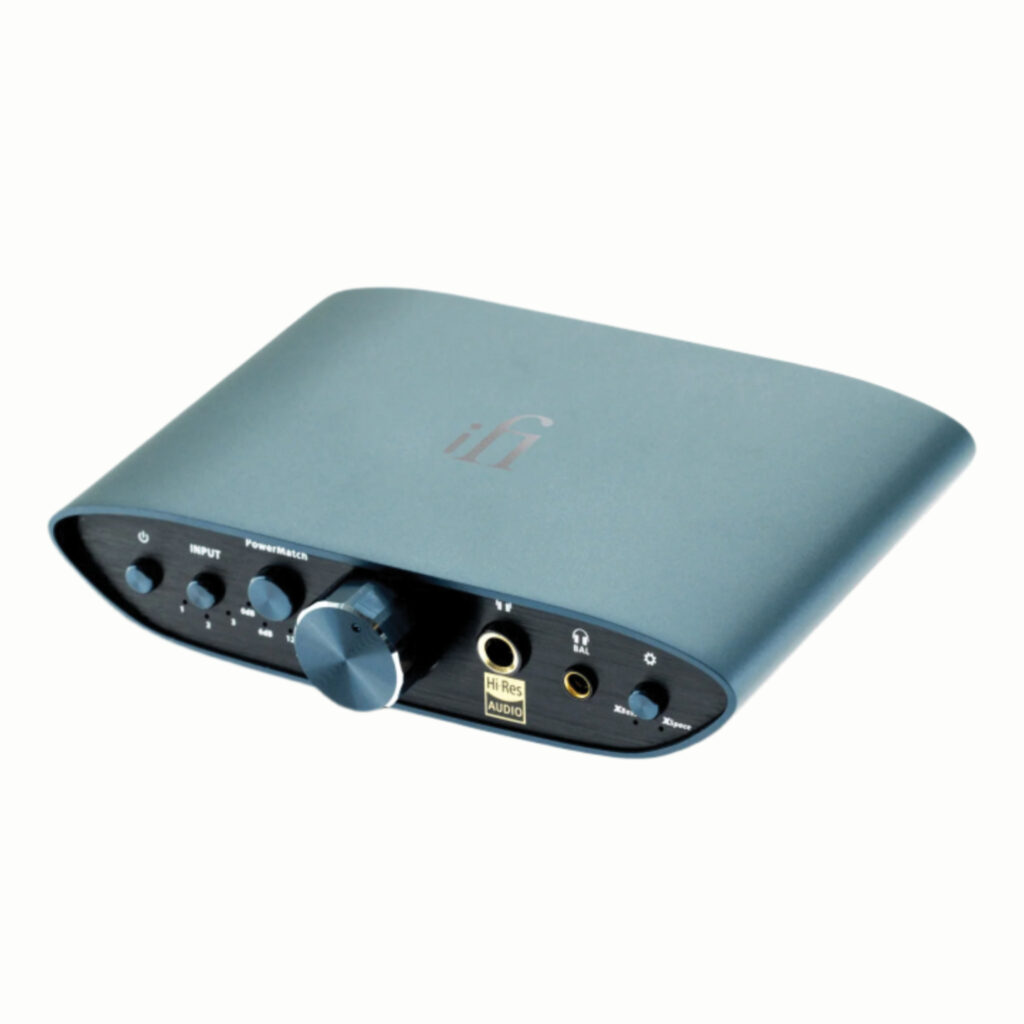
iFi ZEN CAN Signature is a desktop analogue headphone amplifier with four gain settings and physical XBass and XSpace controls. This review concerns the standard version, rather than the HD6XX, HFM or MZ99 editions with their particular EQ arrangements. It also keeps the CAN distinct from the similarly styled ZEN DAC products. This research-based assessment looks at original listening evidence, sensitive-earphone considerations and the way its analogue connections fit a complete desk system.
Research-based review. This assessment draws on manufacturer documentation and the original published evaluations linked below. Audio Review has not performed a hands-on test of this model.
The standard version has its own original review evidence
SenyorC’s original standard-model review describes a relaxed presentation with a little warmth and useful XBass adjustment. It also reports channel imbalance at the bottom of the analogue volume range. The Review Smiths similarly finds the unit enjoyable and straightforward. These are original third-party impressions, not Audio Review listening findings.
Try the actual headphone and source rather than assuming all ZEN combinations behave identically. Match level when comparing amplifiers and listen quietly as well as at the usual setting. A slight preference for warmth or a smoother presentation does not mean the amplifier corrects every headphone’s tuning. The most useful assessment includes noise, left-right balance and the range of comfortable adjustment. Positive musical evidence gives the standard CAN Signature a credible shortlist position, while the reported low-volume issue makes a direct sensitive-earphone check worthwhile. It should be selected as an amplifier that fits a particular chain, rather than as a guaranteed improvement over every computer or player output.
Standard and headphone-specific editions are different choices
The standard version uses XBass and XSpace. Other CAN Signature editions carry HD6XX, HFM or MZ99-specific tuning options. Those labels should not be treated as interchangeable marketing names for identical front-panel processing.
Check the actual edition on the product and in the order description. A generic listing photograph or a review of a different version can easily create the wrong expectation. Headphone-specific processing is not necessarily useful for another transducer, while the standard bass option may suit a broader selection. Neither is mandatory: begin with the processing disengaged, then compare if a real preference emerges. A headphone’s fit and basic tuning remain central. An amplifier preset cannot guarantee a suitable result for every ear, pad condition or musical recording. Accurate edition identity also matters for support material and second-hand pricing. Choose the version for the controls that will actually be used, rather than assuming the word Signature removes the need to understand the variant.
An analogue source is required
RCA, 3.5 mm and balanced 4.4 mm provide three analogue input routes. There is no internal digital converter, USB-audio port, optical input or Bluetooth receiver. The supplied electrical power connection does not carry music.
Use an appropriate line-level source, such as a DAC or suitable player output. A turntable requires the right phono stage before it becomes a suitable source. A phone with no analogue output needs a conversion route elsewhere rather than a passive USB cable. Check the source level and chosen gain before playback. A balanced cable should match the function and wiring at both ends; a visually identical 4.4 mm socket can be a headphone or line connection on another device. The CAN Signature is most coherent when separate analogue amplification is intentional. If a simple laptop-and-headphones setup still needs a DAC, interconnects and another power supply, a combined unit may be more convenient and less expensive overall.
PowerMatch should start at the lowest useful gain
The amplifier provides 0, 6, 12 and 18 dB gain settings. That range helps accommodate different sources and headphones, but more gain is not automatically better sound. The physical volume control also has a useful operating range that should be checked.
Begin at 0 dB and low volume. Assess left-right balance, background noise and comfortable adjustment with the intended earphones or headphones. Sensitivity matters alongside impedance, so a high impedance figure alone should not dictate the maximum gain setting. Do not raise listening level merely to place the knob at a recommended clock position. If channel balance is inconvenient at the required quiet level, consider an appropriate source-level arrangement or a different amplifier rather than listening too loudly. Reduce volume before switching transducers or inputs. A large available output rating does not establish ideal compatibility with every headphone, and the same percentage of knob rotation can produce very different levels with different sources. The useful goal is predictable control and adequate headroom in the actual system.
XBass and XSpace are optional listening tools
The standard model’s bass and space functions operate in the analogue signal path. They are not active noise cancellation, automatic room correction or an assurance of surround decoding. Their value depends on the headphone, recording and listener preference.
Compare each option separately at sensible level. Extra bass can be welcome with a lean headphone but excessive on an already bass-heavy recording. Spatial processing may change the presentation in a way one listener enjoys and another prefers to avoid. There is no need to leave both engaged merely because they are present. Keep the unprocessed setting as a clear reference and check familiar voices and bass lines. These controls are useful because they offer accessible choice without requiring computer software. They should not be described as universally more accurate or as a substitute for choosing a comfortable headphone with appropriate tuning. The strongest reason to value them is that they make normal listening more enjoyable with the actual transducers being used.
Desk integration includes power and speaker routing
The unit needs the appropriate external 5V supply and has a rear balanced analogue output for a suitable downstream arrangement. It is a desktop component, not a battery-powered portable amplifier. There is no remote control.
Check the accessories included in the particular package and follow the specified electrical requirements. Leave room for rear interconnects and use a sensible ventilated position. If active speakers are connected, establish their volume arrangement and verify what remains audible during headphone use rather than assuming automatic muting. A convenient control knob is useful only if it can be reached easily. Include any separate DAC, correct interconnects and required adapters when comparing total cost. For used equipment, confirm edition identity and test input selection, all gain settings and low-level channel balance. The CAN Signature’s value is highest in a system that benefits from analogue flexibility and physical sound adjustment. Paying for a matching stack makes less sense if a simpler complete solution already fits the listening routine.
Alternatives to consider
Topping L70: Compare the volume routine, switching and actual headphone fit. A different control approach may be preferable if repeatable output settings matter more than analogue sound adjustments.
Schiit Asgard 3: Consider another analogue-amplifier route when its inputs and output arrangement suit the intended source and headphones. Compare finished systems with suitable conversion included if needed.
iFi ZEN CAN Signature key specifications
- Role
- Standard ZEN CAN Signature analogue headphone amplifier
- Inputs
- RCA, 3.5 mm single-ended and 4.4 mm balanced analogue
- Headphone outputs
- 6.35 mm single-ended and 4.4 mm balanced
- Additional output
- Rear 4.4 mm balanced analogue preamp connection
- Gain
- 0, 6, 12 and 18 dB PowerMatch settings
- Sound options
- XBass and XSpace on the standard version
- Volume
- Analogue front control
- Power
- Appropriate external DC 5V supply; no internal battery
- Digital conversion
- Not included
- Edition check
- Standard version differs from HD6XX, HFM and MZ99 EQ variants
- Not provided
- USB audio, Bluetooth, optical input or remote control
- Dimensions
- 158 × 117 × 35 mm
- Net weight
- 550 g
Verdict
The standard CAN Signature is a credible research-based analogue amplifier with useful gain and optional sound controls. Confirm the exact edition, suitable line source and quiet-listening balance. It is strongest for a deliberately separate desktop system, with its appeal based on practical control and original musical evidence rather than functions such as digital conversion or wireless reception that it lacks.
Documentation and original reviews
iFi official ZEN CAN Signature product and edition options · iFi official standard CAN Signature manual · SenyorC original standard ZEN CAN Signature review on HifiGuides · The Review Smiths original ZEN CAN Signature evaluation
Editorial record
Sources and updates
Product specifications and factual claims were checked against Official iFi ZEN CAN Signature product page ↗. Scores and buying advice follow our category-specific editorial methodology.
- Published
- November 17, 2026
- Last updated
- November 17, 2026