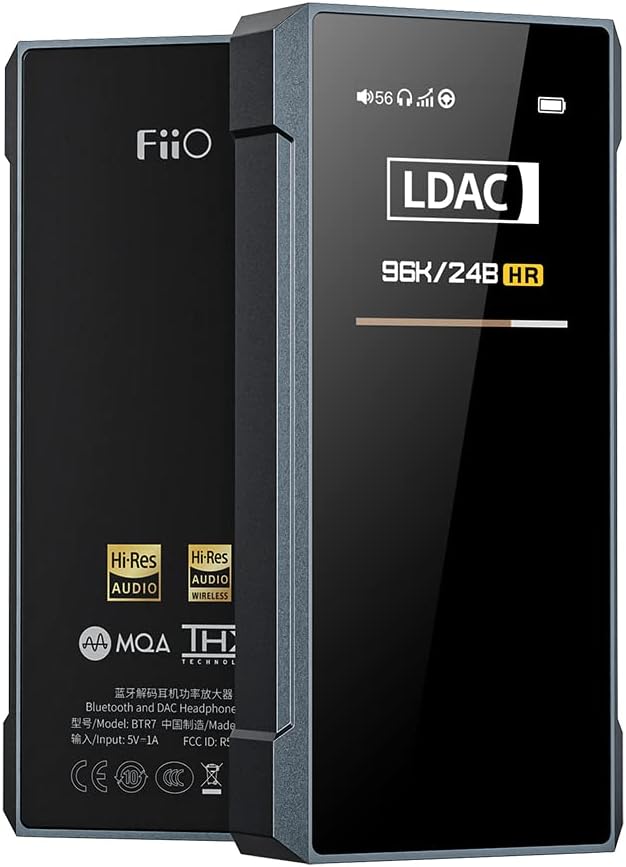
FiiO BTR7 combines a Bluetooth receiver with a USB DAC and headphone amplifier, offering a way to use wired headphones across a phone and computer setup. It is an established model rather than the latest release, and its larger body buys flexibility at the expense of pocket minimalism. The recommendation depends on the outputs and modes actually needed, not simply its once-flagship position within the BTR range.
Research-based review. This assessment draws on manufacturer documentation and the original published evaluations linked below. Audio Review has not performed a hands-on test of this model.
Receiver and USB DAC are the two core jobs
BTR7 receives Bluetooth audio or accepts USB data, then drives wired headphones. FiiO explicitly states that it is not a transmitter for Bluetooth headphones or speakers. Its dongle mode can use the internal battery rather than charging from the phone.
Draw the intended signal route before buying. A phone-to-receiver-to-wired-headphone arrangement is natural, while a television-to-wireless-headphone plan needs a different kind of device. At a desk, decide whether direct USB is preferable to Bluetooth and how the source switches during normal use. The box can cover more than one routine, but that flexibility is useful only when the controls and cables remain convenient. It should simplify a real listening setup rather than become an extra purchase based on an ambiguous wireless label.
The published sound case is encouraging
Headfonics’ original review describes a clean, energetic presentation and particularly values the wired dongle role. It also reports low noise with the IEMs used and positive Bluetooth operation in its test setup. Those are findings with particular equipment, not a guarantee of the same result with every sensitive earphone or difficult headphone.
Compare using the actual load and a known source, with perceived volume matched closely. Listen for useful control at quiet levels, noise between tracks and clean peaks at ordinary listening volume. A more powerful output can seem impressive when it is simply louder, so avoid drawing conclusions from unmatched settings. If the existing source already meets those requirements, decide whether the BTR7’s real advantage is connectivity, charging or control. Practical improvement can justify the purchase without inventing a dramatic sonic transformation.
Output choice needs correct wiring
The official table lists approximately 160 milliwatts single-ended and 320 balanced into 32 ohms, with different figures for other loads. Both a 3.5 mm single-ended output and a 4.4 mm balanced output are provided.
Choose according to the headphone’s sensitivity, impedance and compatible cable. An output figure at one load should not be repeated as universal power, and a balanced socket is not an invitation to use an arbitrary adapter with shared-ground wiring. Begin at a low volume and select gain for usable control rather than maximum possible loudness. If the ordinary single-ended connection already works cleanly, a cable replacement needs a specific justification. The useful result is a suitable output for the actual headphone, not achieving the largest number shown in the specification table.
USB modes have a meaningful EQ difference
FiiO’s official USB FAQ supports up to 384 kHz PCM and DSD256 in UAC 2.0, but states that EQ is not supported in that mode. It lists EQ support in UAC 1.0 and Bluetooth. This is an important qualification to the otherwise useful app-adjustment story.
Decide which matters more to the workflow: the particular format route or device-side EQ. Set up and verify the intended mode before comparing sound, especially if a stored preset is expected to apply automatically. Avoid assuming that the same menu option behaves identically over every connection. If a computer application already applies EQ, make sure another layer is not unintentionally added. A clear known processing path is more useful than several overlapping enhancements whose combined effect becomes difficult to diagnose.
Charging and carrying remain part of ownership
The official design includes an 880 mAh battery and both USB and Qi charging. The body weighs about 68 grams, while Headfonics notes a larger shape and sharper edges than earlier compact receivers. Its original listening use averaged more than seven hours, with runtime dependent on load and level.
Try how it sits with the headphone cable and the bag or pocket normally used. Check that the plug and buttons remain accessible and that the arrangement does not put repeated strain on a phone connection. With an older example, inspect charging behaviour and actual endurance rather than relying on a historical battery claim. Wireless charging can be convenient at a desk, but it does not remove the battery’s age or the need to plan a longer session. Include any required phone cable in the total cost.
Calls, codecs and current alternatives
Bluetooth codec support is broad, but the source must provide the chosen format. The official specifications restrict microphone voice calls to Bluetooth mode, with the relevant headset-microphone compatibility also qualified. This is not a general promise that every USB meeting application receives microphone audio through the same route.
Test a real call and ordinary source switching if work use is important. For video or games, check the actual application and transmitter rather than assuming a low-latency codec is negotiated automatically. Then compare current BTR15 and USB-only options against the complete requirement. Historical flagship status is not a substitute for a fair current price, particularly when buying battery-powered older stock. BTR7 remains attractive when its combination of reception, USB operation, outputs and charging fits a routine that would otherwise require several separate solutions.
Alternatives to consider
FiiO BTR15: BTR15 is worth comparing for an alternative portable balance. Check the required input mode, headphone output and pocket handling rather than assuming the older higher-numbered model is automatically preferable.
FiiO KA17: KA17 makes sense as a comparison when a direct USB connection is the normal routine. Bluetooth and an internal battery should earn their place in the purchase rather than be added for occasional theoretical use.
FiiO BTR7 key specifications
- Role
- Bluetooth receiver and USB headphone DAC/amp
- DAC / amplification
- Dual ES9219C and dual THX AAA-28
- Bluetooth
- 5.1 receiving
- Codecs
- SBC, AAC, aptX, aptX LL, aptX HD, aptX Adaptive and LDAC
- Outputs
- 3.5 mm single-ended and 4.4 mm balanced
- Manufacturer output at 32 ohms
- Approximately 160 mW single-ended; 320 mW balanced
- USB input ceiling
- PCM 32-bit/384 kHz and native DSD256
- EQ qualification
- Supported in Bluetooth and UAC 1.0; not UAC 2.0 per official FAQ
- Battery
- 880 mAh
- Charging
- USB-C and Qi wireless
- Weight
- Approximately 68 g
- Bluetooth transmitting
- No
Verdict
BTR7 remains a flexible and well-documented option for wired-headphone listeners moving between Bluetooth and USB. The original evaluation supports an audition for its sound and practical range, while the official mode information provides important limits that should stay attached to the recommendation.
Confirm the headphone load, desired EQ route and phone cabling before purchase. Compare price and condition with newer alternatives rather than buying a former flagship label. It makes the most sense when its particular combination of features solves a clear daily problem and its larger body remains convenient to carry.
Documentation and original reviews
FiiO official BTR7 output and input specifications · FiiO official BTR7 roles and charging features · FiiO official BTR7 USB modes and EQ restrictions · Headfonics original BTR7 sound and handling review · Headfonics original BTR7 wireless and pairing assessment
Editorial record
Sources and updates
Product specifications and factual claims were checked against Official FiiO BTR7 product page ↗. Scores and buying advice follow our category-specific editorial methodology.
- Published
- November 17, 2026
- Last updated
- November 17, 2026