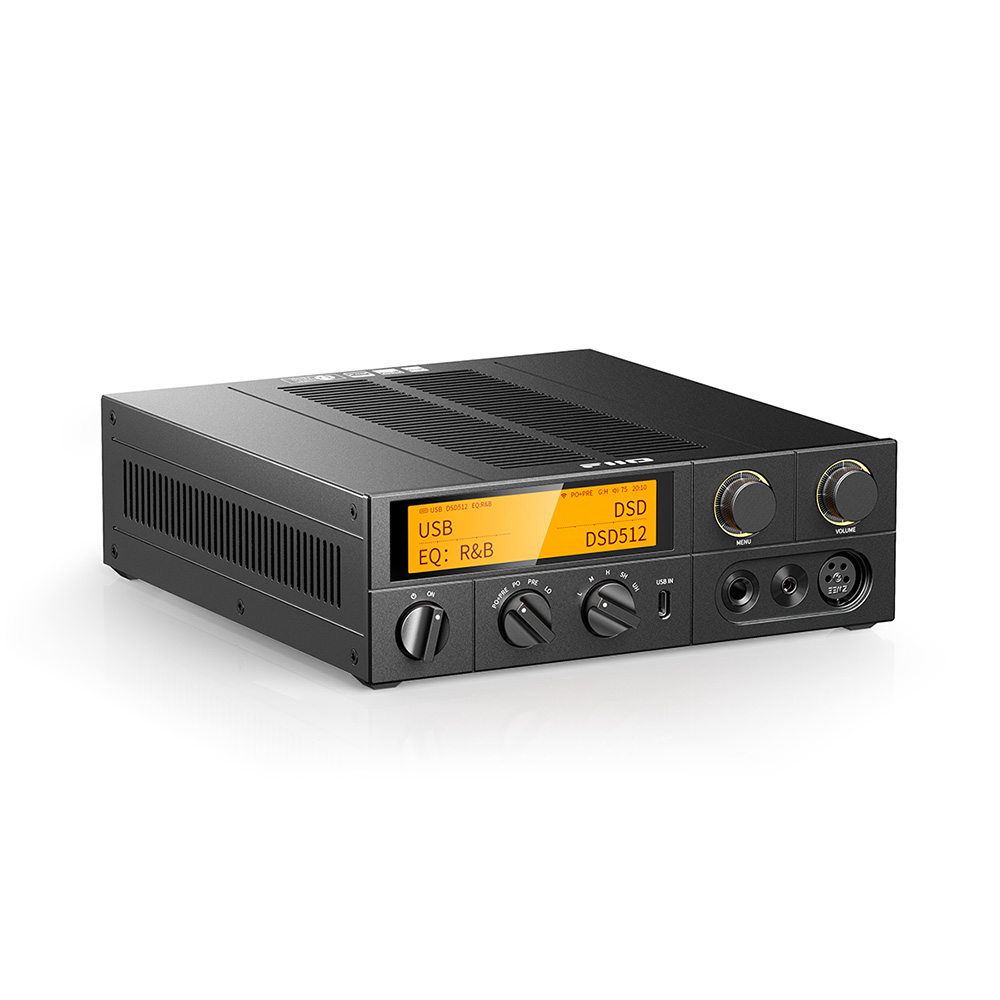
The FiiO KA17 is a USB dongle DAC and headphone amplifier with ambitions beyond a simple replacement headphone socket. It adds a display, physical controls, parametric EQ and a higher-power desktop mode. The buying question is whether those capabilities improve your mobile listening or turn a convenient dongle into a more complicated pocket system.
FiiO KA17 — Design and carrying practicality
The KA17 is small enough to travel with a phone or laptop, but its screen and controls make it more substantial than a tiny passive-looking adaptor. That can be an advantage when you want to confirm settings or change level without opening an app. It can also make the assembled phone, cable and headphone arrangement less elegant in a pocket. Consider the whole combination rather than judging portability from the DAC alone.
A short, flexible data cable reduces strain on the phone connector. Support the DAC rather than letting a stiff headphone lead pull against the phone’s port. At a desk, laying it beside the computer is straightforward; on a walk, a suitable carrying arrangement becomes more important. Headfonics noted warmth and phone battery draw in its original review. That is relevant to this product’s role: higher output capability is useful, but it is not free in a small device that takes power from a host or external supply.
Desktop mode and the two USB-C ports
The official design has one USB-C data and power connection and a separate orange power input. Desktop mode raises the available output capability, while an appropriate external supply can take over powering the DAC. FiiO’s FAQ specifies a 5 V supply rated for at least 1 A. It also explains that some hosts can support desktop mode without external power, provided they supply enough current. This is conditional capability, not a promise that every phone delivers the headline result.
For mobile use, the sensible default is the least demanding operating mode that comfortably drives the chosen headphones. At a desk, the extra supply becomes easier to accommodate and can avoid drawing the DAC’s operating power from the phone. That does not automatically mean the phone itself is being charged through the arrangement. Think of the second port as the DAC’s power connection, not an assumed charging hub. Check the exact source and cable combination before building a routine around it.
This dual role is the KA17’s strongest distinction. It can be a compact travel companion and a small desktop amplifier, but the latter configuration involves another cable and power source. Someone seeking the simplest possible pocket setup may prefer a less elaborate dongle even if its maximum output is lower.
Headphone output and matching
FiiO’s parameter table rates desktop-mode output at 650 mW per channel from balanced 4.4 mm into 32 ohms, with THD+N below one percent. The 3.5 mm figure is 270 mW per channel under the same load and distortion boundary. These are documented manufacturer figures, not measurements made by Audio Review. They also apply to the specified mode and conditions, so they should not be presented as universal battery-phone performance.
The difference can be useful for a suitable full-size headphone, but it does not make every demanding model an ideal match. Sensitivity and voltage needs still matter. With efficient earphones, start on low gain and give priority to a comfortable adjustment range and quiet background. More power is not a reason to increase average listening volume. Use the connector appropriate to the headphone’s wiring; an unsuitable adaptor can create problems that no specification advantage will solve.
Headfonics reported good low-noise earphone use and enough drive for some more demanding headphones. That supports the versatile positioning without proving that it replaces every desktop amplifier. For one especially difficult headphone, seek evidence for that exact pairing. A dongle that works very well with a typical portable headphone can still have limits on quieter recordings or after substantial bass EQ is applied.
Sound quality and the role of EQ
The original Headfonics review was positive about detail, staging and the range of headphones the KA17 could serve. Those are the reviewer’s listening observations rather than Audio Review test results. They support a strong assessment of the complete device, but a new DAC should still be judged by what it improves in your own chain. A well-fitting headphone and a stable source connection remain more important than assuming two DAC chips guarantee a particular sonic character.
Parametric EQ is potentially more useful than repeatedly replacing converters in search of a tonal change. It lets a listener make deliberate adjustments rather than depend on an uncertain hardware signature. Start with modest corrections and keep a reference profile. Large boosts can use headroom quickly, and a louder setting can seem better during a quick comparison. Match playback levels and avoid changing gain, output and EQ together if you want to understand which change matters.
EQ cannot fix poor isolation, physical discomfort or every narrow feature of a headphone’s acoustic response. Fit and seal should be addressed first, especially with earphones. The KA17’s processing is a tool for an already sensible pairing rather than a substitute for choosing the right headphone.
PEQ limits and phone compatibility
The official KA17 page specifies ten-band PEQ for formats up to PCM 192 kHz/24-bit and says PEQ is unavailable in UAC1.0 mode. That processing limit differs from the maximum USB decoding ceiling of PCM 768 kHz and DSD512. A supported file format and an available EQ path are separate questions. If correction is central to the purchase, configure a compatible PCM path rather than assuming the highest-rate mode also enables all processing.
FiiO documents Android app adjustment and a computer web route for settings, while noting that iOS app adjustment is not supported for this model. An iPhone owner should therefore consider initial setup as well as playback compatibility. A suitable connection can still provide audio, but that does not establish identical control access on every operating system. Check the phone’s port and any required data adaptor, particularly when comparing USB-C and older Lightning devices.
Who should buy it?
The KA17 makes the most sense for someone who uses the same headphones with a phone, laptop and occasional desk setup. A visible status screen, physical buttons and configurable EQ can make it more satisfying than a minimal dongle. It is less persuasive for a person whose sole requirement is a tiny headphone socket for efficient earphones. In that case, extra power and another supply option may add bulk without solving a real problem.
Compare current EU offers with the necessary cables and power arrangement included in the total. Do not budget for a balanced cable automatically; first decide whether the headphone needs the output capability and whether its wiring supports the connection. A permanent desk listener should also compare a small mains-powered amplifier, which may offer easier controls and line connections. The KA17 earns its place by travelling between uses, rather than by winning a wattage contest against equipment designed to remain on a shelf.
Alternatives to consider
Questyle M15i: A different portable USB approach for someone prioritising a focused dongle rather than a screen and extensive adjustment.
FiiO BTR17: Compare this when Bluetooth receiving and a battery-powered arrangement would be more useful than the KA17’s USB-only source role.
FiiO KA17 key specifications
- DAC configuration
- Two ES9069Q chips
- Headphone outputs
- 3.5 mm single-ended; 4.4 mm balanced
- Desktop balanced rating
- 650 mW/channel at 32 ohms, THD+N below 1%
- External power
- USB-C; manufacturer specifies 5 V, at least 1 A
- PEQ
- Ten bands; PCM up to 192 kHz/24-bit; not UAC1.0
- Maximum USB formats
- PCM 768 kHz/32-bit; DSD512
Verdict
A versatile USB DAC with useful controls, meaningful EQ and strong conditional output capability. It is especially appealing across portable and desk use, provided you accept phone power demands, the extra cable in an externally powered setup and the documented PEQ limitations.
Primary documentation and independent reviews
FiiO official KA17 product information · FiiO KA17 detailed parameters · FiiO desktop mode and external power FAQ · Headfonics original KA17 review · Headfonics KA17 matching and power discussion
Editorial record
Sources and updates
Product specifications and factual claims were checked against Official FiiO KA17 product page ↗. Scores and buying advice follow our category-specific editorial methodology.
- Published
- November 8, 2026
- Last updated
- November 8, 2026