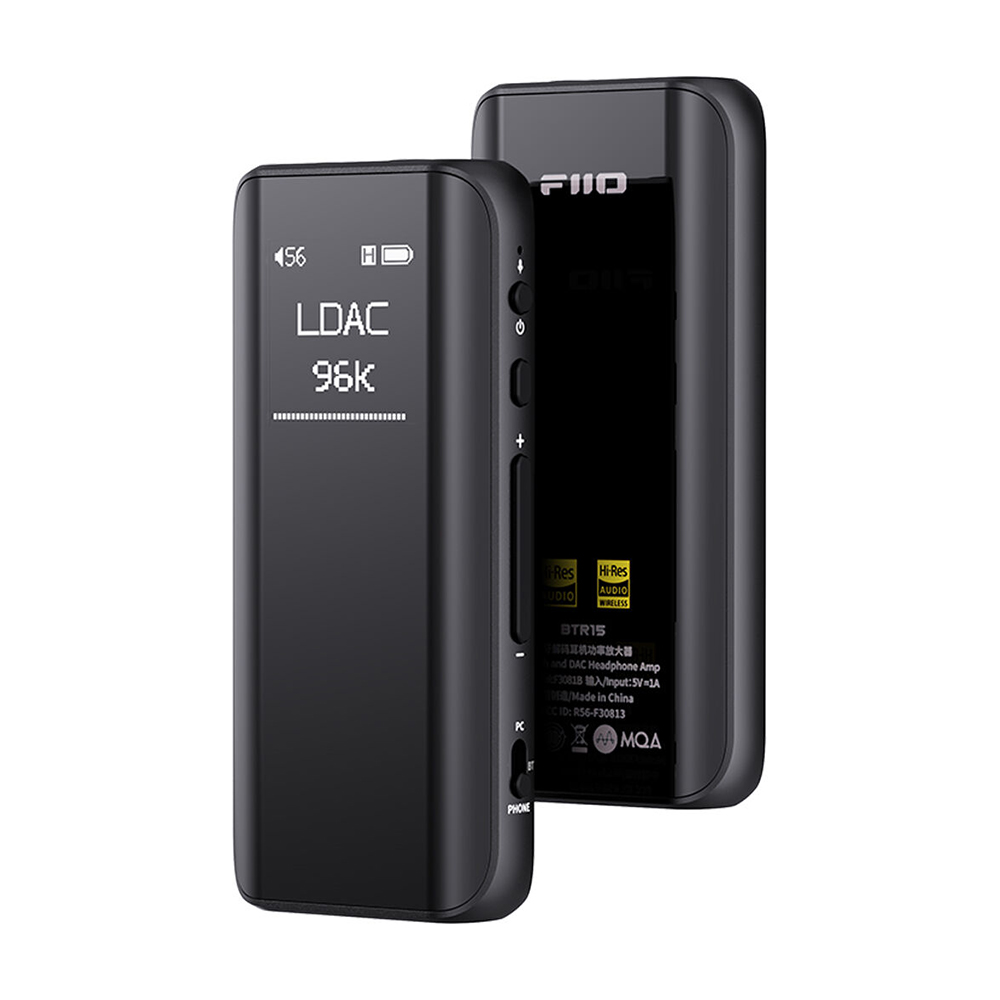
The FiiO BTR15 is a battery-powered Bluetooth receiver and USB DAC that lets wired headphones work more conveniently with a phone or computer. It keeps the headphone cable while removing the need for that cable to run directly to the phone in Bluetooth mode. Its display, two headphone sockets and flexible power modes make it more than a basic wireless adaptor.
FiiO BTR15 — Design and the portable listening routine
A small receiver changes where the cable goes rather than making wired headphones completely wireless. The headphone lead still connects to the BTR15, which can be carried separately from the phone. That is useful when taking the phone out repeatedly, moving around a room or avoiding a cable attached to its charging port. Whether it feels more convenient depends on where the receiver sits and how much spare headphone lead you need to manage.
The OLED display makes status and settings easier to inspect than on a receiver that communicates only through coloured lights. Physical controls are also valuable for routine changes without unlocking a phone. The glass surfaces give the device a polished appearance, but a protective carrying arrangement is sensible for a component travelling with keys and other objects. This is an everyday-use purchase, so handling, clip placement and cable routing deserve as much consideration as the DAC chips inside.
Bluetooth and USB are different use cases
Bluetooth mode lets the phone supply music wirelessly while the BTR15 powers the wired headphones. A supported codec must be available on both devices, and the negotiated connection depends on the source. The receiver is not a guarantee that every phone will provide LDAC or an aptX variant. Check the phone’s actual support rather than inferring it from the BTR15’s codec list.
USB provides a wired alternative for a computer or suitable phone. This can be useful at a desk, when wireless reliability is less important than a direct connection, or when the phone’s codec support is limited. The USB cable needs to support data and the source must recognise the device as an audio output. A charging-only lead can fit the socket while failing to provide the intended connection. The BTR15 is a receiver and converter, not an independent streaming player with its own music library.
For video and games, latency is a separate concern from audio fidelity. A codec advertised for music quality does not promise ideal synchronisation in every app and source combination. If timing is central to the use, test that exact workflow and consider USB as the more predictable alternative rather than buying solely on the Bluetooth version number.
Power modes and battery ownership
The official PC, BT and PHONE modes make the power arrangement unusually clear. PC mode is intended for USB DAC use powered by the computer; PHONE mode uses the internal battery while connected to a phone as a USB DAC; Bluetooth mode uses the battery and permits charging over USB. Choosing the right mode matters because two apparently similar wired connections can have different effects on the phone and receiver battery.
FiiO quotes about eight hours of battery life. Treat that as a manufacturer estimate rather than a fixed all-day guarantee. Output choice, listening level, headphone demand, codec and settings can change the practical result. Someone planning a long commute and a full working day should allow a charging margin instead of assuming the headline duration covers every scenario. Battery ageing is also part of long-term ownership in a way it is not for a simple host-powered dongle.
At a desk, learn the charging and isolation options rather than leaving the device in an arbitrary state. A battery receiver can be useful across portable and stationary listening, but a permanent desktop system may be easier with equipment designed solely for mains or USB power. Portability earns its cost when the device actually leaves the desk.
Headphone matching and output capability
The BTR15 offers 3.5 mm single-ended and 4.4 mm balanced headphone outputs. Official ratings at 32 ohms and THD+N below one percent are 125 mW per channel single-ended and 340 mW balanced. These are manufacturer specifications, not our measurements. They indicate a useful difference in available drive, but neither connector makes every full-size headphone a suitable portable match.
Efficient earphones are the natural starting point for this kind of receiver. Begin with conservative gain and level, then judge whether normal listening leaves a comfortable adjustment range. For full-size models, look at sensitivity as well as impedance. A headphone that reaches a loud level on one track may still leave limited headroom for a quiet recording or a large EQ adjustment. The right output is the one that suits both the electrical demand and the cable wiring.
A balanced cable may be useful when the extra output is needed, but it should not be treated as an obligatory upgrade for every earphone. An additional cable can consume a significant part of the budget for a small receiver. If the existing 3.5 mm setup already works well, convenience and reliability are good reasons to keep it.
Sound quality and the value of PEQ
Headfonics’ original review was favourable about the BTR15’s performance and flexibility with portable headphones and earphones. Pragmatic Audio also found it a useful compact device, while reporting software and mode-switching quirks on the firmware tested in 2024. Those observations should be read in their original version context, rather than presented as a confirmed fault in every current unit. They do make careful initial setup a sensible part of ownership.
Parametric EQ is a strong reason to consider this receiver. It can make deliberate tonal changes across supported Bluetooth and USB paths, rather than relying on replacing hardware in search of an uncertain sonic difference. Start with a modest profile, leave headroom for boosts and compare at matched levels. A profile cannot correct an earphone that fails to seal properly, so fit should come before processing. Avoid making several large changes at once if you want to understand which adjustment helps.
FiiO documents Bluetooth PEQ up to 96 kHz/24-bit and USB PEQ up to PCM 192 kHz. Its maximum USB decoding support, PCM 384 kHz/32-bit and DSD256, is a different limit. The official page also notes that enabling or disabling USB PEQ restarts the USB connection. That is useful context when a setting change briefly interrupts playback; it should not automatically be mistaken for a broken cable.
Value and the right buyer
The BTR15 makes the most sense for someone who likes an existing pair of wired earphones and wants a more flexible relationship with the phone. It can also bridge occasional laptop and mobile listening without requiring separate devices for each. If the aim is completely cable-free exercise or the smallest possible object in a pocket, true wireless earbuds or a tiny USB dongle may suit the routine better.
Compare the current EU price with alternatives including any needed cable or case, and consider the software interface as part of the product. A display and standard 4.4 mm socket are useful physical advantages, while advanced EQ users may prefer a different control ecosystem. The BTR15’s value lies in balanced everyday convenience: good portable functionality, several modes and meaningful adjustment, with the charging discipline and setup attention that a battery-powered receiver requires.
Alternatives to consider
Qudelix-5K: A relevant alternative when advanced EQ management is the main priority. Compare the software workflow as carefully as the sockets.
FiiO BTR17: Consider this when a more capable portable and desk combination is worth the added size and cost for the actual headphone.
FiiO BTR15 key specifications
- Inputs
- Bluetooth receiving and USB-C audio
- Headphone outputs
- 3.5 mm single-ended; 4.4 mm balanced
- Rated power at 32 ohms
- 125 mW/channel SE; 340 mW/channel balanced, THD+N below 1%
- Battery life
- Manufacturer estimate: about eight hours
- USB formats
- PCM up to 384 kHz/32-bit; DSD256
- USB PEQ
- PCM up to 192 kHz
- Display
- 0.96-inch OLED
Verdict
A flexible and useful receiver for keeping wired headphones in a phone-centred system. The screen, power modes and PEQ make a strong practical package, while battery planning, headphone demand and careful mode setup remain important.
Primary documentation and independent reviews
FiiO official BTR15 specifications and modes · Headfonics original BTR15 review · Pragmatic Audio original BTR15 review and firmware context
Editorial record
Sources and updates
Product specifications and factual claims were checked against Official FiiO BTR15 product page ↗. Scores and buying advice follow our category-specific editorial methodology.
- Published
- November 8, 2026
- Last updated
- November 8, 2026