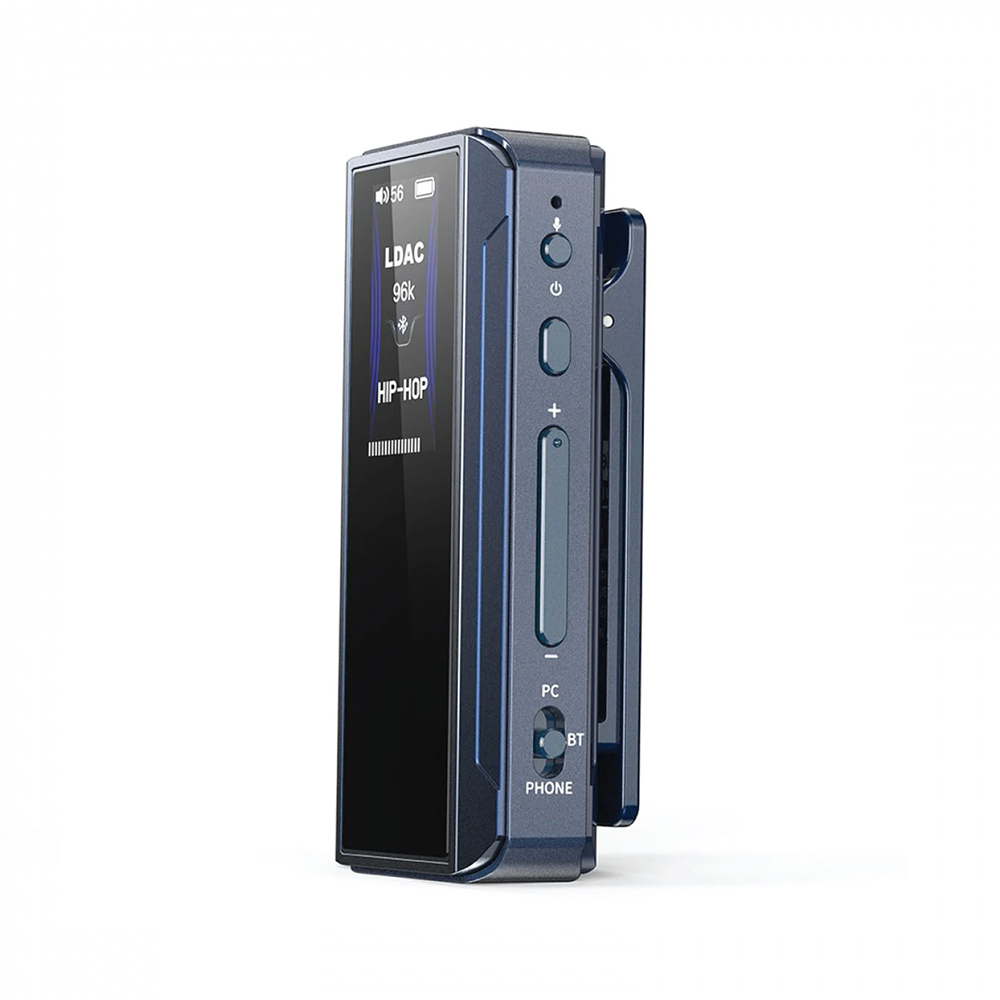
FiiO BTR13 lets a phone or computer feed ordinary wired headphones through a small receiver and DAC/amp. It combines Bluetooth reception, USB input and configurable EQ in a light body with a display. That can preserve the use of a favourite pair of earphones without attaching their cable directly to the phone. It does not turn the earphones into truly wireless products, and it is not a Bluetooth transmitter.
Research-based review. This assessment draws on manufacturer documentation and the original published evaluations linked below. Audio Review has not performed a hands-on test of this model.
Three modes answer different routines
FiiO provides a physical switch for PC, Bluetooth and Phone operation. Its explanation states that PC mode is powered by the computer, while Phone mode uses the internal battery for the USB headphone role. Bluetooth mode receives audio wirelessly and uses the device as the nearby headphone connection.
Choose the role before comparing accessories. At a desk, a direct USB route may be simplest. In a pocket or clipped to clothing, Bluetooth can allow the phone to remain separate from the headphone lead. Neither arrangement removes the cable between the BTR13 and the headphones. Think through where the device will sit, how the lead reaches it and whether the controls remain accessible. The useful upgrade is a routine that becomes easier, not merely an extra object added because it has a DAC chip and a screen.
EQ is a meaningful feature, with sensible setup
The manufacturer describes global PEQ through supported app or web tools across Bluetooth and USB use. Headfonia’s original test reports an early discrepancy between an indicated EQ-off state and an active app preset, so checking the actual configuration is more useful than assuming a factory-looking screen establishes a neutral starting point.
Begin with a known default and save any preferred adjustment clearly. Make small changes, compare at similar perceived loudness and retain enough headroom when boosting frequencies. A downloaded headphone profile is a starting point rather than a personal hearing assessment. Pad condition, ear-tip fit and individual preference still matter. If the device sounds unexpectedly different between sessions, inspect source processing and EQ settings before buying another cable or attributing the change to the DAC architecture.
Published sound evidence is conditional
Headfonia finds a smooth, relatively warm presentation but prefers BTR15 for definition and separation in its comparisons. Headfonics raises different pairing reservations, particularly over Bluetooth and with more demanding headphones. Those subjective accounts support a practical audition rather than a universal claim that the BTR13 has one fixed tonal effect with every load.
Compare it with the existing output using the headphones actually owned. Match volume carefully and listen for clean playback, usable control and unwanted noise during quiet passages. If the old source already works well, the main benefit may be mobility or EQ rather than a dramatic sound transformation. That is still a legitimate reason to buy. It is more useful than expecting a named converter chip to produce the same audible improvement in every system regardless of source, gain, headphone sensitivity and listening level.
Power figures must stay attached to the load
FiiO’s table gives 100 milliwatts per channel from the single-ended output and 220 from the balanced output into 32 ohms under its stated conditions. Those figures do not promise the same power at every impedance or establish suitability for every full-size headphone.
Check the complete output requirement, including headphone sensitivity and the desired listening level. Use low gain where it provides adequate adjustment and assess quieter recordings as well as loud masters. Balanced operation requires a correctly wired compatible headphone cable; a simple adapter should not be assumed to convert an ordinary shared-ground connection safely. There is no reason to buy a new cable solely because the larger output number exists. Choose the output that works cleanly and conveniently with the actual headphone rather than treating maximum power as a target to use.
USB limits and Bluetooth compatibility
The documented USB decoding limit is 16-bit/96 kHz PCM. Bluetooth codec support includes LDAC and several aptX variants, but the transmitting source must support the selected codec. BTR13 cannot send audio onward to Bluetooth headphones.
If a particular file format or source connection is essential, check it before ordering rather than relying on the broad high-resolution description. For ordinary listening, a format ceiling should be weighed alongside the recordings and workflow actually used. For video or interactive games, test the source and application because codec availability and delay compensation vary. A Bluetooth receiver can be convenient without being the right low-latency solution for every task. The correct purchase begins with the signal route, not with an assumption that any wireless audio box can operate in either direction.
Battery and current value
The official endurance table gives at least eight hours in specified AAC Bluetooth conditions with EQ off and a 32-ohm load. It also gives separate results for Phone mode. These are controlled manufacturer conditions rather than a guarantee with every headphone, codec and gain setting.
Plan charging around a normal day and leave a margin for different use. Check how the clip, buttons and headphone plug sit when carried, since comfort and cable routing can matter more than a small numerical specification advantage. Compare current BTR15 pricing and a simple USB-only alternative if wireless reception will be rare. BTR13 is most persuasive when its lightweight receiver role and PEQ are both useful. A smaller saving becomes less attractive if the next model better meets a required input or headphone load.
Alternatives to consider
FiiO BTR15: BTR15 is the immediate comparison when its current price is close. Include the input requirements, headphone load and handling differences rather than deciding solely by the cheapest entry price.
FiiO KA17: KA17 is relevant if wired USB use is the main requirement and Bluetooth is unnecessary. Compare the complete portable routine and source-power needs rather than paying for a receiver function that will not be used.
FiiO BTR13 key specifications
- Role
- Bluetooth receiver and USB headphone DAC/amp
- DAC
- Dual CS43131
- Bluetooth
- 5.1 receiving
- Codecs
- SBC, AAC, aptX, aptX LL, aptX HD, aptX Adaptive and LDAC
- Outputs
- 3.5 mm single-ended and 4.4 mm balanced
- Manufacturer output at 32 ohms
- 100 mW per channel single-ended; 220 mW balanced under stated conditions
- USB decoding
- PCM up to 16-bit/96 kHz
- Modes
- PC, Bluetooth and Phone
- EQ
- Global PEQ via supported FiiO tools
- Battery
- 460 mAh
- Weight
- Approximately 28.6 g
- Bluetooth transmitting
- No
- Dimensions
- Approximately 63.2 × 30 × 18.8 mm
Verdict
BTR13 offers a useful combination of Bluetooth reception, USB flexibility and global EQ in a light inexpensive package. Its clearest role is making suitable wired earphones more convenient with modern sources while keeping sound adjustment close at hand.
Confirm the USB ceiling, source codec and headphone output needs before buying. The original comparisons justify checking alternatives when prices are close, especially for demanding headphones. Choose it for a defined practical benefit rather than expecting an entry-level receiver to replace every desktop amplifier or guarantee an audible improvement over an already competent output.
Documentation and original reviews
FiiO official BTR13 specifications and test conditions · FiiO official BTR13 mode and global PEQ explanation · Headfonia original BTR13 features and sound comparisons · Headfonics original BTR13 headphone matching evaluation
Editorial record
Sources and updates
Product specifications and factual claims were checked against Official FiiO BTR13 product page ↗. Scores and buying advice follow our category-specific editorial methodology.
- Published
- November 17, 2026
- Last updated
- November 17, 2026