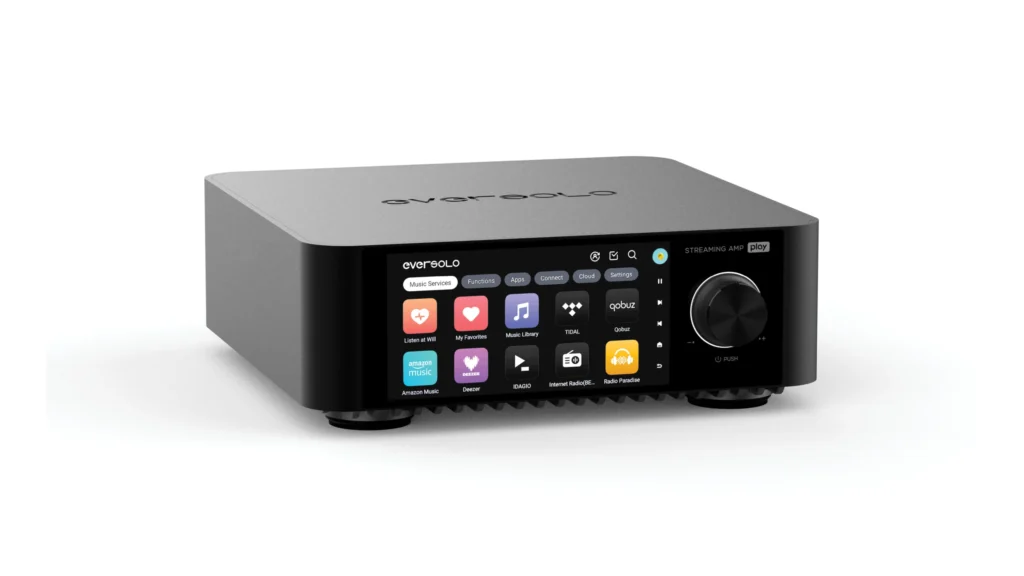
The Eversolo Play aims to be the centre of a stereo system rather than simply another network source. It combines streaming, digital conversion and speaker amplification with connections for television and vinyl. This review concerns the standard Play; the separate CD Edition should not be assumed to be included in every listing carrying the Play name.
Eversolo Play — An integrated stereo system still needs matching
Eversolo specifies 60 W RMS into eight ohms and 110 W into four ohms, with Class-D amplification. These are manufacturer ratings rather than results from our own load testing. Match the speakers and intended listening distance instead of treating a wattage as a guarantee for every room.
The integrated format reduces box count, but it also concentrates control and service functions in one component. Leave ventilation, cable clearance and access to the touchscreen. If the amplifier is hidden in a cabinet, consider whether its local controls will actually be useful or whether app operation will dominate.
TV connection means a stereo audio-return path
The official documentation lists HDMI ARC and describes stereo PCM support. That is a TV audio-return connection rather than a source-switching AV receiver. Consoles and disc players normally connect to the television, which must output a compatible stereo signal.
Do not interpret an ARC socket as a promise of discrete Atmos surround decoding. The Play is a stereo amplifier for a pair of main speakers. A subwoofer output can add bass-system flexibility, but does not turn the unit into a many-channel cinema processor. Decide whether a high-quality stereo TV arrangement is the actual goal.
Phono flexibility requires correct settings
Eversolo documents MM and MC phono support. Those cartridge types can require different gain and loading, so select the appropriate setting according to the cartridge and manual rather than experimenting at a high volume. A turntable with an active internal phono stage normally feeds a line input instead.
The analogue line, optical and coaxial inputs provide other source routes. Label the intended connections before installation, especially where RCA-shaped analogue and digital sockets could be confused. Connecting the correct signal type is more important than purchasing an expensive cable.
Standard Play versus CD Edition
The CD Edition includes optical-disc hardware, while the standard Play should not be advertised as having that built-in drive. Confirm the exact model on the invoice and product selector. A shop photograph showing a disc tray can describe the family rather than the particular option selected.
The documented touchscreen and Eversolo Control workflow make software part of the ownership experience. Check the music services, local-library access and current firmware features you actually need. An update history or long list of apps is not a guarantee that every service is available in every region.
For value, compare the complete stereo setup: speakers, stands, a subwoofer if required, and any existing source equipment that will remain. We have not auditioned the Play or measured its conversion, phono stage or amplifier. Its attraction here is integration and connection flexibility, not an invented claim that it outperforms separate components.
What to expect in a real setup
Does every Eversolo Play have a CD drive? No. The CD Edition is a distinct version. Confirm the exact selected product rather than relying on a family photograph or shortened title.
Can I use a turntable with its own phono stage? Yes, through the appropriate line-level route when the turntable’s internal stage is enabled. Do not feed an already amplified line signal into a phono setting.
Choose the Play version before comparing the package
The standard Play and the CD Edition should remain distinct purchases. A demonstration of disc playback on the latter does not establish that the standard model contains a disc drive. Check the exact version on the order and the rear-panel connections required by the rest of the system. This is especially important when a retailer uses shared photographs or a family description. The standard Play’s appeal should stand on the streaming and amplification functions that are actually included, rather than on an accessory or mechanism belonging to another version.
For vinyl, the availability of phono facilities is useful but does not make every cartridge setting interchangeable. Identify whether the cartridge is moving magnet or moving coil, then check the specified connection and operating settings. Moving-coil cartridges differ in output and loading requirements, so the category name alone is insufficient. Avoid sending an already equalised line-level signal through a phono input. A few minutes tracing the turntable’s signal path can prevent a misleading impression of either the amplifier or the record collection.
Build a two-channel system around actual listening needs
The Play can form the electronics centre of a passive-speaker setup, but speaker choice and placement remain central to the result. Allow space around the amplifier, use properly terminated speaker cable and test the pair at the intended distance. Manufacturer power figures are useful reference conditions, not a prediction of how every loudspeaker will behave in every room. Buying a more demanding speaker later may change the suitability of the system even if the source functions remain convenient.
Television integration should be tested as a stereo workflow. Confirm the TV’s output format, try the apps and external sources used in the household, and verify volume and standby behaviour. The screen and app then need to make switching between television, records and streaming understandable to another user. A component that combines several functions earns its place by reducing daily friction. Compare its complete price with an amplifier plus source that performs the same jobs, including any required phono equipment. Leave budget for sensible speaker positioning and support rather than assuming that an all-in-one electronics package completes every aspect of the installation.
Alternatives to consider
WiiM Amp Pro: Compare a different compact streaming-amplifier platform when interface style and source requirements differ.
Marantz MODEL M1: A relevant stereo alternative to investigate at the full system price, including any separate phono hardware needed for vinyl.
Eversolo Play key specifications
- Assessed edition
- Standard Eversolo Play
- Amplification
- Stereo Class D
- Power claim, 8 ohms
- 60 W RMS
- Power claim, 4 ohms
- 110 W RMS
- TV input
- HDMI ARC, stereo PCM
- Phono
- MM / MC
- Other inputs
- Line, optical, coaxial
- Display
- 5.5-inch LCD touchscreen
- Built-in CD drive
- CD Edition only
Verdict
The Play is worth considering when several stereo sources need one coherent control point. Its TV and phono connections are practical strengths, provided their settings match the sources. Choose the edition carefully and test the control workflow; specifications alone do not establish sound quality or long-term software behaviour.
Primary documentation
Specifications and feature descriptions were checked against the following official documents on 6 November 2026. Compatibility advice is our interpretation of those documented capabilities; it does not establish measured sound quality. Regional bundles, software features and service availability can change, so verify the exact European model and current support information before purchase.
Editorial record
Sources and updates
Product specifications and factual claims were checked against Official Eversolo Play product page ↗. Scores and buying advice follow our category-specific editorial methodology.
- Published
- November 7, 2026
- Last updated
- November 8, 2026