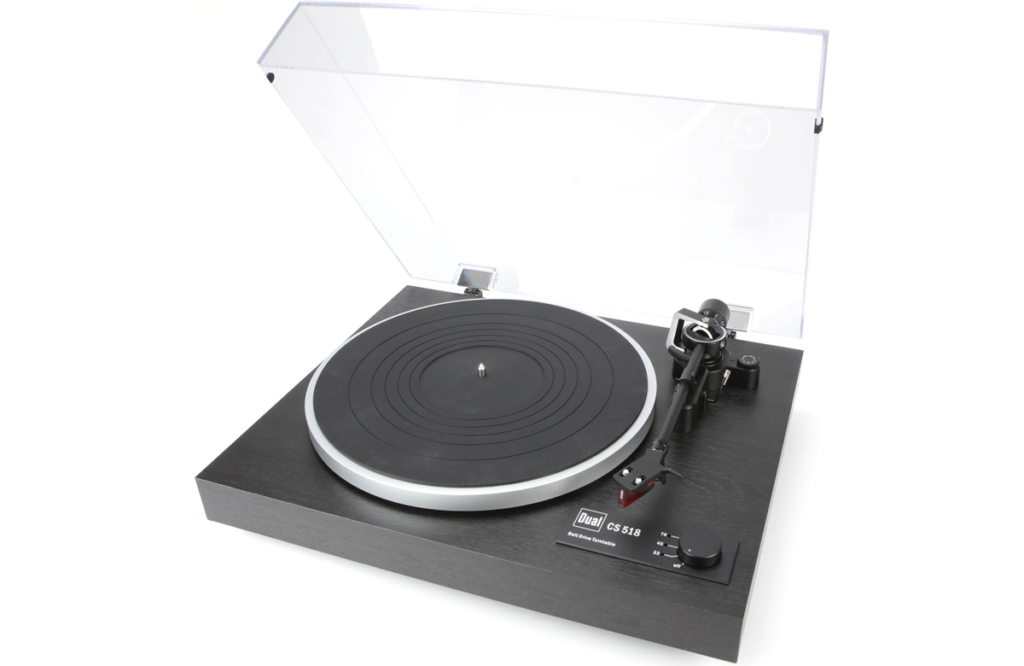
Dual CS 518 is a manual belt-drive turntable that combines a familiar vinyl routine with useful convenience features. Electronic speed selection, a factory-fitted Ortofon cartridge and a switchable phono stage make its system role easy to understand. It is more flexible than a deck that requires an external stage from the first day, while still demanding correct tonearm setup and manual handling. The strongest reason to shortlist it is the combination of practical features and an engaging original listening assessment.
Research-based review. This assessment draws on manufacturer documentation and the original independent evaluations linked below. Audio Review has not performed a hands-on test of this model.
A manual turntable with convenient speed selection
The owner positions and cues the arm, then returns it at the end of the record. There is no automatic start or end-of-side lift in the documented design. The speed selector avoids moving a belt manually whenever changing between supported speeds.
That combination suits someone who enjoys handling records but frequently changes between albums and singles. It is less suitable if unattended end-of-side operation is a requirement. Try the arm lift, speed control and record-changing sequence before purchase rather than deciding only from a photograph. The ordinary actions will be repeated far more often than a cartridge upgrade, so their comfort and clarity deserve a place in the buying decision.
What the original listening review supports
What Hi-Fi’s original evaluation finds a full-bodied, expressive and entertaining presentation, with useful scale and musical flow. It also places the deck against strong Rega and Pro-Ject competition and is less enthusiastic about the internal phono stage than the turntable’s broader capability. Those findings support an audition with the chosen connection arrangement made clear.
Listen to the complete package rather than assuming a demonstration through an expensive external stage represents the built-in output. Compare vocals, dense arrangements and bass rhythm with familiar records. The relevant result is how the deck performs in a system you can actually assemble. A favourable review is useful evidence for the shortlist, but it does not remove the need to prefer the presentation or confirm that the supporting equipment is included in the budget.
Built-in phono stage and the correct input
The switchable stage permits a line-level connection when enabled or use of a suitable external phono input when bypassed. Select the mode deliberately and reduce volume while changing connections. Passing an already amplified line signal into another phono stage is not the intended arrangement.
For a first system, the internal stage can reduce the number of boxes and purchases. Later, bypassing it lets the owner evaluate another stage without replacing the whole deck. That is a useful option, but an upgrade should solve an identified need or produce a preferred result in a fair comparison. It is not necessary to plan immediate replacement before hearing the supplied system. A working baseline makes later choices more meaningful.
Arm setup still matters with a fitted cartridge
A factory-fitted 2M Red saves the initial cartridge-selection task, but the owner still needs to follow the counterweight, tracking-force and anti-skating instructions. Use the supplied manual for the actual model rather than copying a setting from another Dual or cartridge.
Ask the dealer to demonstrate setup if unfamiliar with handling a stylus. Keep the guard in place when appropriate during assembly and make sure the surface is level. A simple setup check can prevent poor tracking or an unstable arm position that might otherwise be blamed on the recording. The aim is a repeatable mechanical arrangement, not endless adjustment. Once correctly established, record handling should remain calm and straightforward.
Removable headshell and future choices
The removable headshell makes a cartridge change more approachable, but compatibility still involves mass, alignment and the arm’s supported range. A cartridge that fits the mounting holes is not automatically a complete match. Check the relevant dimensions and setup requirements before buying a replacement.
For many owners, the most sensible first step is learning the supplied cartridge and maintaining the stylus correctly. If trying an upgrade later, compare at similar level and keep the original setup documented. Also consider record condition and the phono stage. A more expensive cartridge cannot restore information damaged on a record or correct a poor physical installation. The CS 518 offers a path for change without making constant modification a requirement for enjoying records.
Three speeds do not answer every record question
The speed selector includes a seventy-eight setting. Before playing unfamiliar older discs, confirm the appropriate stylus and cartridge arrangement for the actual record type rather than assuming one fitted stylus suits every disc merely because the motor can turn at the required speed.
The same practical care applies to ordinary records. Use the correct speed, keep the playing surface clean and avoid handling the stylus casually. If a passage mistracks, investigate condition and setup before increasing tracking force beyond the cartridge guidance. A turntable’s flexibility is valuable when used with the right consumables and procedures. The presence of an extra speed is a useful option, not a reason to skip checking how a particular collection should be played.
Placement, maintenance and the complete price
Use a stable level support with appropriate separation from loudspeaker vibration. Leave enough space for the lid and for safe access to the arm. A crowded cabinet can make record changing awkward even when the deck technically fits its stated dimensions.
Budget for stylus care, eventual replacement and any phono equipment required by the chosen system. If buying used, inspect the belt, arm bearings, headshell connection and stylus condition. Compare Planar 3 and Debut PRO B as complete packages, including cartridge and stage differences. The Dual value is strongest when its convenient speed selection, fitted cartridge and switchable output all serve real needs, rather than when the purchase is reduced to a comparison of cabinet finishes or one advertised specification.
Alternatives to consider
Rega Planar 3: Planar 3 is a worthwhile manual-deck comparison. Include the actual cartridge and any required phono stage in the package price, and compare speed-changing convenience as well as the listening presentation.
Pro-Ject Debut PRO B: Debut PRO B offers another upgradeable manual approach. Compare the complete cartridge and connection arrangement rather than assuming that a particular arm material or drive label establishes the better system.
Dual CS 518 key specifications
- Drive
- Belt drive with DC motor
- Operation
- Manual, no automatic start or end lift
- Speeds
- 33⅓, 45 and 78 rpm
- Speed change
- Electronic selector
- Cartridge
- Ortofon 2M Red moving magnet
- Tonearm
- Twin-gimbal design
- Headshell
- Removable
- Phono stage
- Switchable MM stage
- Output
- RCA, phono or line mode
- Digital output
- None
- Weight
- 5.8 kg
Verdict
CS 518 is an appealing manual turntable with a positive original listening assessment and a practical set of conveniences. Electronic speed selection and a switchable phono stage make it easier to integrate into several sensible systems.
Set it up carefully, accept the fully manual end-of-side routine and compare the internal output with the system you plan to own. Strong alternatives deserve an audition, but the Dual offers a coherent combination of engagement, usability and future connection flexibility at an appropriate current price.
Primary documentation and independent reviews
Dual official CS 518 product information · Dual CS 518 official setup and connection manual · What Hi-Fi original CS 518 listening evaluation
Editorial record
Sources and updates
Product specifications and factual claims were checked against Official Dual CS 518 product page ↗. Scores and buying advice follow our category-specific editorial methodology.
- Published
- November 17, 2026
- Last updated
- November 17, 2026