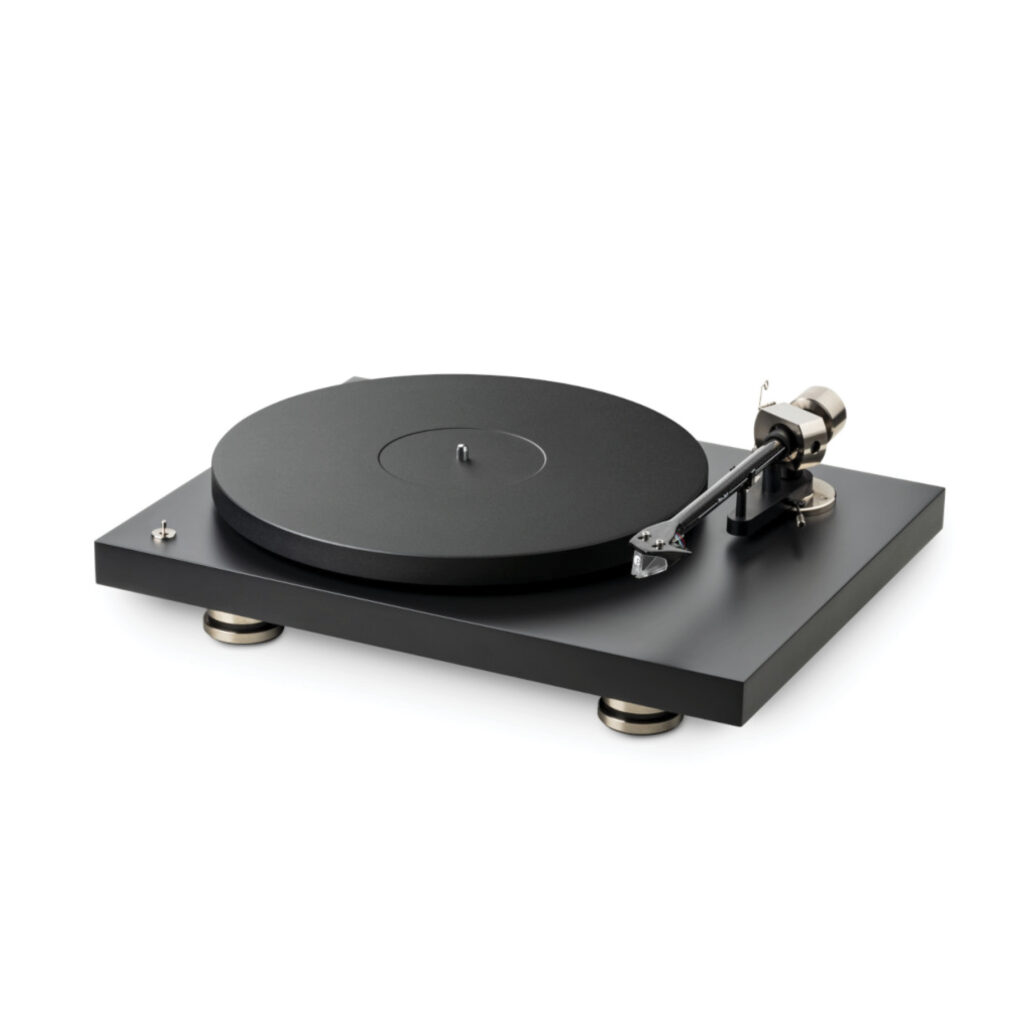
The Pro-Ject Debut PRO B adds a specially configured moving-magnet cartridge and balanced phono connection to the Debut PRO platform. It offers a useful middle ground between a simple factory package and a turntable intended for careful cartridge development. The important buying question is whether its adjustment and connection options will be used, with a suitable phono stage included in the system plan.
Pro-Ject Debut PRO B — Design and the PRO platform
The Debut PRO B has a restrained rectangular form with a conventional cover and a substantial metal-arm assembly. A damped aluminium platter and height-adjustable feet support its focused hi-fi role. The appearance is more traditional than a skeletal deck and less control-heavy than a direct-drive design with a pitch slider. That can be a practical fit for a living room, provided the shelf gives the lid and arm enough clearance.
The published six-kilogram weight is only one aspect of placement. A level support and distance from direct speaker vibration remain important. Check whether footsteps affect the shelf and whether the furniture resonates at normal listening levels. Solving those physical issues before experimenting with accessories gives a more reliable foundation. A neat installation should also leave the rear sockets accessible, especially if the connection will later change from RCA to mini-XLR.
The Pick it PRO Balanced cartridge
The supplied Pick it PRO Balanced is a moving-magnet cartridge configured for the manufacturer’s balanced connection approach. That distinction is central to this model. Many buyers associate balanced phono with moving coils, but this particular MM package offers a different route. It should not be assumed that any replacement MM cartridge retains the same wiring arrangement simply because it fits the mounting holes.
An MM-compatible phono stage remains a straightforward option through the RCA connection. The cartridge’s gain and loading requirements still need to match the electronics. If an amplifier has no phono input, an external stage must sit between the turntable and a normal line input. The balanced socket does not remove the need for cartridge-level amplification and RIAA equalisation. A direct connection to an ordinary XLR line input is not the intended signal path.
Factory fitting simplifies the initial alignment task, but setup still deserves checking after transport. Follow the current instructions for tracking force and anti-skate, and keep the stylus protected while assembling the deck. If a retailer performs the installation, ask for the cartridge model and settings to be recorded. Those details become useful when the stylus is replaced or the turntable moves to another system.
Balanced operation and its real cost
The mini-XLR output requires an appropriate balanced phono cable and a suitable receiving phono stage. Those are separate purchases unless explicitly included in a dealer bundle. A balanced route can improve rejection of picked-up interference in a correctly implemented system, but the connector alone does not guarantee a better result. Compare the actual signal path and noise performance rather than assuming a particular socket shape establishes sound quality.
The conventional RCA route makes the turntable useful without immediately replacing existing phono electronics. That is an attractive ownership option: the receiver or amplifier can remain in use while the owner decides whether the balanced path solves a real need. It also prevents a false all-or-nothing choice. A functioning, quiet MM setup does not become incomplete merely because the turntable has an additional output available.
When comparing phono stages or output connections, match levels carefully. Different gain can make one route appear more dynamic or detailed simply because it is louder. If hum is the problem, inspect grounding, cable routing and nearby equipment first. A deliberate troubleshooting process is more useful than replacing several components together and then being unable to identify which change mattered.
Arm adjustment and the upgrade path
The 8.6-inch carbon-aluminium arm allows both VTA and azimuth adjustment. These facilities help accommodate changes in cartridge or mat height, but they are not controls that need constant movement during normal listening. Establish the factory package correctly, then change settings for a specific reason. Small mechanical adjustments should be made carefully, with the stylus protected and the original position recorded.
The integrated headshell favours a settled installation rather than rapid cartridge swapping. An owner who enjoys changing several pre-mounted cartridges may prefer a removable-headshell design. For a listener who wants one good cartridge and an occasional future upgrade, the PRO B’s approach can be entirely sensible. Check mechanical fit, mass and phono-stage requirements before buying a more expensive cartridge, especially when changing from MM to MC.
The anti-magnetic aluminium platter and its damping are part of the platform, but a record weight or replacement mat should be considered in the context of the whole setup. Adding mass or changing record height can affect operation and arm geometry. Begin with the supplied arrangement and correct adjustment. An upgrade path is valuable because it offers options when needed, not because the owner must purchase every accessory immediately.
Speed changes and everyday use
The electronic control switches the ordinary 33 and 45 rpm speeds. Pro-Ject also supplies a round belt for the documented 78-rpm arrangement, which requires the appropriate belt setup. Buyers regularly alternating between modern LPs and historical records should understand that procedure in advance. Historical records can also need a different stylus and equalisation; speed support alone does not make the supplied cartridge suitable for every disc.
The arm is manually cued and returned. There is no automatic end-of-side operation, integrated USB recorder or wireless transmitter. These boundaries suit a focused analogue source but should be clear before purchase. For someone who needs record digitisation or unattended playback, the complete solution may involve different equipment. A dealer demonstration should include the handling routine as well as listening.
Keep the records and stylus clean with suitable methods and retain the packing for transport. An occasional setup check is sensible after a move or cartridge change. If distortion is heard, try a known clean record and inspect the setup before assuming it is a characteristic of the deck. A turntable cannot repair damaged grooves, and a more expensive cartridge is not a substitute for correct alignment.
Research evidence and value
AVForums’ original Debut PRO test found the earlier platform an engaging, capable package. That review covered the original PRO, not a direct test of the B version’s new cartridge and balanced path. The manufacturer documents the B changes, but the older listening judgement should remain attached to its tested configuration. Audio Review has not performed a hands-on or laboratory test of the PRO B.
The strongest reason to shortlist the B is therefore its verified combination of a supplied MM cartridge, useful arm adjustment and a balanced development route. Audition the current package with the intended phono electronics before assuming it reproduces every conclusion from the predecessor review. Use familiar records and comparable levels. The cartridge and stage are part of the sound comparison, not incidental accessories.
Compare the complete European price with a simpler Debut, an X-series model and relevant direct-drive alternatives. Include a phono stage and any balanced cable required. The PRO B is most attractive when its flexibility serves a real plan. If the owner wants to connect a turntable to a line input with almost no setup and leave it unchanged, a model with an integrated phono stage may provide better practical value.
Alternatives to consider
Pro-Ject Debut Carbon EVO 2: Compare the exact cartridge and connection package if a simpler starting point already meets the plan.
Pro-Ject X1 B: A relevant comparison when developing a broader balanced-capable analogue system.
Pro-Ject Debut PRO B key specifications
- Drive / operation
- Belt drive / manual
- Tonearm
- 8.6-inch carbon-aluminium; VTA and azimuth adjustable
- Cartridge
- Pick it PRO Balanced MM
- Platter
- Die-cast aluminium with TPE damping
- Outputs
- RCA phono and balanced mini-XLR phono
- Speeds
- 33 / 45 electronic; 78 uses documented round-belt setup
- Weight
- 6 kg
Verdict
The Debut PRO B is a thoughtfully equipped manual turntable for a buyer who values arm adjustment and a balanced phono route while starting with an MM cartridge. Its strongest value comes from a planned complete system. Include the phono stage and cable costs, and audition the current B package rather than relying only on predecessor reviews.
Primary documentation and independent reviews
Pro-Ject official Debut PRO B information · Pro-Ject Debut PRO B operating manual · AVForums original Debut PRO review; predecessor context
Editorial record
Sources and updates
Product specifications and factual claims were checked against Official Pro-Ject Debut PRO B product page ↗. Scores and buying advice follow our category-specific editorial methodology.
- Published
- November 8, 2026
- Last updated
- November 8, 2026