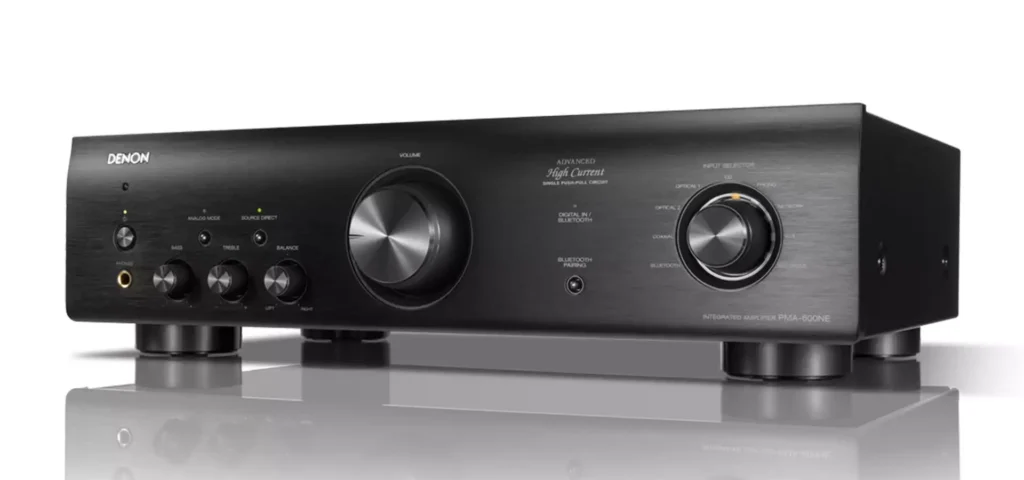
Denon PMA-600NE combines conventional speaker amplification with MM phono, optical and coaxial conversion and Bluetooth reception. It is an affordable stereo hub rather than a HEOS streaming amplifier. This research-based review considers the direct, clear presentation described in original European evaluation and the practical requirements of using records, digital transports and a phone. It also keeps the forty-five-watt and seventy-watt manufacturer claims attached to their different load, bandwidth and distortion conditions, instead of presenting them as interchangeable measures of output.
Research-based review. This assessment draws on manufacturer documentation and the original published evaluations linked below. Audio Review has not performed a hands-on test of this model.
Clear and direct is the useful original-review description
Audio’s original Polish evaluation describes the PMA-600NE as dynamic, detailed and comparatively direct, with a solid low-frequency foundation and neutral, explicit voices. It does not portray it as a device that disguises every poor recording. The publication also supplies separate laboratory evidence. Those findings are not tests performed by Audio Review.
Audition familiar voices and a less polished favourite recording alongside cleaner material. Match levels against the alternative and listen at the volume normally used at home. A clear presentation can be useful without needing extra treble or an exaggerated sense of excitement. Speaker balance and room reflections may matter more than small amplifier differences, particularly in a modest system. Follow bass notes and vocal phrasing instead of judging only the initial impact. The original evidence supports a capable budget integrated amplifier. A buyer who prefers a consistently softer presentation should still compare alternatives rather than assuming all affordable amplifiers share the same character or that a positive review settles personal preference.
Bluetooth does not turn the amplifier into a HEOS player
The official EU manual lists Bluetooth reception with SBC and AAC. Wi-Fi, Ethernet, HEOS and direct network-service playback are not part of the PMA-600NE’s architecture. The word NETWORK on an analogue input label refers to a source connection, not a built-in streaming engine.
Try the actual phone for pairing and reconnection. Music sent by Bluetooth still depends on the source device, its application and the negotiated codec. A buyer wanting playback to continue independently of the phone should budget for an appropriate external network source or compare a streaming integrated amplifier. That separate-source approach can be flexible because service technology can change without replacing the amplifier. It also adds cost and another control layer. Check the full routine with another household device and decide who controls volume. The most useful feature is one that makes ordinary listening predictable. Treating every wireless function as equivalent to network playback can lead to an otherwise avoidable purchase disappointment.
The digital inputs suit transports and compatible stereo television
Optical and coaxial audio provide useful routes for conventional digital sources. There is no computer USB-DAC connection or HDMI ARC input, so those jobs require a different supported path rather than a connector assumption.
For a CD transport, confirm compatible stereo PCM output. With television, check the actual optical connection, source-format setting and lip synchronisation through both internal applications and external devices. Volume and standby control may differ from an HDMI-based system, so demonstrate the remote routine. A computer can supply music through another appropriate device, but that should be included in the price and desk or rack plan. Do not expect movie bitstreams to be decoded as surround sound by a stereo amplifier. Basic digital flexibility can be valuable without becoming a complete modern multimedia platform. The PMA-600NE makes most sense when these conventional routes already cover the sources rather than when the owner needs to add several adapters to recreate missing interfaces.
MM vinyl and direct controls support straightforward ownership
The built-in phono stage is intended for an appropriate moving-magnet cartridge. Physical bass, treble and balance controls are provided, with Source Direct and analogue listening options serving different operating preferences. Those modes should be selected with awareness of the current source.
Check the turntable’s output setting. A record player with its own enabled line-level stage belongs on a line input, while a cartridge needing a different gain or loading arrangement may require external equipment. Assess hum with a quiet record section and sensible signal-cable placement. Start tone controls at neutral and make modest changes if useful for the actual room or recording. They do not replace speaker positioning or provide automatic calibration. Demonstrate remote volume adjustment from the usual seat, especially late at night. A conventional layout can be easier for the household than a complex application, provided everyone understands which source is selected and how to restore normal playback after experimenting with modes.
Outputs and power should be interpreted as a stereo system
Denon specifies forty-five watts per channel into eight ohms across the audio band at its stated distortion, and seventy watts into four ohms at one kilohertz with a different distortion limit. A subwoofer connection and recorder output also have different purposes; a fixed recording feed is not a variable preamplifier output.
Consider speaker sensitivity, impedance, listening distance and desired headroom together. A higher number taken from another test condition is not an automatic improvement. Choose an active subwoofer with suitable controls if extra bass is needed, and check integration rather than assuming automatic room management. Try the actual headphones separately for comfortable volume range and noise. Leave the ventilation and cable clearance described in the instructions, even in a compact budget rack. Practical matching matters because the amplifier cannot correct an unsuitable loudspeaker load or poor placement. A modest system can perform convincingly when those choices are sensible, without needing to chase the largest advertised output figure.
Value depends on the complete source collection
The PMA-600NE offers a useful combination for someone starting with records, a digital transport and occasional phone playback. A buyer with one established analogue source may need less, while a household centred on direct streaming and television may benefit from a more integrated platform.
Compare actual local offers with suitable passive speakers, stands and any network source included. Check regional mains suitability, remote and every intended input on a used or demonstration example. Do not treat launch-era pricing as a permanent value guarantee. The absence of native streaming can support a modular system if it is deliberate; it can also make an apparently cheaper amplifier more expensive once another source is added. Avoid confusing this model with Denon’s HEOS-equipped alternatives or assuming that a similar front panel means identical connectivity. Its strongest case is a conventional stereo routine with positive musical evidence and a fair complete price. That is enough to make it interesting without inventing facilities outside its intended role.
Alternatives to consider
Cambridge Audio AXR100: Compare the actual conventional source and tuner requirements with the intended speakers. Account for differences in physical size and current complete-system pricing.
Denon PMA-900HNE: Consider native HEOS network playback if direct streaming is central. Do not assume that the smaller PMA-600NE offers the same network platform because both carry a Denon badge.
Denon PMA-600NE key specifications
- Role
- Conventional integrated stereo amplifier
- Manufacturer output, 8 ohms
- 45 W/channel, two channels, 20 Hz–20 kHz, 0.07% THD
- Manufacturer output, 4 ohms
- 70 W/channel, two channels, 1 kHz, 0.7% THD
- Analogue sources
- RCA line inputs and MM phono
- Digital sources
- Two optical and one coaxial; compatible stereo PCM
- Wireless
- Bluetooth reception; official EU manual lists SBC and AAC
- Outputs
- Passive speakers; headphones; mono subwoofer; fixed recorder output
- Controls
- Volume, source, tone and balance; remote
- Modes
- Source Direct and analogue listening options
- Network / TV / computer
- No HEOS, Wi-Fi, HDMI or USB-DAC input
- Dimensions (W × H × D)
- 434 × 121 × 308 mm
- Net weight
- 6.8 kg
Verdict
PMA-600NE is a convincing research-based budget option for conventional stereo sources, MM vinyl and Bluetooth. Keep its network, HDMI and USB limitations clear, compare power under labelled conditions and audition suitable speakers. With a source arrangement that already fits, it offers a sensible foundation. Include any external streamer before deciding the final value.
Documentation and original reviews
Denon official PMA-600NE EU owner manual · Denon official EU PMA-600NE power and input specification · Audio original PMA-600NE listening and laboratory evaluation
Editorial record
Sources and updates
Product specifications and factual claims were checked against Official Denon PMA-600NE product page ↗. Scores and buying advice follow our category-specific editorial methodology.
- Published
- November 17, 2026
- Last updated
- November 17, 2026