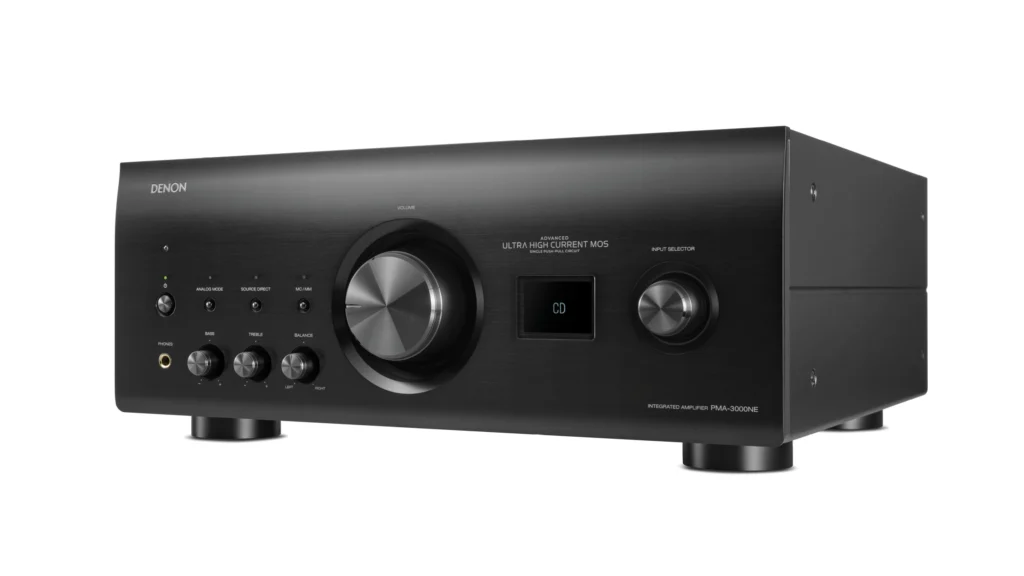
Denon PMA-3000NE is a premium conventional integrated amplifier that pairs a substantial analogue platform with computer USB conversion and MM/MC phono. It is not a network streamer and does not include HDMI or Bluetooth. This research-based review considers the refined, stable and spatially convincing presentation described in original European evaluation while keeping the practical output and expansion limits clear. Its premium appeal depends on using the conventional source facilities and preferring the musical result, rather than assuming a flagship must contain every modern convenience feature.
Research-based review. This assessment draws on manufacturer documentation and the original published evaluations linked below. Audio Review has not performed a hands-on test of this model.
Refinement and spatial stability define the original evidence
HIFI.DE’s original PMA-3000NE evaluation describes a finely differentiated, smooth presentation with stable spatial organisation and useful dynamic capability. It also finds the phono and digital sections convincing while identifying the absent pre-out and non-switchable dual speaker terminals as practical drawbacks. These are findings from the publication’s system, not Audio Review listening results.
Audition natural voices, a larger acoustic ensemble and a recording with strong rhythmic changes. Match levels and listen for subtle phrasing and the shape of notes rather than only an immediate sense of size. A refined amplifier can remain detailed without spotlighting every transient, but a listener preferring a more overtly energetic balance may choose differently. Use the intended speakers and ordinary listening level as well as a brief louder passage. The original evidence supports a serious premium audition. It does not make a more expensive component automatically worthwhile in a room where speaker placement or a different source interface matters more.
USB conversion and optical sources have different capabilities
The official manual documents computer USB playback of supported PCM up to thirty-two-bit, 384 kHz and DSD up to 11.2 MHz. Optical and coaxial connections support a different stereo PCM range. Those format ceilings should not be transferred indiscriminately between inputs.
Try the actual computer, operating system and player, using the appropriate official setup and driver where required. Check application switching and returning from sleep. Include ordinary CD-quality recordings in the demonstration rather than assuming the largest file automatically provides the most useful comparison. A built-in converter can make a computer-based system simpler, but the computer remains responsible for playback and library management. If the household wants music independent of a laptop, add a suitable network source or compare another integrated platform. The digital section is valuable when it serves the existing collection reliably. It does not need inflated high-resolution claims or a promise that every file type can be used through every connector.
MM and MC vinyl are substantial parts of the system case
The phono section provides documented moving-magnet and moving-coil settings. Original evaluation supports its performance, but the cartridge must still suit the stated gain and loading conditions. A general MC label is not a substitute for checking a specific cartridge’s requirements.
Confirm whether the turntable supplies cartridge level or an already equalised line signal. Use the correct input and assess hum in the intended rack layout, keeping the record player appropriately separated from the amplifier’s power supply. Compare a quiet passage and a demanding record with consistent cartridge setup and record condition. An external phono stage can remain useful for a particular compatibility or tonal preference, but should solve an identified issue. The built-in stage may eliminate another box for a well-matched cartridge, which belongs in the complete-price assessment. A premium integrated amplifier is most coherent when those included facilities are actually used rather than bypassed automatically because separate equipment is presumed necessary.
Analogue controls do not replace modern network convenience
The amplifier provides familiar source, tone and balance operation, with documented analogue listening and direct modes. Network services, Bluetooth and HDMI remain outside its built-in role. A source input label for network equipment does not itself supply a player.
Demonstrate how the external streamer or computer will be controlled alongside the amplifier. For television, test an appropriate stereo digital route and the documented Auto Play behaviour rather than assuming HDMI ARC-style volume integration. Check synchronisation, source switching and recovery from standby. Make sure another household member can return to the normal music source without a detailed sequence. A separate-source architecture can be attractive because software platforms can change independently of amplification. It also adds boxes, cost and another interface. The PMA-3000NE makes most sense when that modular arrangement is deliberate. It is less convenient if the buyer expects one premium component to provide every streaming and television function without additional equipment.
Output and speaker terminals impose specific expansion limits
The recording feed is fixed level, and EXT.PRE IN is an input intended for an externally controlled preamplifier. Neither is an ordinary variable pre-out. The two sets of speaker terminals do not create independently switchable source zones.
Plan any active speaker, power amplifier or subwoofer integration before buying. Confirm that the proposed downstream equipment has the necessary controls and connections instead of assuming a fixed recorder feed will behave as variable volume. Use external-preamp mode only in the documented arrangement, with clear responsibility for level control. Follow the permitted speaker-load conditions when both terminal sets are used together. Try the actual headphones separately for noise and useful volume range. A substantial enclosure also needs secure support, ventilation and room for plugs behind it. These practical constraints do not remove the amplifier’s musical appeal, but they can matter to a buyer expecting a flexible preamplifier hub. Establish them before the purchase rather than working around them later.
Premium value comes from the whole matched system
The eighty-watt eight-ohm and one-hundred-and-sixty-watt four-ohm claims use different bandwidth and distortion conditions. They should remain labelled and should not be used alone to rank this amplifier against products quoting different regimes.
Consider speaker sensitivity, load, distance and the required headroom, then audition the actual combination. Compare current complete offers with a network source, suitable furniture and any specialist vinyl requirement included. Check the exact regional mains version, remote, condition and support on a demonstration or used unit. A buyer starting from scratch may prefer a streaming integrated system with room adjustment, while an owner of excellent existing sources may value conventional amplification more. Do not assume that more expensive electronics can compensate for poor loudspeaker placement or an awkward room. PMA-3000NE has the clearest case when its refined presentation, phono capability and computer conversion all improve a carefully matched system. Its flagship construction is meaningful when those strengths are useful together.
Alternatives to consider
Audiolab 9000A: Compare the source and expansion arrangement with the actual loudspeakers at complete current prices. Include any specialist cartridge or network requirements consistently.
Yamaha R-N2000A: Consider a different premium approach when network playback and room adjustment are central. Demonstrate the real household control routine alongside musical preference.
Denon PMA-3000NE key specifications
- Role
- Premium conventional integrated stereo amplifier-DAC
- Manufacturer output, 8 ohms
- 80 W/channel, two channels, 20 Hz–20 kHz, 0.07% THD
- Manufacturer output, 4 ohms
- 160 W/channel, two channels, 1 kHz, 0.7% THD
- Analogue sources
- RCA line; MM / MC phono; external-preamp input
- Digital sources
- PC-USB; three optical; one coaxial
- USB formats
- Supported PCM up to 32-bit/384 kHz and DSD up to 11.2 MHz
- Optical / coaxial
- Supported stereo PCM up to 24-bit/192 kHz
- Outputs
- Passive speakers; headphones; fixed recorder output
- Expansion
- No variable pre-out; EXT.PRE IN is a separately controlled input
- TV feature
- Compatible digital-source Auto Play; no HDMI ARC
- Network / wireless
- No native service player or Bluetooth
- EU manual mains
- AC 230 V, 50/60 Hz; verify exact regional unit
- Dimensions (W × H × D)
- 434 × 182 × 443 mm
- Net weight
- 24.6 kg
Verdict
PMA-3000NE is a convincing research-based premium option for conventional computer and vinyl stereo, with positive evidence for refinement and spatial stability. Network, HDMI and preamp-expansion needs require separate planning. Compare the actual complete system and audition suitable speakers. Its strongest value comes from using the included conventional facilities rather than treating the flagship badge as a universal recommendation.
Documentation and original reviews
Denon official PMA-3000NE EU owner manual · Denon official PMA-3000NE output specification · Denon official PMA-3000NE supported digital formats · HIFI.DE original PMA-3000NE listening and usability evaluation
Editorial record
Sources and updates
Product specifications and factual claims were checked against Official Denon PMA-3000NE product page ↗. Scores and buying advice follow our category-specific editorial methodology.
- Published
- November 17, 2026
- Last updated
- November 17, 2026